
Moving Through the Spanish Borderlands: What Should Really Concern Us About Ceuta
The media and political discourse on the mass migration that took place on July 31 in the Spanish territory of Ceuta has focused on the question of the right of people to enter Europe from the global south and the claims of the thousands who entered Ceuta with the hope of staying in Spain.
Rather than engage in a dehumanizing debate about the legitimacy of migrants' claims or the fetishization of the migration experience, I instead want to pose a different set of questions. Who and what get to move through border spaces, and why? Who gets to move through the Spanish borderlands in particular? And how does the business of securing Europe's borders affect us all? In the span of three days in the middle of September, I moved between two countries and two continents to think about these questions.
The Spanish borderlands
Spain has a unique border space, which is why it has become such a focus in Europe's efforts to securitize its borders. In the south of Spain, you have Gibraltar, a British territory that gives Spain a land border with the UK, and two Spanish territories, Ceuta and Melilla, which are the only European land borders with Africa. The Strait of Gibraltar also represents the shortest maritime border between the EU and the African continent.
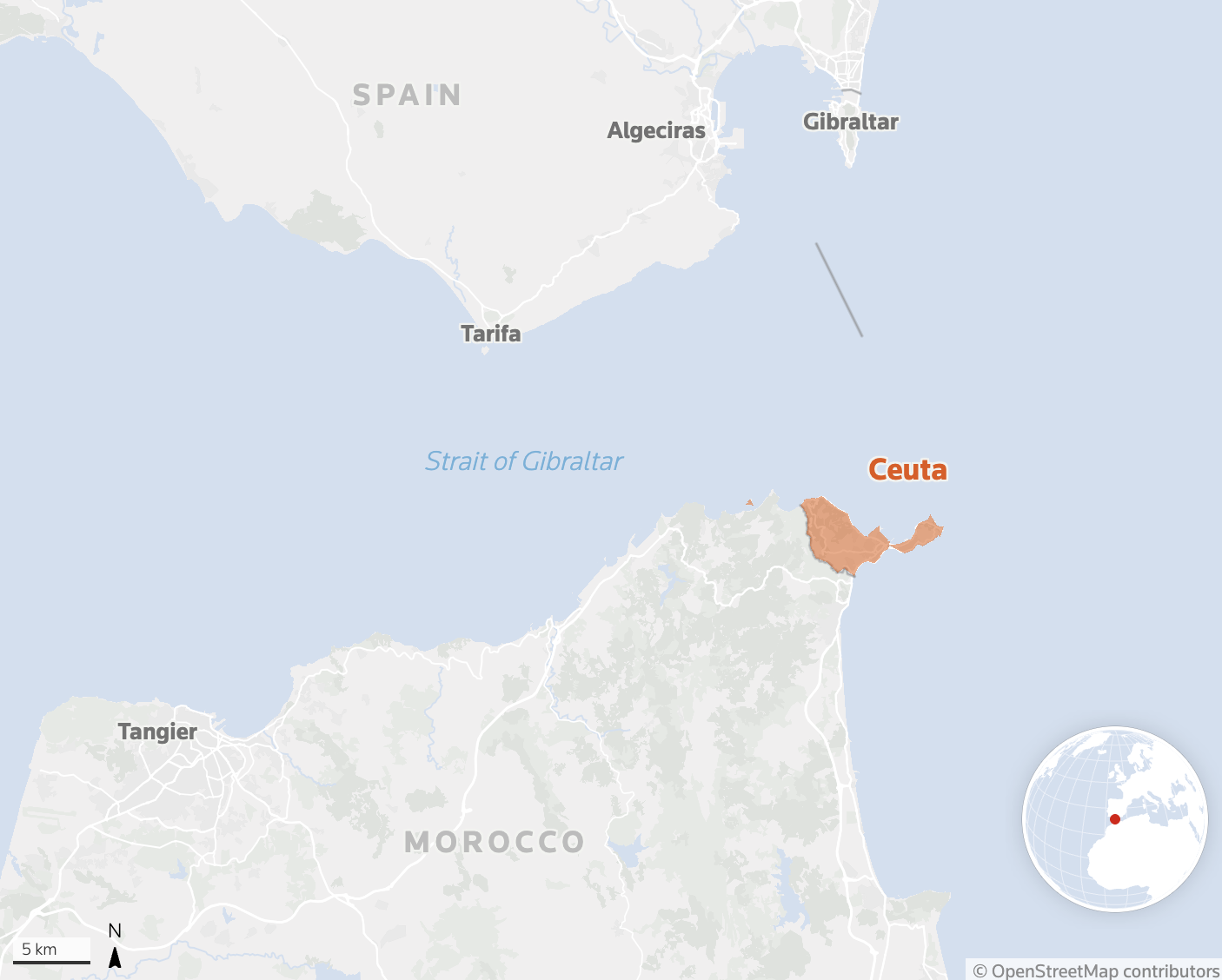
Spain’s border with Morocco. (Image: © OpenStreetMap contributors via Reuters)
To get to Ceuta, one option is to take a ferry from the port city of Algeciras, located in the southern province of Andalucia. Algeciras is also located on the opposite side of the Bay of Algeciras from Gibraltar, into which thousands of workers cross “freely” every day. It was in Algeciras that I had my first interaction with the Spanish immigration regime.
An encounter with the secret police
I had just arrived in Algeciras the night before from Madrid. As I sleepily walked into a station to catch a bus to Gibraltar, two people in plain clothes physically stopped me as I walked past them. They quickly flashed their badges at me and said, “Muéstranos su DNI” (“Show us your ID”). I looked around, confused, as these people did not appear to be police. They became angry, and I explained that it scared me that they weren’t wearing police uniforms. One of them flashed their badge again.
I realized that at that moment, I was a victim of the Spanish securitization regime, and I handed over my passport. They noted down my passport information, asked me if I did drugs, and let me on my way to Gibraltar.
A day in the UK
The border between Spain and Gibraltar is a porous one. I arrived in Gibraltar after having just been confronted with the securitization regime in Algeciras and walked into British territory without so much as showing my passport. To get to Gibraltar, you simply walk or drive in across an active airfield, the sort of space that is typically quite securitized.
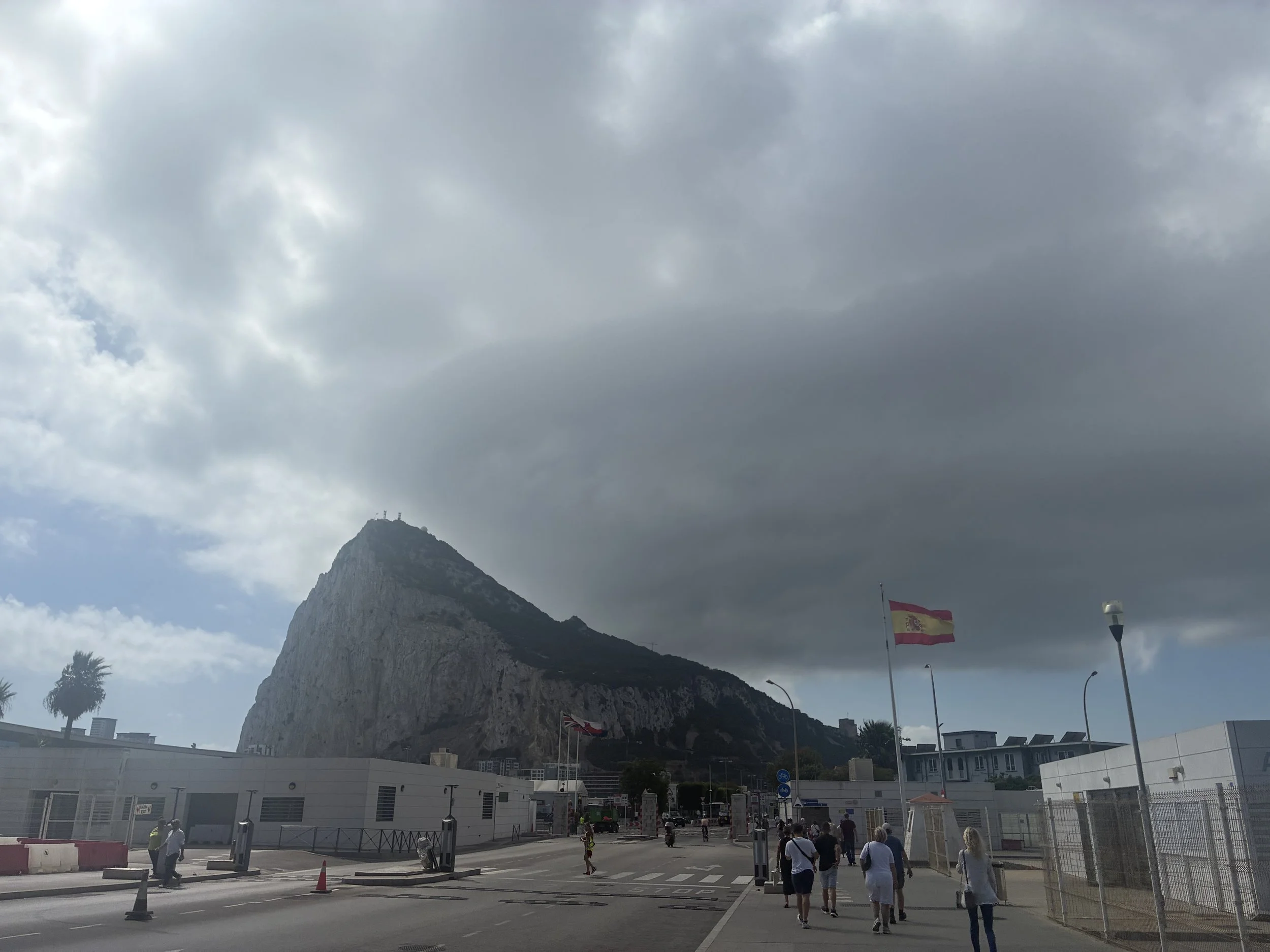
Crossing from Spain to Gibraltar. (Photo: Derek Sherrange)
Entering Gibraltar was like walking into any other city in the UK if it was filled mostly with tourists who had recently disembarked from a cruise ship. My day there was fairly uneventful, and I saw nothing that indicated a Spanish or British animosity towards the visitors crowding the city streets.
Who and what gets to cross the Strait?
The next day I made my way onto a ferry from the port of Algeciras on my way to Ceuta. As I made the hour-long journey across the Strait, I sipped a coffee and watched the steady flow of capital (in the form of large container ships that are logistically essential to the functioning of the global economy) into the port of Algeciras. This ease of movement struck me as in quite a contrast to the thousands of migrants whom Spain tried to prevent from entering Ceuta just a little more than a month before.
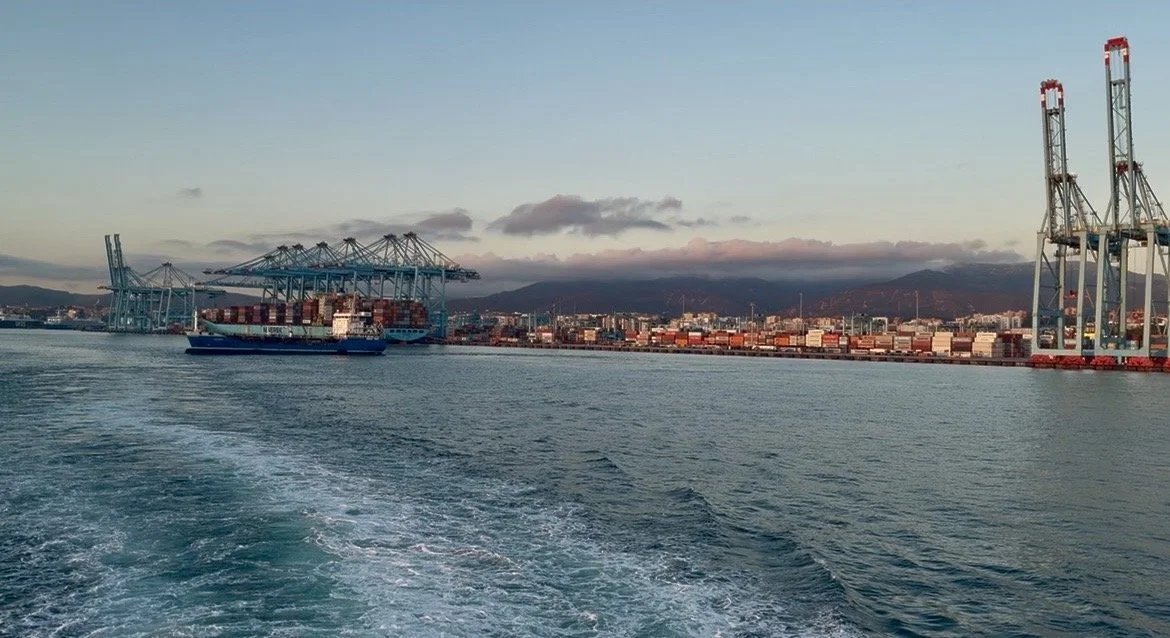
On the ferry from Algeciras to Ceuta. (Photo: Derek Sherrange)
I was on my way to Ceuta not only to understand the experience of moving through Spain’s border spaces but also to see for myself the situation following the mass arrival of migrants into the territory. What I found should leave us all concerned - but not for the integrity of borders. As my journey to Gibraltar shows, borders are not the stiff walls that the global right wants us to think they are. On the contrary, they have always been porous and moving based on political demands. So if the integrity of the border between Ceuta and Morocco is not at stake, then what is?
The militarization of daily life
My first stop when I arrived in Ceuta was a cafe to have some breakfast. I happened to choose a cafe which was right next to a Carrefour supermarket. As I sipped another coffee and ate my pan con aceite y tomate, I watched as two members of the Spanish military and a private security guard enacted a classist and racial profiling regime to control entrance into the grocery store. Well-to-do looking customers were allowed into the grocery store without a second look while I watched several racialized and poor prospective customers forced to show their ID. The most disturbing part was that this whole act appeared to be, for the most part, normalized. While those who knew they would not be stopped strolled confidently into the store, those who knew they would be prepared their IDs to be inspected as soon as they approached the entrance.
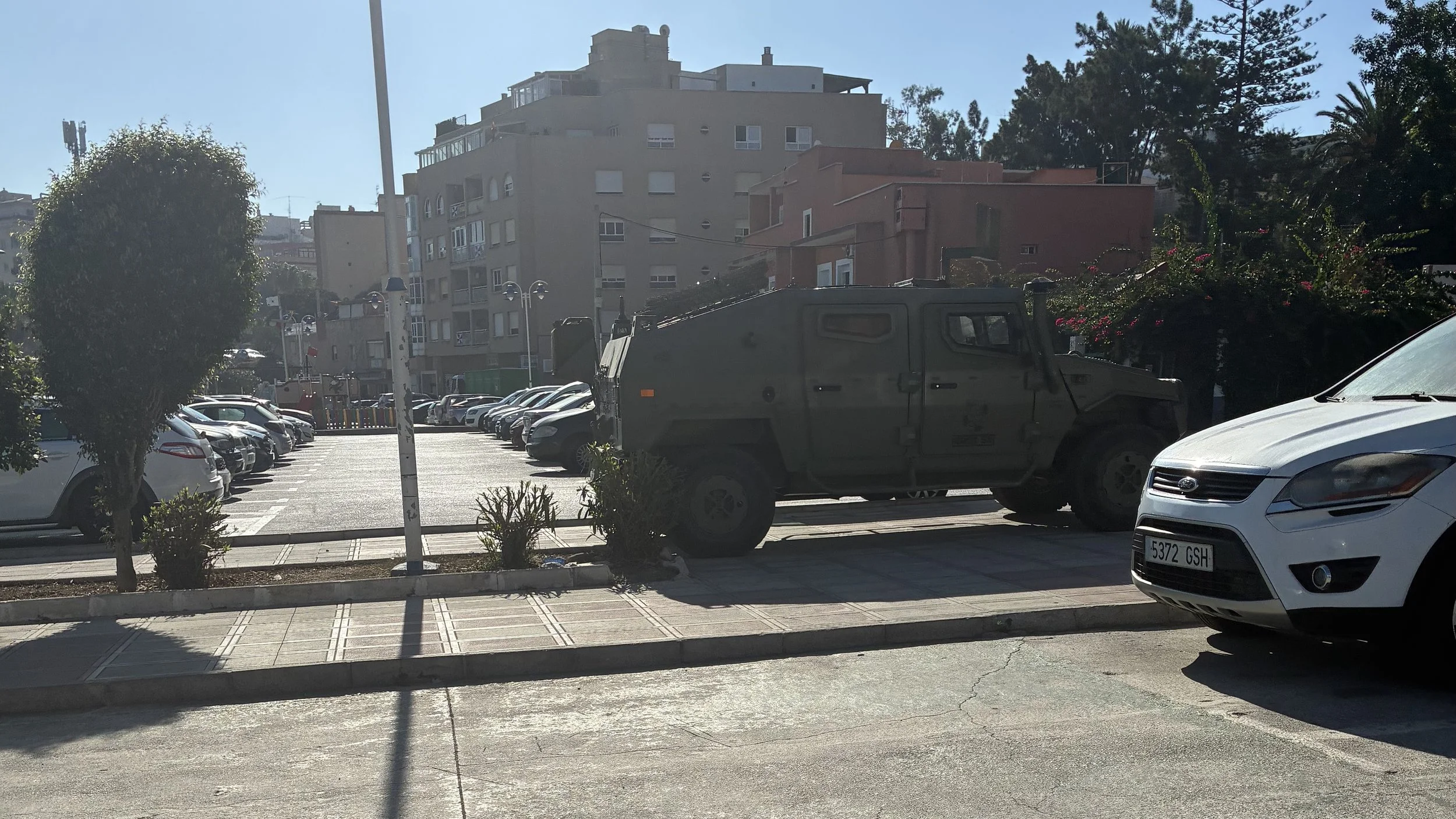
An armored personnel carrier on the streets of Ceuta. (Photo: Derek Sherrange)
This securitization and militarization of everyday life is the thing we should be afraid of in Ceuta right now, and it doesn’t end at a supermarket entrance.
Xenophobia in Ceuta’s city center
Based on the news reports coming out of major news outlets in Spain, not to mention the narratives circulating on social media, I expected to find a city in chaos with very few Ceutís on the streets. As I made my way to the center of the city, however, I found quite the opposite. I strolled up the main thoroughfare in the city center and felt as though I was back in Madrid. Ceutís could be seen crowding the streets, going about their daily lives as normal, sipping coffees and drinks on terrazas.
The only sign something unusual was going on in this city was not groups of migrants causing trouble, but signs on almost every business telling the migrants in one form or another that they are not wanted there. As I came upon the Plaza de los Reyes I saw a big sign hanging from the main monument in the square. The sign was designed to look like a closed envelope and written on top of it was cryptic lettering that read “Hay una carta para ti” (“There’s a letter for you”), alluding to the possibility of migrants receiving deportation letters.
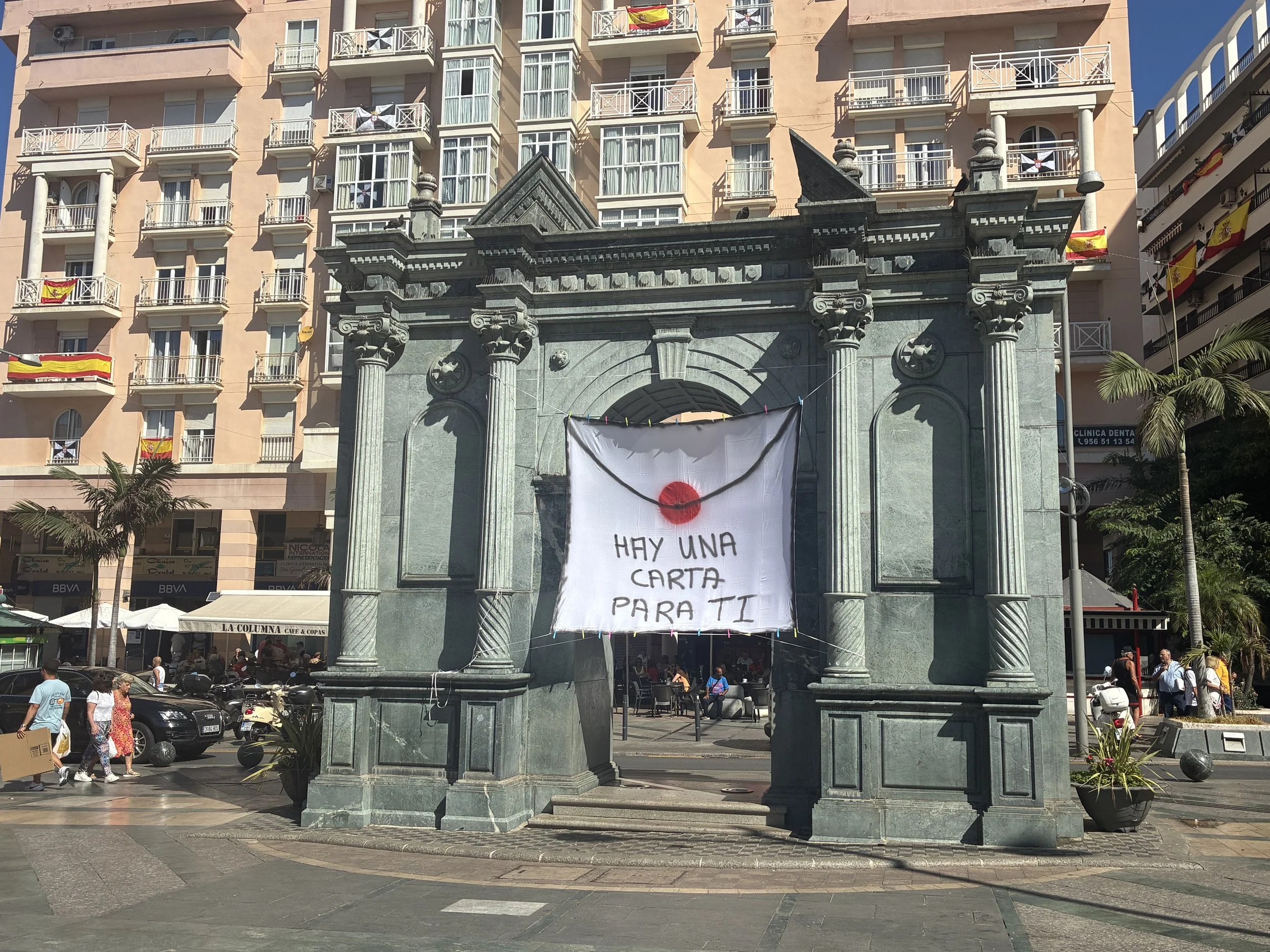
A banner in the center of Ceuta displaying threatening language toward migrants. (Photo: Derek Sherrange)
This veiled threat to the migrants was consistent with the widespread xenophobic and anti-immigrant sentiments plastered across the city center.
From a bustling city center to bare life
After I had walked through the center, I boarded a bus to a local beach, the Playa de Benitez. As the bus wove its way through the hilly streets of Ceuta, I watched as Ceutís went about their lives as normal and children left school, boarding the bus en masse presumably to head home for the day. I arrived at the Playa de Benitez to find a pristine beach. The only signs that the migrants had been there were the heavy military and police presence on the beach and the men and boys who were walking briskly past in both directions, often holding a single plastic shopping bag.
As I walked the 15 minutes from the Playa de Benitez to the Playa del Trampolín, the concentration of people who had recently migrated became more evident. Men and boys selling bread and cigarettes began to emerge on the street, and the hundreds of temporary shelters that had been built on the beaches due to the lack of housing came into view.
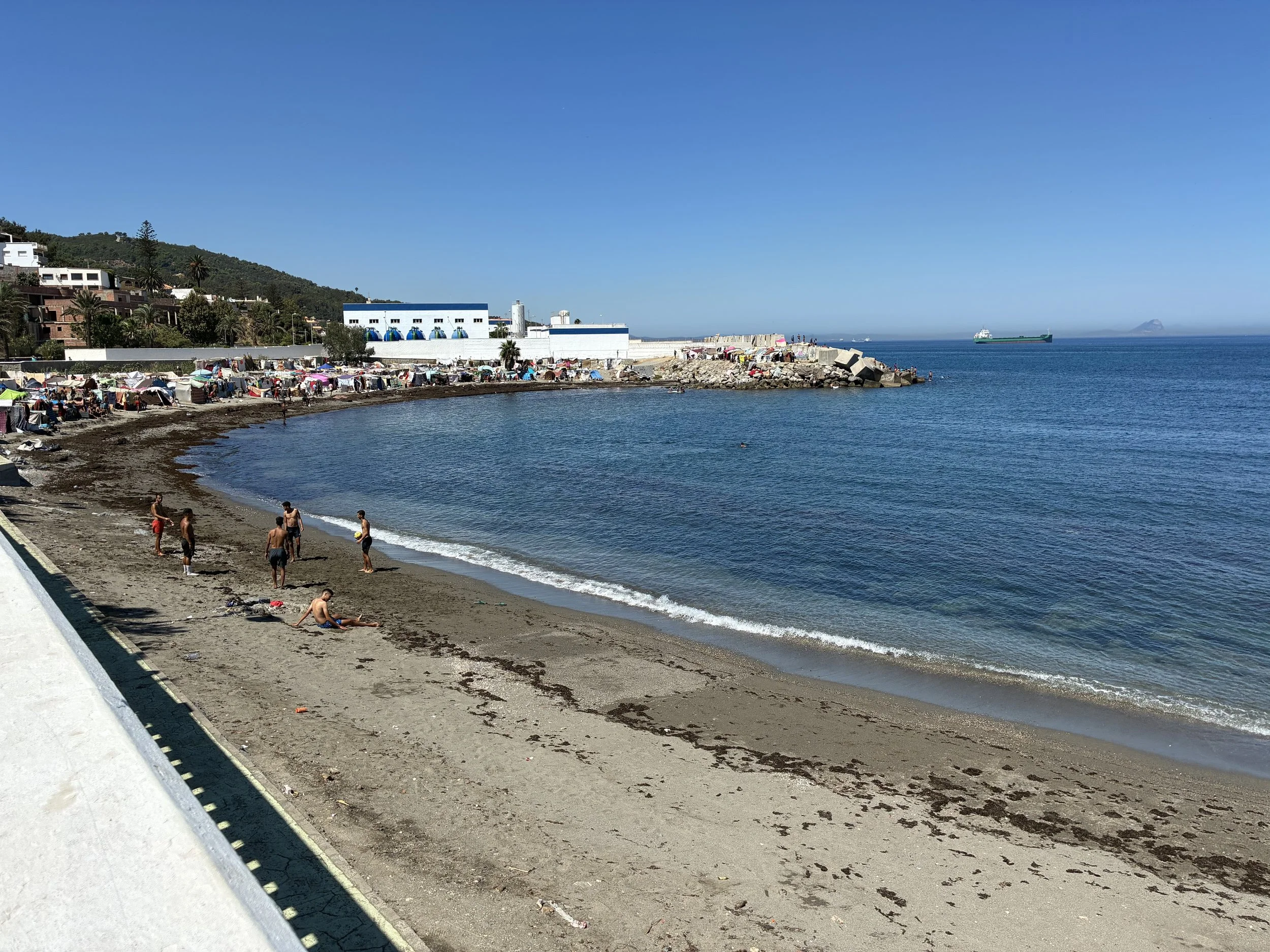
The Playa del Trampolin in Ceuta, where many migrants remain stuck in limbo after crossing from Morocco. (Photo: Derek Sherrange)
Once I reached the Playa del Trampolín, I was confronted with the striking contrast between the terrazas filled with people leisurely enjoying food and drink, and the state of bare life in which migrants were living on Ceuta’s beaches. To multiply the cruelty, the peninsula I had so easily crossed just hours before, and that many migrants so desperately wanted to reach, was there in perfect view from that very beach.
Just prior to publication of this article, Spanish police began clearing the Playa del Trampolin. In an October 7 webinar, a representative from No Name Kitchen, a nonprofit that has been working to distribute food and other resources to migrants, provided an update on the situation. According to the representative, many of the migrants have been convinced to return to Morocco and brought to the border on buses. (According to El Salto reporter Sarah Babiker, sources on the ground in Ceuta are skeptical about the extent to which these returns are truly “voluntary.”) In addition, others have been allowed into the few shelters for migrants in the territory, and an unknown number have scattered throughout Ceuta in order to avoid detection by authorities who have threatened them with deportation.
The real story
My three days in the Spanish borderlands did not represent a comprehensive examination of the social and political dynamics at work in these territories. Yet even in a brief visit as a US passport holder, I bore witness to the dichotomies of who and what gets to move through these border spaces and the role that the criminalization of migration plays in shaping daily life there.
Ever since the July 31 mass crossing into Ceuta, the public debate has largely been about who is allegedly behind the migration wave, what should happen with the migrants, and how to keep the border “secure.” What should really concern us, however, is not the possibility of migrants getting to the peninsula, but rather the fact that some people can go into grocery stores and relax on terrazas while others are left to suffer on a beach. What should really concern us is that the response to that reality is the militarization of all of our lives.