
Who Cares: Reimagining Care Amidst Technological Innovation
The Who Cares series investigates structural issues and developments in the political economy of care in New York State and how people on the ground are living and responding to these realities. Who Cares original artwork by Marisa Zarczynski.
“We live in a brave new world,” said my mentor at Weave News, with a touch of worry in his tone. We had just concluded a sobering conversation about artificial intelligence (AI) and the obstacles that AI-generated content presents to independent news outlets like our own. Sure, AI may increase the capacity of writers to cover complex topics on deadlines, but at what cost to the industry, to people’s livelihoods and well-being, to humanity?
Not all conversations on AI end with existential concerns, though. In fact, for some populations – like people living with disabilities and chronic illnesses – AI conversations are often filled with a sense of possibility and hope. In these contexts, AI appears to offer a gateway to companionship, autonomy, and living independently. What if, therefore, we stop looking at AI as an obstacle and begin to co-design it so that it increases our individual and collective capacities in ways that help more than harm?
This is one of several questions I have considered since the Summit on Aging and Independence, a conference hosted by Western New York Independent Living in Buffalo, New York on September 30, 2026. To be sure, I left the Summit more conflicted about AI than when I arrived. But I also left weighing the pros and cons of technological innovation in the home care industry more generally. Why has New York State invested in technological innovation as a strategy for improving care? What are these innovations? And how does AI fit into this new technological landscape?
The summit’s view
Western New York Independent Living (WNYIL) is what I would call an “anchor institution.” It’s a cultural organization that serves as a major employer and engine for significant economic opportunity, much like hospitals and research universities. WYNIL generates opportunities for people who are living with visible and invisible disabilities and/or age-related afflictions – as well as people who provide care.
WYNIL represents a “family of agencies” that seeks to help people thrive in their home communities, no matter the physical, mental, or structural obstacles they face. Through advocacy, community partnerships, and peer-directed programming, the organization aims to “enhance the quality of life for people with disabilities.” This means creating a regional network dedicated to “empowering [people with disabilities] with choices, opportunities, and a sense of community belonging.” The Summit on Aging and Independence is a case in point.
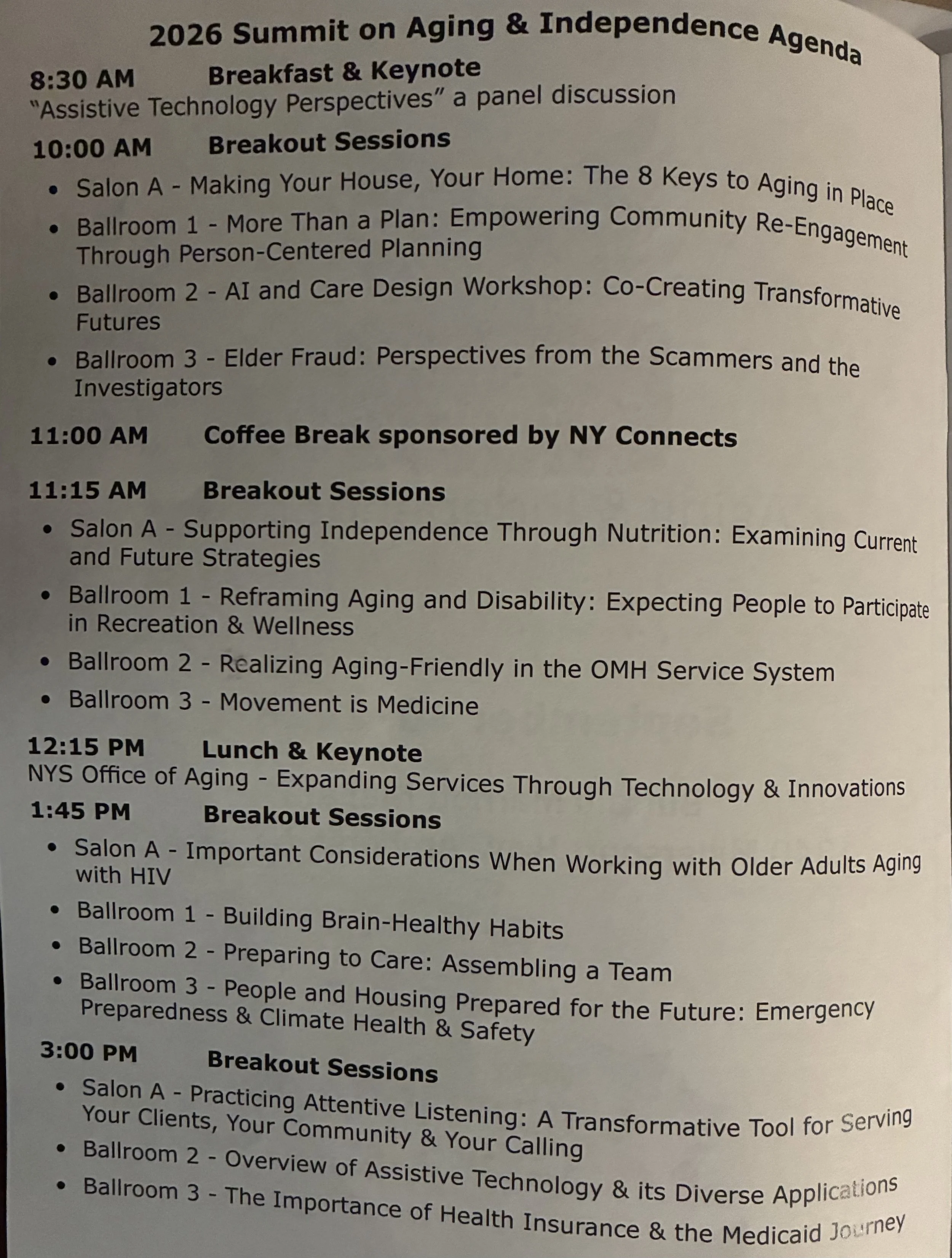
The agenda for the Summit on Aging and Independence, hosted by Western New York Independent Living (WNYIL).
The purpose of the Summit was to showcase strategies for increasing the ability of people who are aging to thrive in their home communities. There were four breakout sessions throughout the conference, each with multiple presentations running concurrently. Among the topics discussed were techniques that clients could use to improve their quality of life, such as planning in ways that center the individual and their needs; supporting independence through nutrition; building brain-health habits to sustain awareness; and gaining access to health insurance and Medicaid. There were also presentations for caregivers to improve the services they provide, including how to build a care team; how to prepare for emergencies in the homeplace; and how to expand care services through assistive technologies.
The technological landscape for aging New Yorkers
One of the key takeaways from the conference was that new technologies, when applied to assist individuals at achieving the goals they set for themselves, can improve the lives of people with serious, long-term healthcare needs. Individuals who are aging or living with disabilities can continue to live independently and vigorously with the help of assistive technologies, including AI.
The Summit’s keynote speaker was Michael Gunn, Assistant Deputy Director of Policy, Planning, Program and Outcomes for the New York State Office for the Aging. Gunn explained that his office aspires to improve the lived experiences of people who are aging in New York State, focusing on four programmatic goals: combating isolation and loneliness, helping individuals with chronic conditions lead healthy lives, supporting caregivers provide services, and eliminating elder fraud.
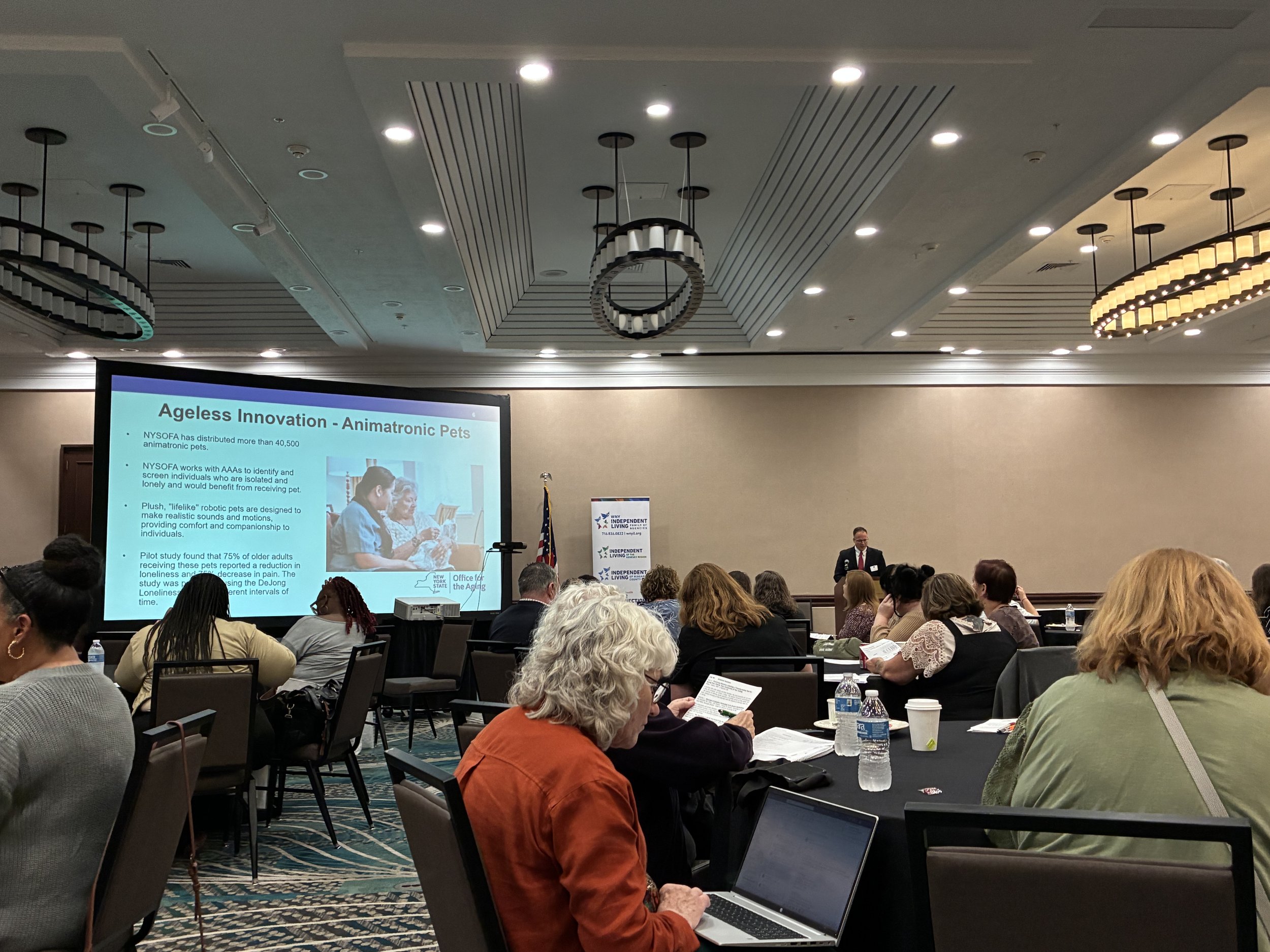
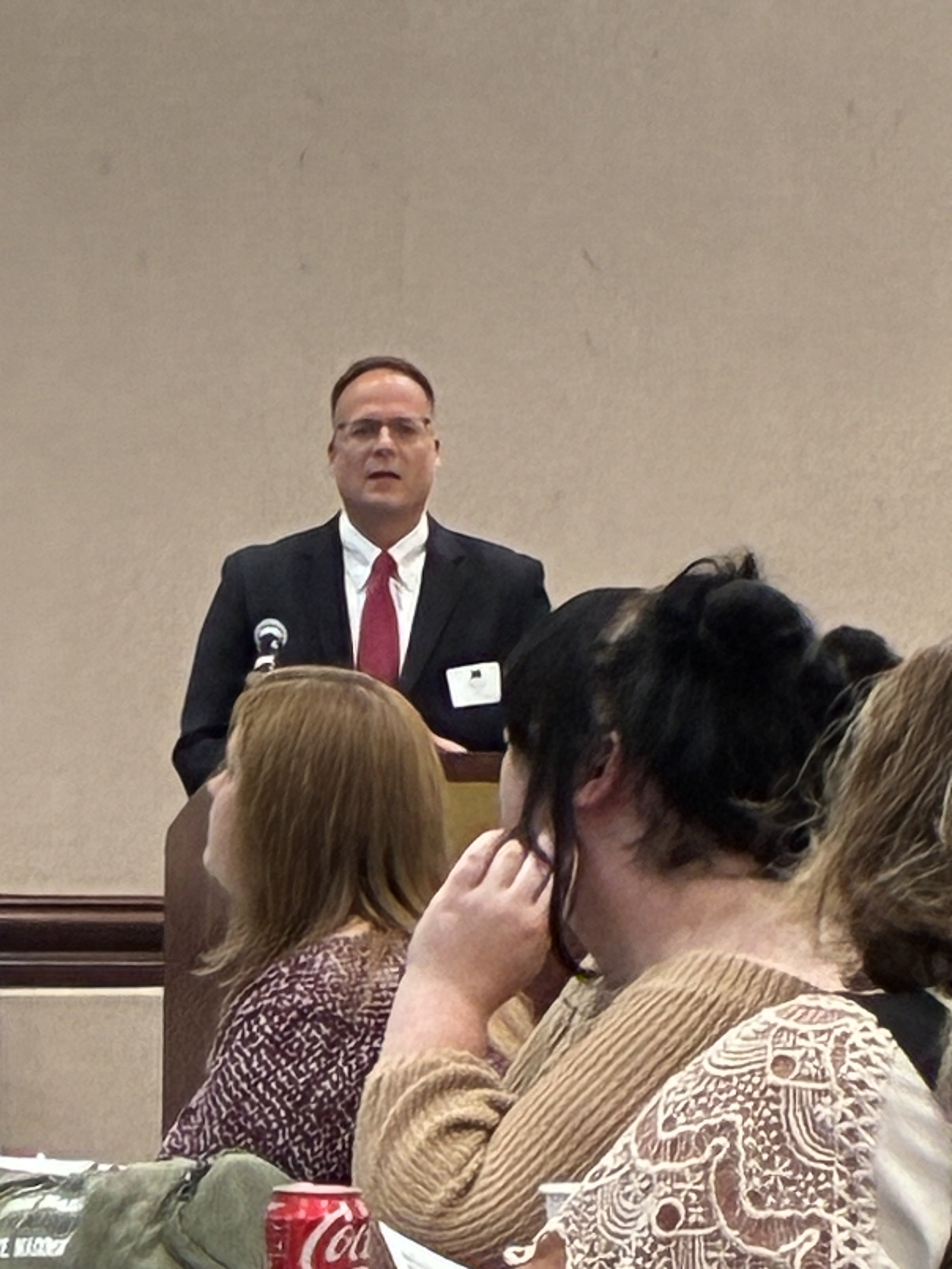
Michael Gunn of the New York State Office for the Aging speaks at the summit. (Photos: Steve Peraza)
The technological innovations on which Gunn presented were various and quite impressive. In September 2026, the New York State Office for the Aging (NYSOFA) published the NYS Innovations in Aging Guidebook, showcasing “many low-cost, high-impact digital solutions that are expanding access to services and supports” to meet the office’s goals.
This report was (at least) 8 years in the making. In 2018, the NYSOFA created its first “public-private partnership” with Ageless Innovations, a technology company building animatronic pets to address the problem of social isolation among older adults. Since then, the state has cultivated partnerships with “30 technology companies to increase service provision and improve the overall health and welfare of older adults.” According to NYSOFA, the tools developed in these public-private partnerships will “fill in service gaps, enhance services, and address workforce shortages.”
NYSOFA’s commitment to technology appears to have outpaced the state’s investment in care workers, especially wage increases. One key question, then, is to what extent have NYS’s technological innovations improved the quality of care for older adults. Have these innovations been designed to keep care worker wages low and, ultimately, replace care workers altogether?
Of the 22 innovations presented in the guidebook, I explore four below.
To eliminate elder fraud, the state partnered with Silver Shield, a company that scans text messages for potential scams. When facing a potential risk, Silver Shield subscribers will receive “easy-to-understand, personalized guidance on how to stay safe [from] different types of scams currently circulating.” In a seven-month trial run in 2026, older adults in New York State flagged 8,300 suspicious messages through Silver Shield. 1,113 were actual scams. The project reportedly saved an estimated $16 million in fraud losses.
To improve wellbeing, the state partnered with Vivo, a team of expert personal trainers who have developed “an evidence-based strength training and exercise program designed to increase strength and reduce falls and injuries related to falls.” Participants can join an online, live and interactive fitness group where the trainer can provide individualized feedback. Older adults in the program reported 100 percent increases in perceived health improvement.
To support caregivers, New York State partnered with the Association on Aging in New York (AgingNY), a non-profit organization for aging services, and Trualta, an advocacy organization for caregivers, to create the New York Caregiver Portal. In 2026, the portal helped 6,000 caregivers receive structural support and training: “The New York State Caregiver Portal, which is powered by Trualta, teaches critical skills to reduce caregiver stress levels and increase confidence in one's caregiving abilities while connecting caregivers to other New York State resources.” 93 percent of the users reported that they became more confident caregivers and learned new caregiver skills through the portal's trainings.
Finally, to combat isolation and loneliness, the NYS Office of Aging partnered with ElliQ, “an AI care companion robot designed to foster independence and provide support for older adults through daily check-ins, assistance with wellness goals and physical activities, companionship, social opportunities, and more using voice commands and/or on-screen instructions.”
The AI care companion robot’s role is to build relationships with older adults as it is “designed to convey empathy to create trust and drive engagement and behavior change.” The office distributed 850 units to older adults in New York as of summer 2026. 93 percent of the older adults who used ElliQ reported that the robot reduced loneliness.
A brave new world
While Gunn reported on the NYS Office for the Aging’s successes with technological innovation, I couldn’t help questioning my own perspective toward AI. I had recently attended a workshop called “AI and Care Design,” hosted by Dr. Joy Ming, an Assistant Professor at SUNY-Buffalo’s Department of AI and Society. One of the chief goals of the workshop was to invite participants to reflect on their uses of AI and to imagine ways to co-design an AI such that it will improve their capacity to work, to care, and to live.
The workshop began by asking participants to identify who provided care in their communities and what type of support they received. We filled out worksheets that organized our responses according to six support needs: closeness, belonging, feeling valued, someone to count on, guidance, and being needed. Then, Dr. Ming explained adroitly what AI is, what it can do, how it works, some of its drawbacks (like algorithmic bias, hallucinations, and sycophancy bias), and the potential harm that AI may cause individuals, groups, organizations, and ecosystems. Finally, she invited us to imagine an AI that could help more than harm. More specifically, she asked us to ponder how AI could assist in the achievement of our six support needs.
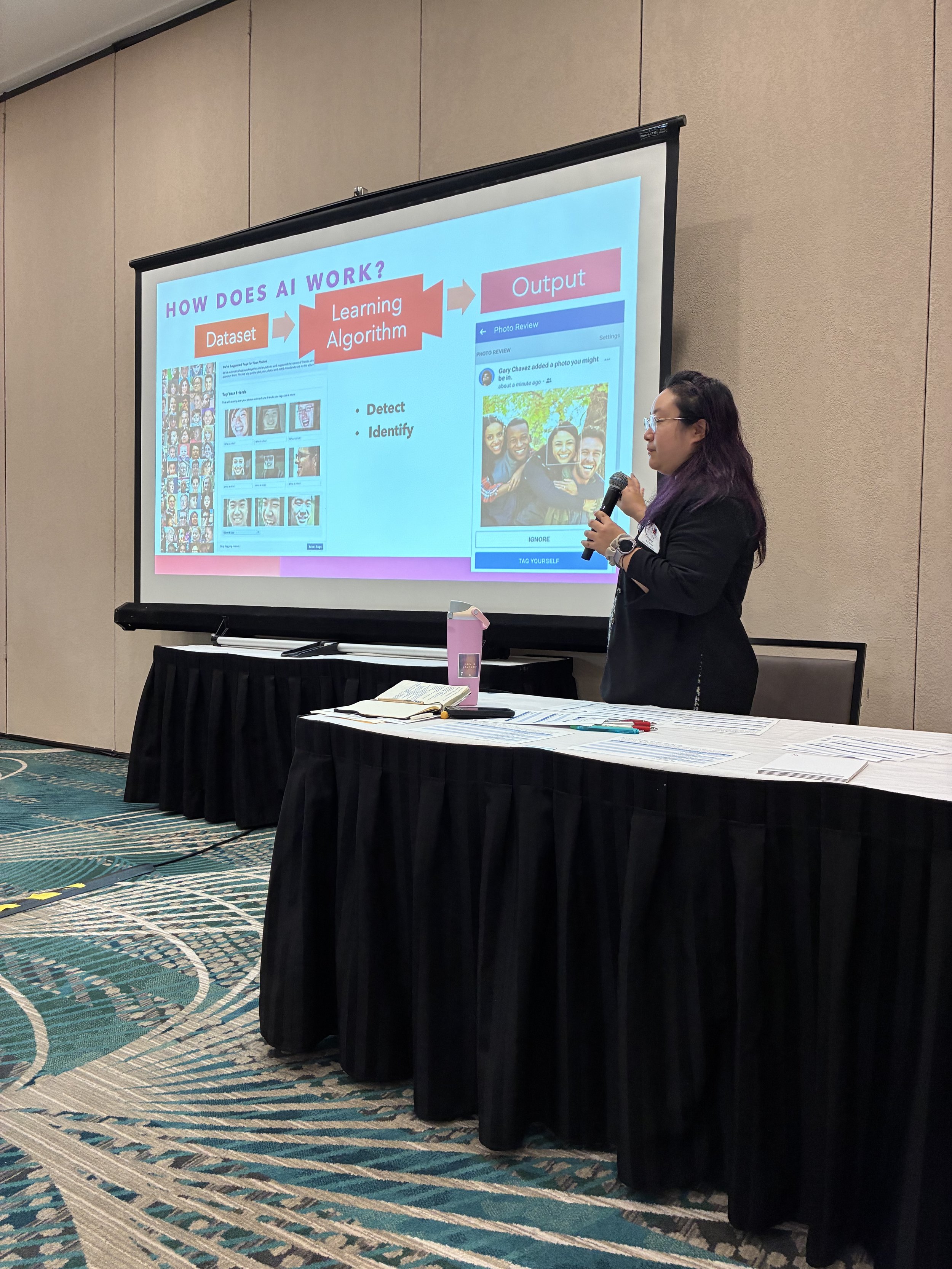
Dr. Joy Ming, a faculty member at SUNY-Buffalo, speaks at the summit. (Photo: Steve Peraza)
One reason to co-design an AI is to make it more sensitive to our needs. As Dr. Ming explained, “AI is only as smart as the data that is available.” Ostensibly, AI users can provide the data that an AI can use to satisfy our human support needs.
As someone who spends significant amounts of time alone, and who has matured to an age at which I can feel physical decline, I can imagine an AI-future in which an ElliQ robot is my best friend. Not only will I program it to talk to me about sports, flowers, and rap music (my favorite recreations currently), but I’ll make sure that it tells me when my Zoom meetings are coming, when to take my medications, when I should renew my health insurance, and which of my family members to call for check-ins. This is certainly a tool I can use to stay engaged and connected.
For other older adults with more extensive care needs, the ElliQ would, presumably, be even more assistive – and if that will improve their quality of life, then I support it. It’s a brave new world.
But what will be the cost to human existence if we co-design our worlds with AI instead of one another? I think back to my mentor’s laments about the impact of AI on news creation and wonder, can AI actually replace care workers in all their human warmth and complexity? Can ElliQ complete the activities of daily living that paid and unpaid caregivers perform for care receivers? If they could, should we reimagine a world where care is the work of AI?
I remain conflicted.