
Holding the Line: How Defenders Continue to Act When Space is Closing
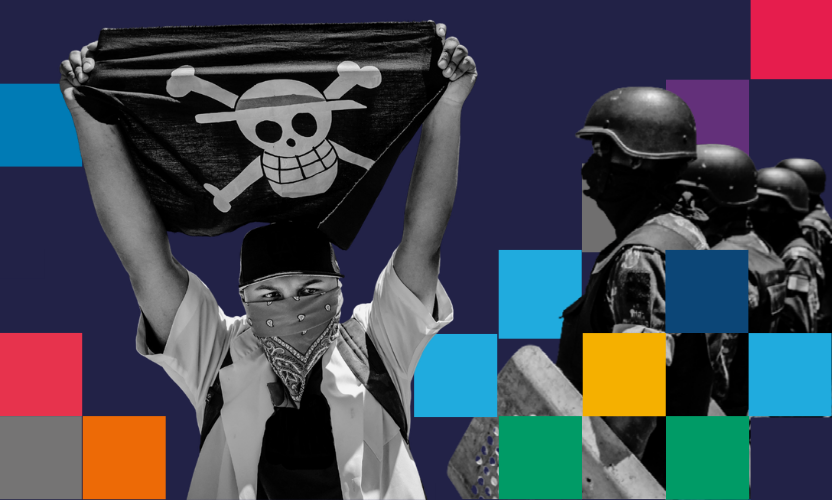
Across political systems, repression is no longer defined primarily by visible crackdowns. Instead, it increasingly operates through law, procedure, and administrative control. Courts remain open. Legislation is formally passed. Hearings are scheduled. Yet civic space narrows. Defending the Defenders: The Global Rise of Legalized Repression is a three-part series examining 1) how repression has been legalized; 2) how journalism is being suffocated without formal bans; and 3) how defenders continue to resist within - and against - the legal systems used to constrain them. (Image courtesy of CIVICUS)
At 7:30 in the morning, the knock comes without warning.
Christian is still at home when the police enter. They move quickly through the apartment, opening drawers, collecting devices, taking his laptop and phone. The protest itself had taken place weeks earlier — a road blockade in Munich, where he and others sat in the street, waiting to be removed. The action lasted less than an hour. The consequences did not.
In the weeks that followed, dozens of activists linked to the Last Generation movement were placed in preventive detention across Germany, some held for days or even weeks, as part of a broader crackdown that included coordinated police raids and investigations into the group’s activities, and growing use of criminal charges against organisers.
What stayed with him most was not the arrest, but what came after. The sense that something had shifted. That the boundaries of everyday life had quietly changed.
As he put it, “the constant repression of activist movements discourages people… for the fear of repercussions on their personal life.”
A growing emphasis on endurance
Across contexts, from climate activists in Europe to land defenders in Southeast Asia, protest is increasingly defined not only by the act itself, but by what follows. Legal cases stretch over months, sometimes years. Costs accumulate. Surveillance intensifies. Uncertainty becomes routine, shaping not only whether people act, but how long they can continue.
What happens after the protest is no longer incidental to it; it has become central. Participation is increasingly structured by endurance — by the capacity to navigate legal, financial, and administrative pressures that unfold over time. Repression, in this sense, does not end when the protest is over. It extends into the duration that follows.
This reflects a broader transformation in how civic action is sustained under pressure. Protest is no longer defined solely by visibility or immediate disruption, but by continuity — the ability to remain active over time despite accumulating constraints.
Across Europe, for example, authorities have increasingly relied on measures such as preventive detention — used dozens of times against climate activists in Bavaria alone — alongside prolonged investigations and legal proceedings that extend the impact of repression far beyond the initial act. According to the CIVICUS Monitor, detention and legal harassment are among the most widespread restrictions on civic freedoms globally, often unfolding over prolonged periods rather than ending with a single intervention.

Last Generation activists in Chancellor Olaf Scholz costumes spill oil in front of the Federal Chancellery in Berlin, Germany in July 2022. (Photo: Stefan Müller, CC BY 2.0, via Wikimedia Commons)
These conditions begin to shape behaviour long before repression is fully enacted, making participation increasingly dependent on access to resources, networks, and the capacity to absorb sustained pressure. As Andrew Firmin, Editor-in-Chief of the CIVICUS Monitor, explains, civil society today extends far beyond formal organisations and includes a wide range of collective practices that allow people to continue acting even under constraint. What emerges is a shift from momentary mobilisation to sustained engagement — a form of action built less on immediacy than on endurance, and less on visibility than on the ability to continue over time.
Adapting to constraint
As the space for action narrows, civil society is not withdrawing but reorganising. Movements are adjusting both how they operate and how they define effectiveness, shifting away from reliance on large-scale visibility towards forms of mobilisation that are more flexible and less exposed to disruption.
Public demonstrations continue, but they are increasingly complemented by smaller, decentralised actions that distribute participation across time and place. Informal networks, temporary alliances, and fluid organisational structures allow activists to act without concentrating risk in a single moment or location, making it harder for authorities to intervene decisively.
This shift reflects more than a tactical adjustment. It signals a change in how impact is understood. Visibility, once a source of amplification, can now increase vulnerability, prompting movements to prioritise persistence over scale and repetition over singular, high-profile actions. In more restrictive environments, this recalibration becomes essential — a way of remaining active while reducing exposure.
The implications are evident across different contexts. In Thailand, where hundreds of activists linked to the 2020 pro-democracy protests remain entangled in prolonged legal proceedings, legal processes extend far beyond the initial act of protest. Cases unfold over years, requiring sustained attention, resources, and coordination. Legal teams rotate between courts, often travelling long distances between hearings, managing dozens of ongoing cases simultaneously.
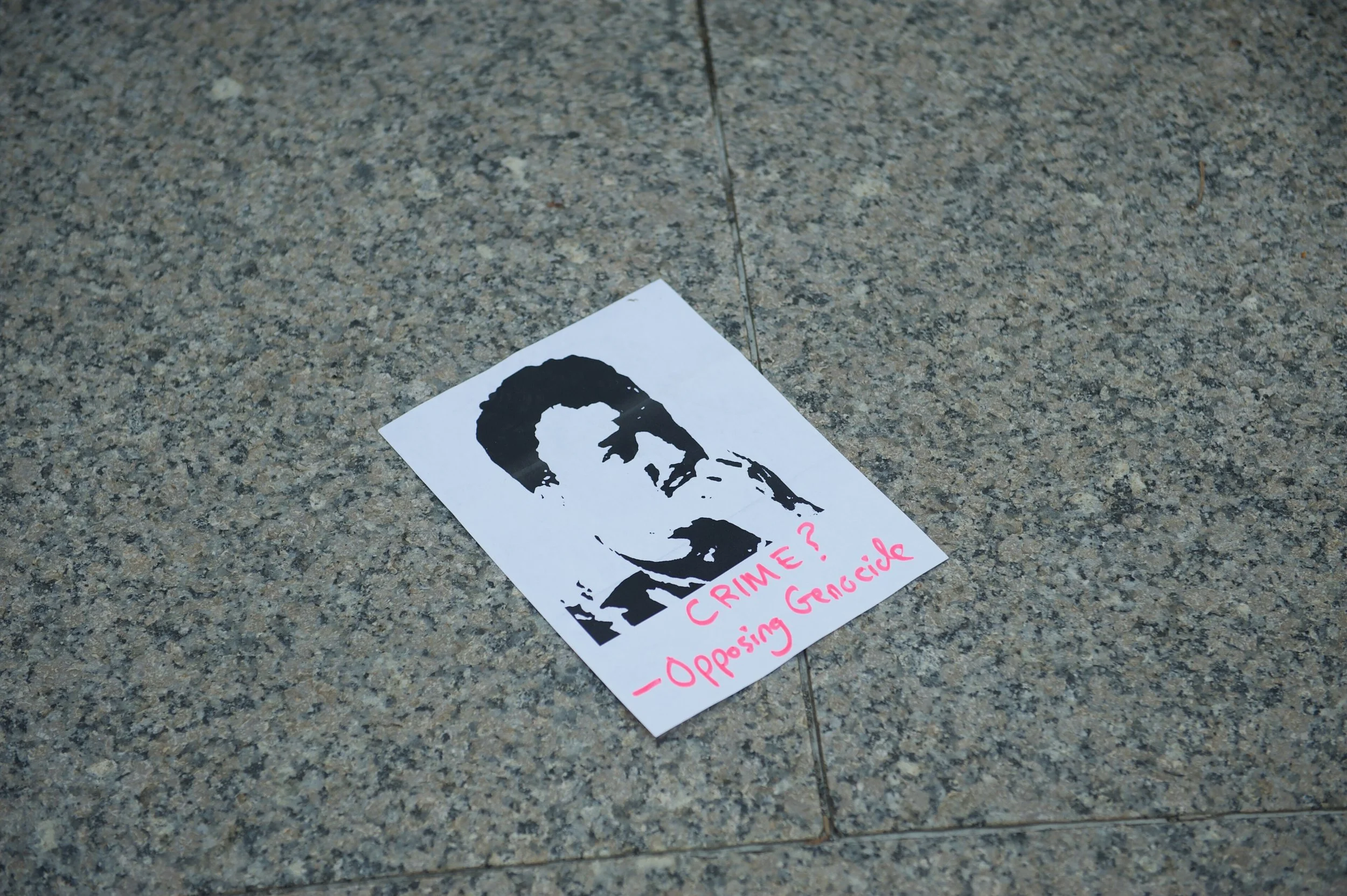
A scene from protests in Thomas Paine Park against the detention of Palestinian activist and Columbia student Mahmoud Khalil, March 2025. Khalil remains in legal limbo as the Trump administration continues its efforts to deport him for his advocacy of Palestinian human rights. (Photo: SWinxy, CC BY 4.0, via Wikimedia Commons)
As one lawyer working on activist defence cases explains, legal proceedings have increasingly become “routine rather than exceptional,”with courts processing large numbers of cases linked to protest actions over extended periods. This normalisation of prolonged legal pressure reshapes not only how movements respond, but how they organise from the outset.
Remaining operational under these conditions depends on continuous adjustment. Responsibilities are distributed, visibility is carefully calibrated, and decisions are shaped by an ongoing assessment of risk. These are not reactive measures, but embedded practices — ways of sustaining action within environments where exposure carries increasing consequences.
Adaptation, in this sense, is not about avoiding pressure, but about learning how to operate through it.
Sharing risk, working beyond visibility
This adaptation is not only visible in how movements organise, but in how they share the burden of acting under pressure. One of the most significant shifts in how civil society operates today lies in how risk is redistributed — quietly and collectively, often out of sight.
The 2025 report from the Coalition Against SLAPPs in Europe (CASE) and the Daphne Caruana Galizia Foundation.
What was once borne by individuals is increasingly absorbed across networks: legal costs are shared, information moves through trusted channels, and responsibilities are distributed in ways that prevent any single person from carrying the full weight of exposure. Activists often use such approaches in response to lawsuits designed not to win in court, but to drain resources and silence criticism. These so-called Strategic Lawsuits Against Public Participation are widely recognised as a form of legal intimidation, aimed at exhausting activists, journalists, and organisations rather than securing a legal victory.
This redistribution does more than mitigate risk; it reshapes participation itself, allowing engagement to continue even as pressure intensifies. Collective capacity, rather than individual resilience, becomes the condition for action.
For those directly affected, this shift is deeply personal. It begins with exposure, but it is sustained through isolation. As Italian climate activist Giacomo Baggio recalls after facing targeted legal action, “in the beginning I felt very alone… I knew this legal action was targeted specifically towards me.” What follows, in many cases, is the gradual construction of support systems — legal, financial, and emotional — that make it possible to continue.
This is not accidental. As Firmin has observed, repression increasingly operates through a dual logic: tightening restrictions on organisations while simultaneously raising the personal cost of participation, a pattern also documented in global human rights reporting. The effect is not only to deter action, but to fragment it — pushing movements towards forms that are less individually exposed and more collectively sustained.
At the same time, much of this work takes place beyond public view. Civil society actors document abuses, follow legal cases, intervene in policy debates, and negotiate space in ways that rarely produce immediate visibility but cumulatively shape what remains possible. In multiple contexts, these efforts have contributed to delaying or reshaping restrictive measures, even when they have not prevented them entirely.
This quieter form of resistance is often hardest to see precisely because it unfolds over time. As one journalist noted during a panel discussion at CIVICUS International Civil Society Week, people “don’t notice free speech until it’s gone… and once it’s gone, it takes time before they realise the consequences are very different from what they used to be.”
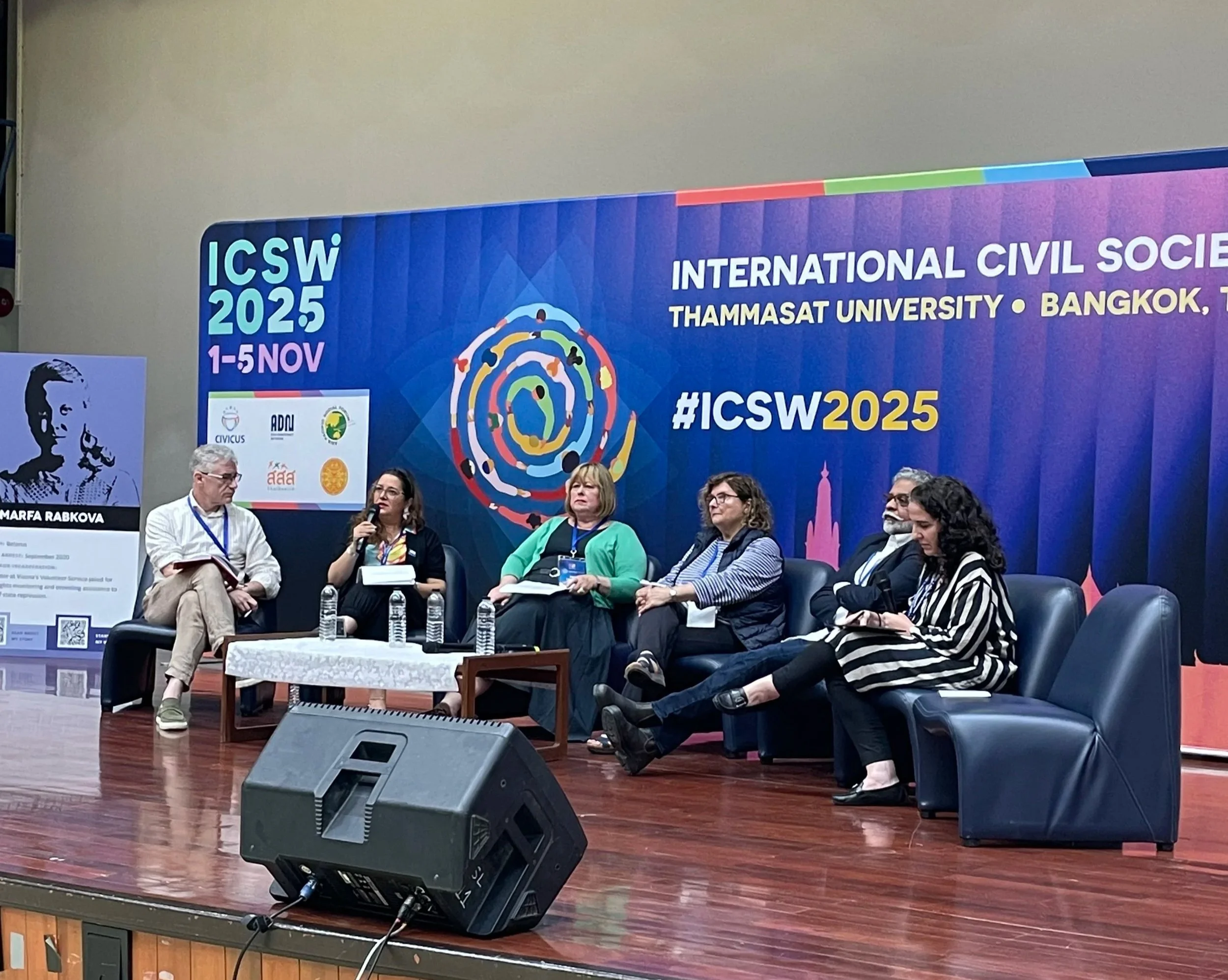
Panelists at the CIVICUS International Civil Society Week, held in November 2025 in Bangkok, Thailand. (Photo: Gaia Guatri)
The work of sustaining civic space lies not only in reacting to restrictions, but in maintaining the conditions that allow participation to persist.
What emerges is a form of resistance that is less centralised and more difficult to dismantle precisely because it is distributed — sustained through networks, shared resources, and ongoing coordination that allow action to continue even when it is no longer immediately visible.
Staying connected across borders
As pressure intensifies, connection becomes more than a strategy — it becomes infrastructure. Civil society actors increasingly rely on transnational networks not only to amplify visibility, but to sustain the practical conditions of participation: accessing legal support, securing resources, and ensuring that cases do not disappear once they leave the headlines.
“Holding the line…is not a static position. It is a continuous practice — one that unfolds across courtrooms, across communities, and across borders, even as the costs accumulate and outcomes remain uncertain. Civic space may be narrowing, but it is not closed. It is being contested, negotiated, and redefined by those who continue to act within it.”
These connections often operate through informal channels — encrypted messaging groups, activist coalitions, and legal defence networks — but their effects are concrete. Names circulate. Cases are followed. Pressure that might otherwise remain local becomes visible across borders. Initiatives such as CIVICUS Stand As My Witness and monitoring by Amnesty International demonstrate how international attention can shape the conditions under which repression unfolds, particularly in contexts where it depends on limited scrutiny.
For those directly involved, this connection is not abstract. It is experienced as a form of continuity. Baggio describes how international and local solidarity become essential in sustaining action under pressure: “it gives a lot of hope…it shows that movements are not being extinguished but are responding and continuing.”
At the institutional level, this dynamic is increasingly recognised as central to the protection of civic space. As Gina Romero, UN Special Rapporteur on the rights to freedom of peaceful assembly and of association, has emphasised, the ability of activists to remain connected — across borders, movements, and support structures — directly shapes whether civic freedoms can be exercised in practice, particularly in environments where isolation becomes a mechanism of control.
Firmin similarly underscores that activists consistently highlight the importance of not being left alone. In practice, connection functions less as protection in a formal sense, and more as presence — ensuring that pressure is seen, tracked, and, at times, contested. It does not prevent repression, but it alters its visibility, and with it, its limits.
The art of resistance
As pressure reshapes the conditions of action, it also reshapes its forms. Where direct confrontation becomes difficult, resistance does not disappear — it relocates.
In Afghanistan, where public space for dissent has been dramatically restricted, artistic practices have become one of the few remaining channels through which expression can persist. Initiatives such as ArtLords have long used murals, visual storytelling, and community-based art to document social and political realities, including restrictions on women’s rights. Since the Taliban’s return to power, such forms of expression have adapted — moving from public walls to more discreet and transnational forms of circulation, allowing stories to continue even when visibility carries risk.
Elsewhere, resistance takes shape through the protection of information itself. Investigative collaborations like Forbidden Stories ensure that the work of journalists facing threats does not disappear with them. By distributing sensitive investigations across international partners, the project makes it significantly harder to silence reporting through intimidation or violence. What is preserved is not only individual safety, but the continuity of the work itself.
In Hong Kong, following the tightening of the National Security Law, independent media and civil society actors have been forced to reconfigure how they operate. Some have relocated abroad; others have shifted to encrypted communication or reader-supported models. Outlets such as Hong Kong Free Press continue to document local developments under sustained pressure, illustrating how journalism itself becomes a form of long-term resistance.
These dynamics are also visible in student movements. Across European and North American campuses, pro-Palestine activists increasingly use visual and performative forms — banners, murals, and symbolic installations — to sustain visibility under growing protest restrictions. Art becomes a way to occupy space and circulate messages even when demonstrations are curtailed or heavily policed.

Some of the squares in the “From Occupation to Liberation” quilt unfurled by activists on the front steps of New York’s Metropolitan Museum of Art in March 2024. (Images courtesy of the artists via Hyperallergic)
Across these contexts, resistance becomes less about singular acts and more about continuity. As Syndala — a pseudonym used for security reasons by a 22-year-old Russian activist involved in pro-Palestine organising in Europe — explains, repression does not necessarily silence movements: “the more they repress us, the more our voices become louder.”
This does not mean pressure is ineffective. Rather, it reshapes how dissent is expressed — pushing it into forms that are less visible, but often more adaptable. What is lost in openness is not simply diminished, but transformed: into images, into coded language, into shared narratives that move across borders and contexts.
In this sense, art — broadly understood as expression, storytelling, and symbolic action — becomes more than a medium. It becomes a form of international resilience. Across vastly different contexts, from Kabul to Hong Kong to European campuses, these practices connect actors who may never meet, but who operate within a shared logic: to continue, to adapt, and to remain present even under pressure.
What emerges is not the disappearance of dissent, but its transformation. It is sustained not only through visible acts of protest, but through the creative and transnational infrastructures that allow resistance to endure — even when it can no longer be easily seen.
Holding the line
Meanwhile, for activists who participate in traditional protests, the consequences continue to unfold. Court dates accumulate, restrictions remain in place, and uncertainty lingers — not as an exception, but as part of what participation now entails. What began as a brief act of dissent extends far beyond the moment itself, reshaping everyday life in ways that are less visible, but no less consequential.
For Christian, the shift is not only legal, but deeply personal. The protest lasted less than an hour. What followed has stretched into months — a slow, persistent extension of pressure into spaces that once felt ordinary. Returning home after the police search, he recalls, “I didn’t feel at home anymore.”
That disruption does not end with the event. It lingers — in routines, in relationships, in the quiet recalibration of what participation means. And yet, it is within this extended aftermath that something else becomes visible: not only the cost of dissent, but the persistence of it.
Across contexts, this has become a defining condition of civic action. As this series has shown, repression today rarely takes the form of sudden rupture. It is structured through law, extended through procedure, and experienced through its long-term effects — shaping not only how dissent is expressed, but who is able, or willing, to take part.
And still, civil society does not recede. It reorganises. It becomes less centralised, more adaptive, and more deeply embedded in everyday practices — operating across multiple spaces at once, from public protest to informal networks, from visible mobilisation to sustained, often unseen forms of engagement. The State of Civil Society Report 2026 documents this persistence globally, not as evidence that pressure has eased, but as a reflection of how deeply adaptation has become part of civic action itself.
Holding the line, in this context, is not a static position. It is a continuous practice — one that unfolds across courtrooms, across communities, and across borders, even as the costs accumulate and outcomes remain uncertain. Civic space may be narrowing, but it is not closed. It is being contested, negotiated, and redefined by those who continue to act within it.
As Andrew Firmin puts it, even small forms of support — from legal assistance to international solidarity — “can make a big difference” in enabling activists to continue under pressure.
The protest ends. The process does not.
Across this series — from the architecture of repression, to its impact, to the ways it is navigated — one pattern remains constant: activism is not disappearing. It is evolving.
And it is within that evolution — quieter, more dispersed, but no less deliberate — that the possibility of resistance endures.