
Who Cares: Looking for the Place Where Workers’ Rights Meet Disability Rights

The Who Cares series investigates structural issues and developments in the political economy of care in New York State and how people on the ground are living and responding to these realities. Who Cares original artwork by Marisa Zarczynski.
There appears to be an underexamined tension in the New York State home care crisis. On one hand, the crisis speaks to a workforce issue: falling wages have led many workers to leave the industry. On the other hand, there is a disability rights issue, in part instigated by the work force crisis: many people who need care and want to live independently are at risk of being forced into long-term care institutions.
In advocacy circles, the difficulty remains building a strong and impactful coalition of workers and disability rights activists. Such a coalition, should it emerge, would enable both groups to mount an effective challenge to the state and its private equity backed affiliates.
Labor upheaval in the care sector
On the labor front, it is clear that a vital constituency of workers have been devalued by private equity backed companies.
In the case of the Consumer Directed Personal Assistance Program (CDPAP), a single fiscal intermediary, Public Partnership LLC (PPL), controls the recruitment and payment of personal care aids for New York State Medicaid recipients who qualify for the program, specifically residents with chronic illnesses and/or mental and physical disabilities. Since PPL was awarded an $11 billion contract in 2024 to manage home care for CDPAP, replacing the more than 600 fiscal intermediaries (FIs) that had previously operated in the home care sector, the company has eliminated wage diversity among “personal care aids” (the home care workers), reducing pay to the minimum wage in New York State ($16 per hour).
As a consequence, tens of thousands of home care workers have abandoned the program, leaving CDPAP consumers without staff. In this context, the crisis calls for labor activism.
CDPAP grew out of the Independent Living Movement in New York State, where activists demanded that the state cooperate in self-direction of long term care by Medicaid recipients. This requirement owes to a Supreme Court decision that compels state governments to ensure that people with chronic illnesses and physical and mental disabilities - that is, consumers with long-term care needs - have equal opportunities to live independently in the least restrictive situation possible. In other words, consumers are legally entitled to home care services which allow them to live outside of long term care institutions like nursing homes, assisted living facilities, and residential care homes.
VIDEO: NYAIL and the Independent Living Movement in New York
In New York State, the CDPAP successfully served this purpose, but the transition to a single fiscal intermediary (PPL) has jeopardized the capacity for New York residents with long term care needs to live independently, as there are fewer personal care aids available for home care work. The imminent threat to CDPAP consumers is that they will lose the home care services they need to live independently and find themselves institutionalized.
Home care workers have proven most difficult to organize. In the lead up to the PPL transition, the health care worker union 1199 SEIU supported the reform. While the union has not officially organized CDPAP workers, they believed that labor negotiations would be more efficient if they targeted a single fiscal intermediary. Since the transition, the union has begun preliminary efforts to organize CDPAP’s personal care aids, ostensibly to bargain collectively with PPL for wage increases for personal care aids. In other words, rather than address the employment conditions under which personal care aids existed before the PPL transition, 1199 SEIU seemed to delay organizing them until favorable bargaining circumstances emerged.
Rising mobilization for disability rights
While it is too early to predict the outcome of this labor organizing, it’s clear that the decision by the union left many disability rights activists in the lurch. Whereas a united front of organized labor and disability rights advocates could possibly have challenged the transition to PPL more effectively, the union’s support of the transition in favor of collective bargaining prospects negatively impacted CDPAP consumers. The transition has since taken effect, and tens of thousands of CDPAP workers have turned elsewhere to earn their living. The New York State residents with Medicaid who once relied on personal care aids through CDPAP to support them in their activities of daily living now find themselves lacking staff and struggling to remain independent of institutional care. They are also quite reasonably suspicious of the union’s interests in reform negotiations now that PPL is in charge of CDPAP.
In turn, advocacy efforts to challenge the rise of private equity authority in the state sanctioned home care program are bifurcated. Well-organized campaigns demanding an end to PPL’s control of CDPAP are primarily constituted by disability rights advocates. Chief among them is the New York Caring Majority, which has organized powerful direct actions to protest the devastating impacts of the transition to NYS Medicaid recipients who rely on CDPAP for care.
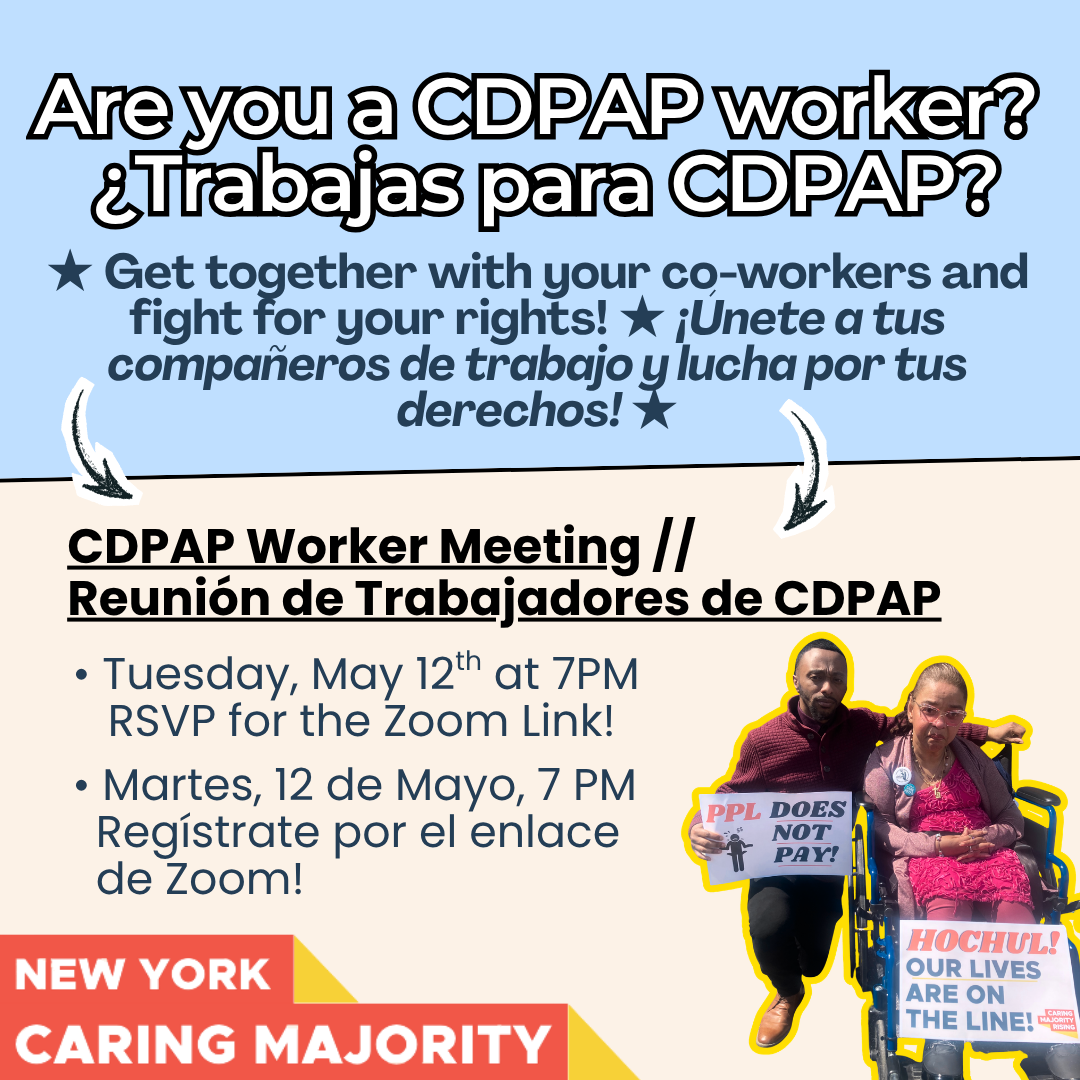
Fascinatingly, the NY Caring Majority has launched its own effort to organize CDPAP workers in hopes of waging a second front of protest against the PPL transition.
A united struggle?
To be clear, home care workers have always been part of the NY Caring Majority, but the questionable efforts of the state’s most powerful health care worker union have allowed the PPL transition to devastate the CDPAP. This union has waited for the smoke to clear from the transition to begin organizing CDPAP workers. Now, CDPAP consumers and the workers they rely on face life-threatening circumstances.
If, for example, a consumer hires their child to provide home care, but that worker cannot afford to pay living expenses for themselves and their CDPAP consumer, the two parties find themselves, together, unable to live independently. Such a scenario, which is quite realistic, reveals the steep price some CDPAP consumers and workers pay for the ‘powers that be’ to find leverage in the home care political economy.
A promising sign is the united front currently represented by the No More 24 movement sending shockwaves through New York City. Though it is primarily a campaign led by home care workers, disability rights activists have played a vocal and galvanizing role in the organizing. Disability rights advocates, for example, drafted the “Disability Justice Open Letter of Support for NYC Home Care Workers’ ‘No More 24’ Struggle,” in which they stated:
“We are disabled, crip, mad, debilitated, and disability activists, advocates, scholars, workers, and home care recipients. We proclaim our full support for the struggle of the home care workers of New York City who are currently engaged in the “No More 24” campaign. We specifically support their immediate demand for enactment of the No More 24 bill (City Council bill, Intro. 303), and we support the broader struggle of the Ain't I A Woman?! coalition against the hyper-exploitation of home care workers.”
The No More 24 movement has already gotten the attention of major news outlets such as The Guardian. It remains to be seen whether labor and disability rights activists can broaden the movement’s base and deepen its impact. If they can, the movement could prove to be a decisive intervention. A strong, united effort to combat private equity in home health care is needed if consumers and workers are to advance a successful, life-preserving campaign to ensure that CDPAP survives.