
International Water Law and Our Post-Crisis Reality
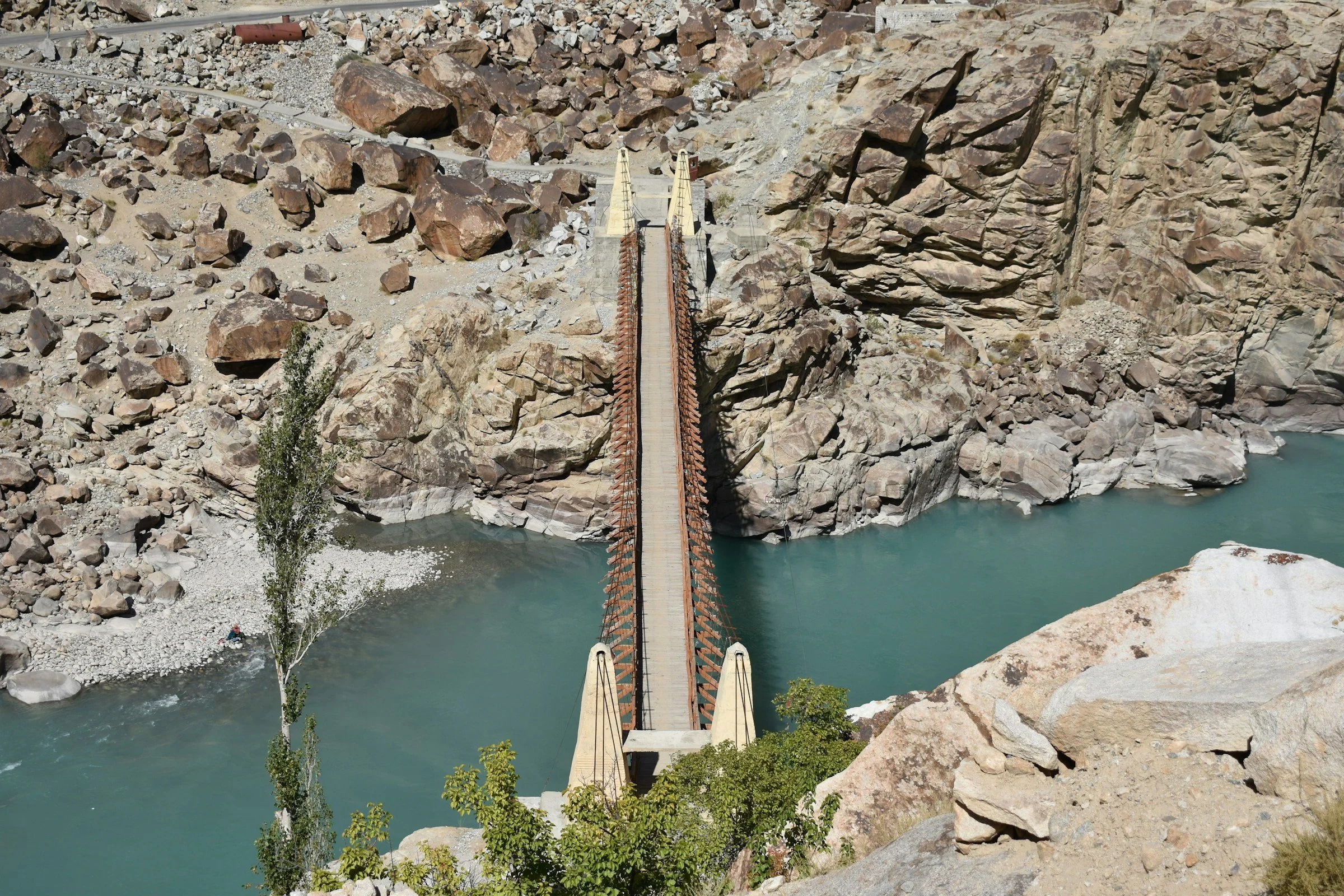
Indus River, Batalik. (Photo: Rahul Pathania on Unsplash)
Our dwindling savings account
Long before treaties, agreements or conventions, the Indus Valley Civilisation had rules for water use. And they worked. Centuries later, the rules from the days of the Indus Valley Civilisation have multiplied and become more sophisticated, but the water sources they are meant to protect have been depleted beyond recognition.
In January 2026, a flagship report by UN researchers disclosed that the world has entered a new era of ‘water bankruptcy’. While we have heard the term ‘water crisis’ in global discourse on an increasingly regular basis, experts warn that we are now in a ‘post-crisis’ state where water systems are not able to return to their baseline.
What does water bankruptcy look like? Some of its impacts are visible in the form of food insecurity, diseases, higher infant mortality rates, economic disruption, migration and conflict over scarce water sources. These effects threaten to snowball into dystopian levels, particularly in water stressed countries like Pakistan, unless there is an urgent and coordinated global effort to protect remaining fresh water reserves.
The modern international water law has been in place for decades, yet the poor state of global environmental rule of law has rendered its legal frameworks ornamental in nature. In the world of ‘water bankruptcy,’ international water law must be reworked to be transparent, enforceable and adept in adapting to the new reality. Additionally, the state of bankruptcy must act as a catalyst to radically reimagine our relationship with water beyond commodification.
Water rules: who gets what
In an overview of how global water law have evolved over time, scholars Joseph Dellapenna and Joyeeta Gupta conclude that it has six dominant features; its cultural origins (i.e, in arid societies), the role of religion, conquest and colonisation, global engineering, epistemic communities, and finally, contemporary globalisation. To these we can add a seventh dominant feature which is increasingly becoming the focal point in the development of water law: the impact of anthropogenic climate change on the availability of fresh water.
These features have resulted in the development of international water law, which ‘provides an underlying legal framework that enables countries to cooperate peacefully and use water resources in a way that maximises shared socio-economic and environmental benefits’. It comprises international treaties, bilateral and multilateral basin agreements, and customary water law.
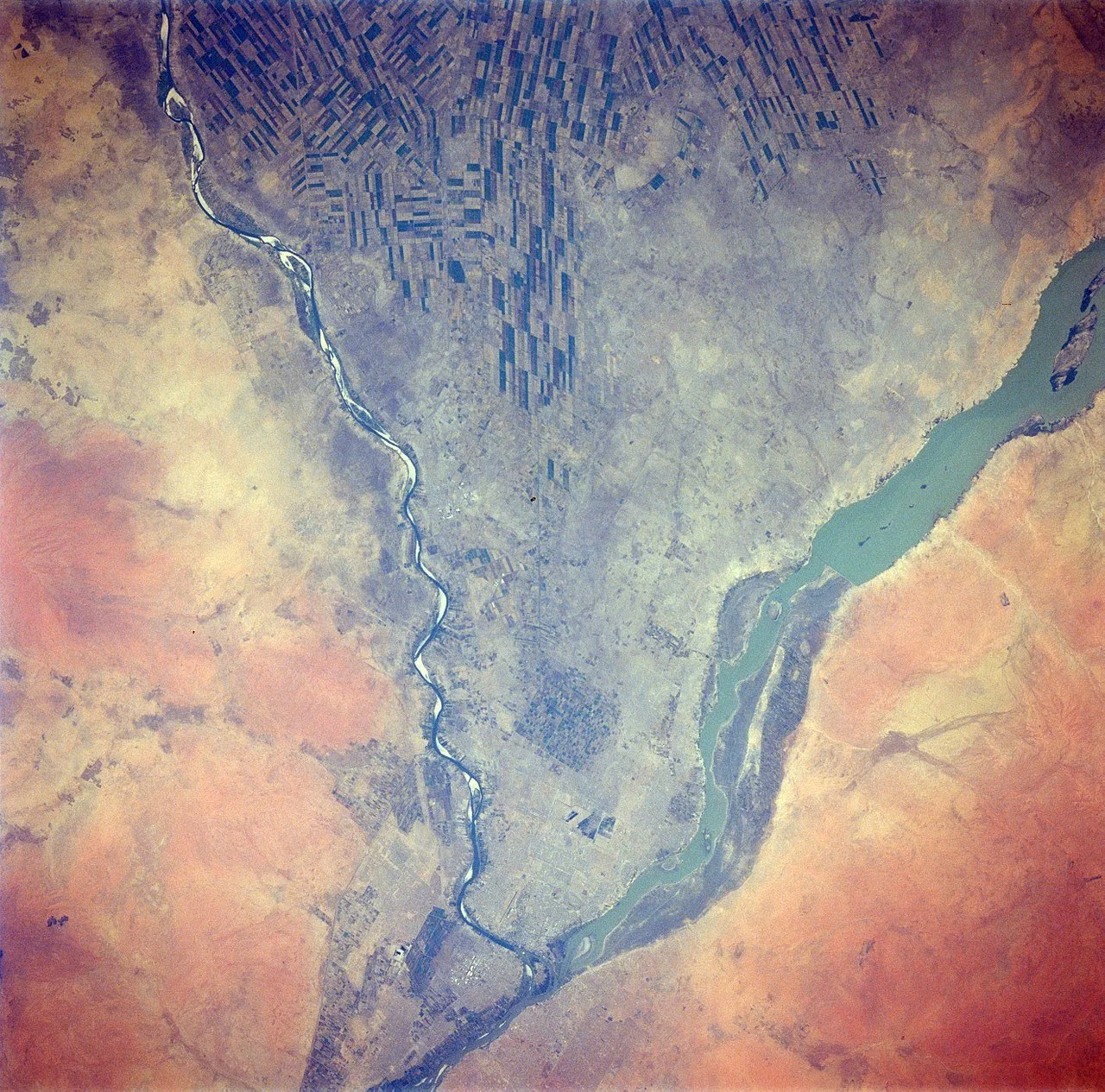
Vertical view showing the smaller Blue Nile merging with the White Nile. Khartoum, the capital city of Sudan, lies at the confluence (on both sides of the Nile). (Photo: NASA, Public domain, via Wikimedia Commons)
International water law is inadequate in the bankruptcy era for at least two major reasons. First, its laws, institutions and investments were conceptualised in the crisis era when hydrological variability was almost certain and reversibility was possible. Second, they were created with the ideological foundations that prioritised water as an economic commodity.
Leaks in international water law
International treaties on water concern the poor state of environmental rule of law as they encourage peaceful coordination between riparian nations on consumption of water for economic development, but are highly flexible on sustainable usage.
The two major United Nations treaties on water are the 1992 UN Convention on the Protection and Use of Transboundary Watercourses and International Lakes (Water Convention) and the 1997 UN Convention on the Law of the Non-navigational Uses of International Watercourses (UN Watercourses Convention). The treaties focus on the usage of shared water resources between states based on the principles of reasonable and equitable utilisation (UN Watercourses Convention Article 5 and 6), no significant harm (Article 7) and obligation to cooperate (Article 8).
“Bilateral agreements are created to satisfy the global economy. Even countries that state that they want to help the poor and the unenfranchised, such as the current government of Mexico, do so at the expense of Indigenous, MestizX, and non-Indigenous communities who are the ones directly connected to bodies of water. We are thus now seeing these local communities stand up and resist the usurpation of their own water governance system.”
The two UN Conventions do not replace bilateral agreements around specific basins but provide the framework for developing such agreements.
One such agreement, the Indus Water Treaty, was considered for decades to be one of the most successful transboundary water-sharing treaties in the world. Thanks to a seemingly foolproof mechanism for settling disputes, it endured multiple conflicts between India and Pakistan. However, the success of these conflict resolution mechanisms was called into question last year after India announced it had put its participation in the treaty in “abeyance”. This declaration has highlighted the precarious position of ‘strong’ treaties in the face of increasing geopolitical tensions and climate pressures.
Moreover, the Conventions stress the importance of sustainable usage of water but falter when it comes to implementing this principle. There is a severe lack of concrete enforcement mechanisms available to the UN’s Water Convention Implementation Committee, which serves primarily in an advisory capacity and has developed an implementation mechanism that is “non-confrontational, non-adversarial, transparent, supportive and cooperative in nature”. Consequently, sustainability functions as nothing more than a buzz word, taking a back seat to riparian states' right to utilise fresh water, albeit equitably, for economic development.
Perhaps the most visible demonstration of international water law’s inadequacy in the era of bankruptcy is its tolerance for large dams. International customary law, which is highly important as a significant number of states are not signatories to water agreements, promotes ‘a race to dam’ that incentivises investments in large scale dams. Such projects can fuel conflict between upper and lower riparian states and can be devastating to local ecologies and to the communities that depend on the river.
What now?
The post-crisis era demands that we speak not only about the right to water, but also the rights of water. Indigenous peoples from around the world, from the Andes to the Amazon, have long regarded water as a living entity, infused with spirit, agency and autonomy. For example, folklore from across communities in Pakistan has featured rivers and waterbodies as central characters.
These knowledge systems created symbiotic relationships with waterbodies, and the rules around water reflected this dynamic. However, this has long been overshadowed by material and cerebral colonisation that reconfigured water as a possession – to be owned and exploited – and has shaped the later water rules. In these rules, water is still treated as a commodity, albeit one that needs to be shared equitably between its consumers.
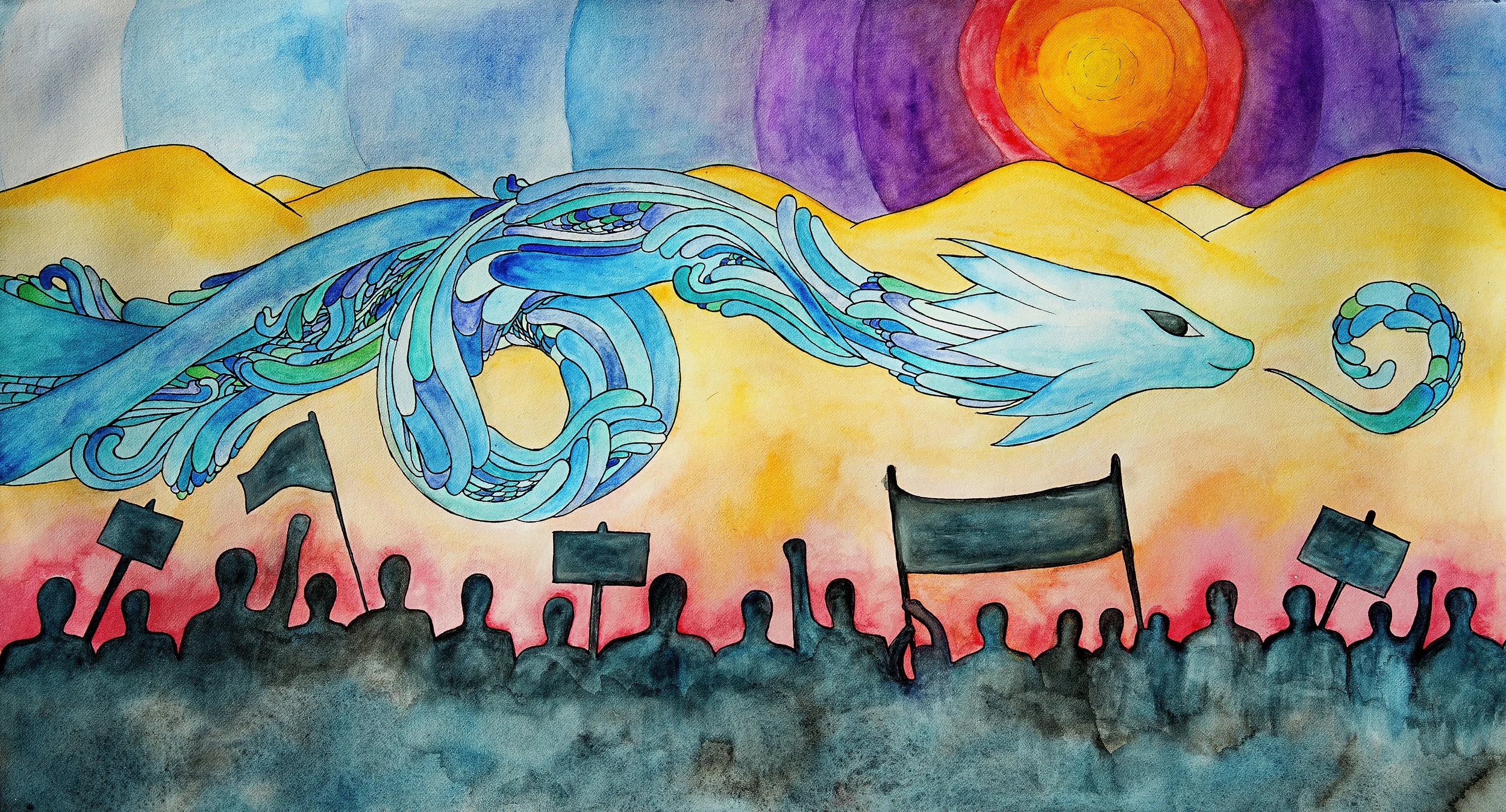
Rivers and their guardians. (Image courtesy of Talking Rivers)
Blake Lavia and Tzintzun Aguilar-Izzo, community organisers and storytellers at Talking Rivers, point out that contemporary society is organized around “the needs of the global market economy,” placing those needs above all other needs. “Bilateral agreements are created to satisfy the global economy. Even countries that state that they want to help the poor and the unenfranchised, such as the current government of Mexico, do so at the expense of Indigenous, MestizX, and non-Indigenous communities who are the ones directly connected to bodies of water,” they observe. “We are thus now seeing these local communities stand up and resist the usurpation of their own water governance system.”
The water governance systems ignore the needs of the Indigenous peoples whose way of life depends on and protects the watercourses; smallhold farmers, women and children who are disproportionately affected by the effects of climate change; the non-human life whose survival depends on the watercourse; and finally, the water systems themselves that, although resilient, cannot sustain further onslaught that commodification entails.
The answer then lies not in an equitable share in the loot but a more fundamental reconfiguration that restores the status of the watercourses. In the words of Indigenous scholar Rye Karonhiowanen Barberstock, “let us remember that water is not separate from us — it is within us, around us, and part of every heartbeat on Earth.”