
Beyond Frida’s Kilns: A Community’s Fight to Overcome a Toxic Legacy

Traditional brickwork indoors. Red bricks form the ceiling of a house in Tequisquiapan. These handmade bricks are a standard building material for both the structure and the interior finish of local homes. (All photos courtesy of the author.)
One by one, the men enter the dim room and line up along the back wall - many with crossed arms, some with skeptical expressions. The space is no larger than ten square meters; the air is heavy with dust, carrying the smell of sweat mixed with clay. Most of the men wear caps and work clothes. One is still in rubber boots; until moments ago, he had been knee-deep in mud, turning it with a pitchfork.
Don Albino, the oldest ladrillero, takes a seat on the right. Though in his late sixties, his posture is perfectly straight, his broad, muscular back bearing witness to a lifetime of physical labor. Unlike the others, he knows what to expect. Representing the ladrilleros - the region’s brickmakers - he has gathered the men to meet two visitors who have come onsite to engage with them. On the opposite side of the room, these visitors have just finished setting up for their presentation.
The projector feels almost out of place here; it is hard to imagine these walls ever being used for a digital slideshow. Yet, as Joaquín Antonio Quiroz Carranza, a tall and composed man, begins to speak, the room grows quiet.
Confronting a complex legacy
Against the shadowed wall, the projector casts an image from another era. The painting by Frida Kahlo, titled “Los hornos de ladrillero” (“The Brick Kilns”) and created in 1954 shortly before the artist’s death, depicts a figure working at a brick kiln. It looks exactly like those just outside this room in San Nicolás, a neighborhood of Tequisquiapan in the central north of Mexico.
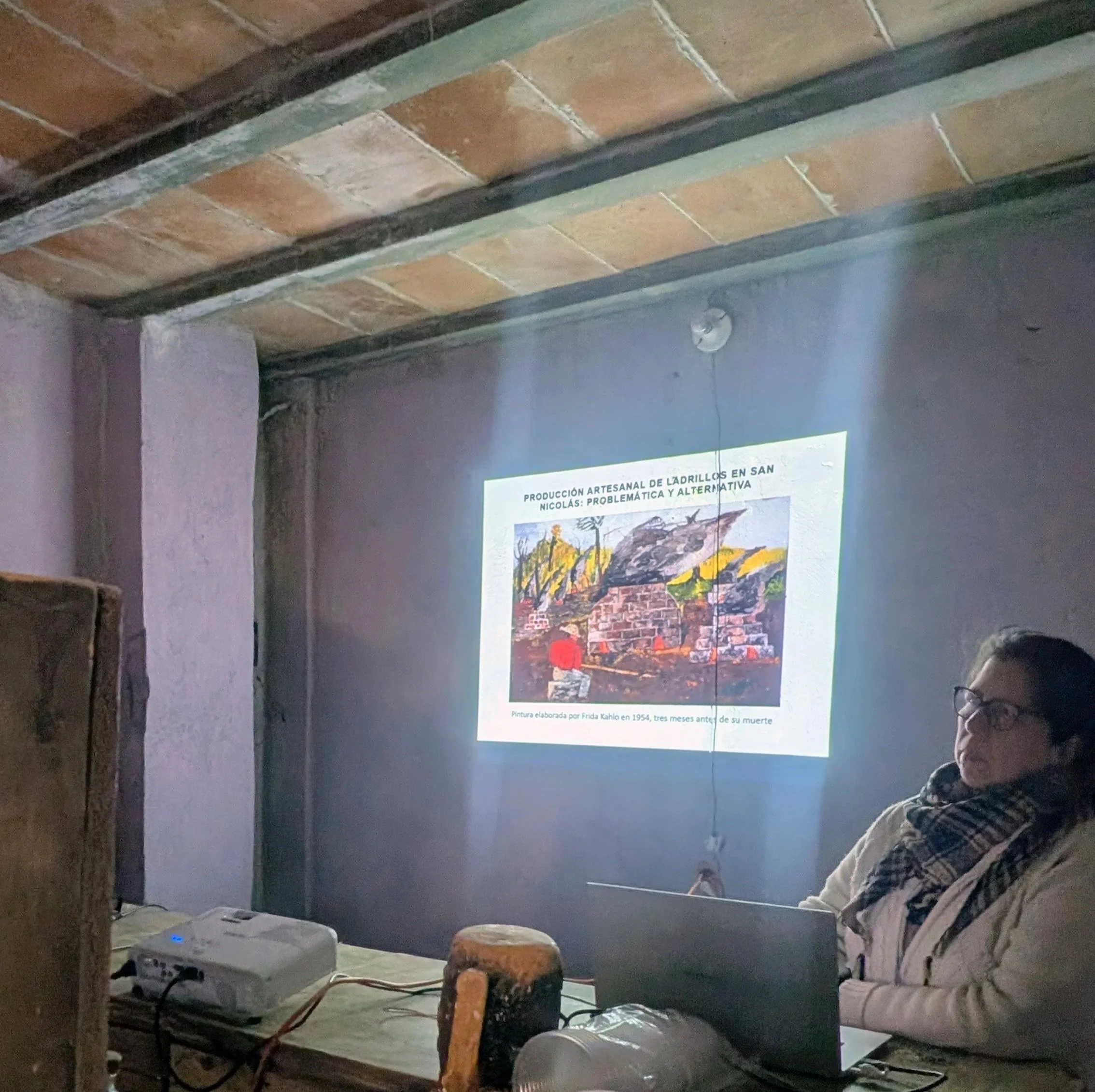
Frida Kahlo’s art lights up the room. Quiroz explains the project while Cantú manages the presentation from the back. The slide on the wall shows Frida Kahlo’s 1954 painting, Los hornos de ladrillo.
The painting evokes more than artistic heritage. Much of the canvas is filled with thick black and gray smoke rising from the kilns. For decades, the brickmaking process has contaminated air, water, and soil - not only in San Nicolás, but across many regions of the country. It is this environmental, social, and economic legacy that the speaker, Quiroz, and his wife, Citlalli Cantú Gutiérrez, are determined to confront.
“Together with a number of scientists,” says Quiroz, “we have redesigned the production process to make it more sustainable and to protect the health of workers and nearby residents. Our proposal is not an abstract model. It is a concrete, workable alternative - developed on the ground - that can be carried forward to other regions confronting similar challenges.”
The hard economic realities of brickmaking
Brickmaking is an ancient craft in Mexico, practiced by families for generations. Today, the country counts roughly 20,000 brick production units. San Nicolás alone is home to around 120 kilns and, according to research conducted by Quiroz’s team, the area suffers from some of the worst air quality in the region. For the men in this room, the consequences are immediate - embedded in the air they breathe every day.

This traditional kiln is located on the production site of the ladrilleros in San Nicolás. It is used to fire the clay bricks that the industry depends on.
Much of the problem is rooted in economic pressure. Brick prices are largely set by contractors or local intermediaries and sometimes barely cover production costs. Each kiln produces around 10,000 bricks every 20 to 30 days, relying on the labor of seven to eight workers. At a market price mostly ranging between $2.80 and $3.50 MXN per brick (approx. $0.15 to $0.18 USD), a firing cycle generates roughly $35,000 MXN (approx. $1,840 USD) in revenue. Once basic input costs are deducted, this leaves wages of only $2,000 to $3,000 MXN (approx. $105 to $158 USD) per worker for nearly a month of labor. As Quiroz walks through the calculations, several men nod in recognition.
Under these tight economic conditions, producers are forced to rely on the cheapest fuels available. "Industrial and hazardous waste, illegally diverted by companies authorized to collect and transport it,” Cantú explains, “is sold to brick producers instead of being delivered to approved treatment facilities. As a result, kilns are fired with whatever materials are at hand - including used motor oils, solvent mixtures, plastics, old tires, and municipal refuse."
Toxic health effects
While Quiroz leads the discussion, Cantú adds key insights at just the right moments. The support they offer each other, combined with their deep understanding of the systems supporting brick production, allows them to meet the ladrilleros on solid, practical ground.

On the grounds of the ladrilleros in San Nicolás, Quiroz (right) speaks with an attendee before the official start of the presentation.
The environmental implications of the production process are severe. Each kiln emits an estimated 1,075 metric tons of greenhouse gases annually, alongside a mix of toxic pollutants, including heavy metals and persistent organic compounds. The extent of contamination is visible in soil measurements from San Nicolás. Research conducted by Quiroz and his accompanying scientists, found concentrations of polychlorinated biphenyls (PCBs) - toxic chemicals with dangerous effects on the environment - in urban soil ranging from 1,517 to 5,000 mg/kg. This is staggeringly higher than the Mexican Official Standard (NOM-133-SEMARNAT-2001), which sets a maximum limit of 5 mg/kg.
Half of the children sampled were found to carry PCBs in their blood, along with lead and arsenic. According to the scientific team, emissions from artisanal brick kilns are associated with severe and chronic health effects, including cancer, respiratory disease, neurological damage and reproductive harm.
A focus on practical solutions
While the burnt fuels pose a health risk to the surrounding area, the brick producers do not have a choice - burning these materials is the only affordable option. Any effort to reduce emissions must address this cost structure, a reality Quiroz and Cantú are well aware of.
Their talk to the ladrilleros is solution-oriented. The men listen attentively, occasionally exchanging glances. The centerpiece of the presentation, now visible on the slides, proposes establishing a local pilot plant to produce biomass briquettes and distributing them free of charge as a sustainable alternative fuel. Made from organic residues such as manure, sawdust, and cardboard, these briquettes would significantly reduce toxic emissions.

Molded bricks are laid out in the sun to dry on a production site in San Nicolás.
Projecting a spreadsheet on the wall, Quiroz demonstrates that the project also holds considerable economic potential. Operating a single briquetting machine for two eight-hour shifts per day could produce approximately 260 metric tons of briquettes per month - an output massive enough to fuel 130 kiln firings. In practical terms, this means one single machine could meet more than the entire monthly fuel demand for the 120 brick kilns of San Nicolás. For an individual producer, this switch would cut fuel costs to zero while eliminating the need to burn toxic waste.
To illustrate the technical feasibility, Quiroz and Cantú show a video of the machinery required to press the biomass. The equipment could be supplied by the German mechanical engineering company Weima, which specializes in shredding and compression technology. Through conversations with Weima’s local representatives, Quiroz and Cantú have confirmed that the machine is suited for the intended purpose.
Paying a "historical debt”
The video plays several times as Quiroz explains the details, until the mechanics are clear to everyone. By now, the men’s postures have opened up, and the presentation has evolved into a discussion.
When asked what has driven the couple to pursue this cause so relentlessly, Quiroz frames the project as a matter of "historical debt." While the men themselves have refrained from any complaints or grievances, he insists the ladrilleros represent a vast yet often overlooked industry - one that has provided the very foundations of housing for generations.

Red bricks build the ceiling and the heater of a house in Tequisquiapan. These handmade bricks are a standard material for both structural elements and functional interior features.
Alongside structural economic pressures, brick producers face precarious working conditions: a lack of adequate facilities and equipment, constant exposure to harsh weather, and shifts that often exceed twelve hours. Furthermore, they operate without social security. In Mexico, this translates to a total absence of health and disability insurance, no access to housing loans, and the lack of a retirement pension.
Taken together, these factors contribute to sustained physical strain and psychological stress. "These conditions in no way reflect the value of your labor,” Cantú emphasizes, directly facing the ladrilleros. "You sacrifice your health and endure severe physical demands to supply the bricks our region depends on. It is unacceptable that an industry so fundamental to our local economy and infrastructure remains so deeply undervalued."
From a position of powerlessness within a system dominated by monopolized supply chains, many workers have come to accept these conditions as unchangeable. For the couple, however, these constraints are drivers rather than obstacles. “Our objective extends far beyond improving environmental conditions,” Quiroz declares. “We will challenge local political actors and demand the settlement of the generational injustice done to all of you.”
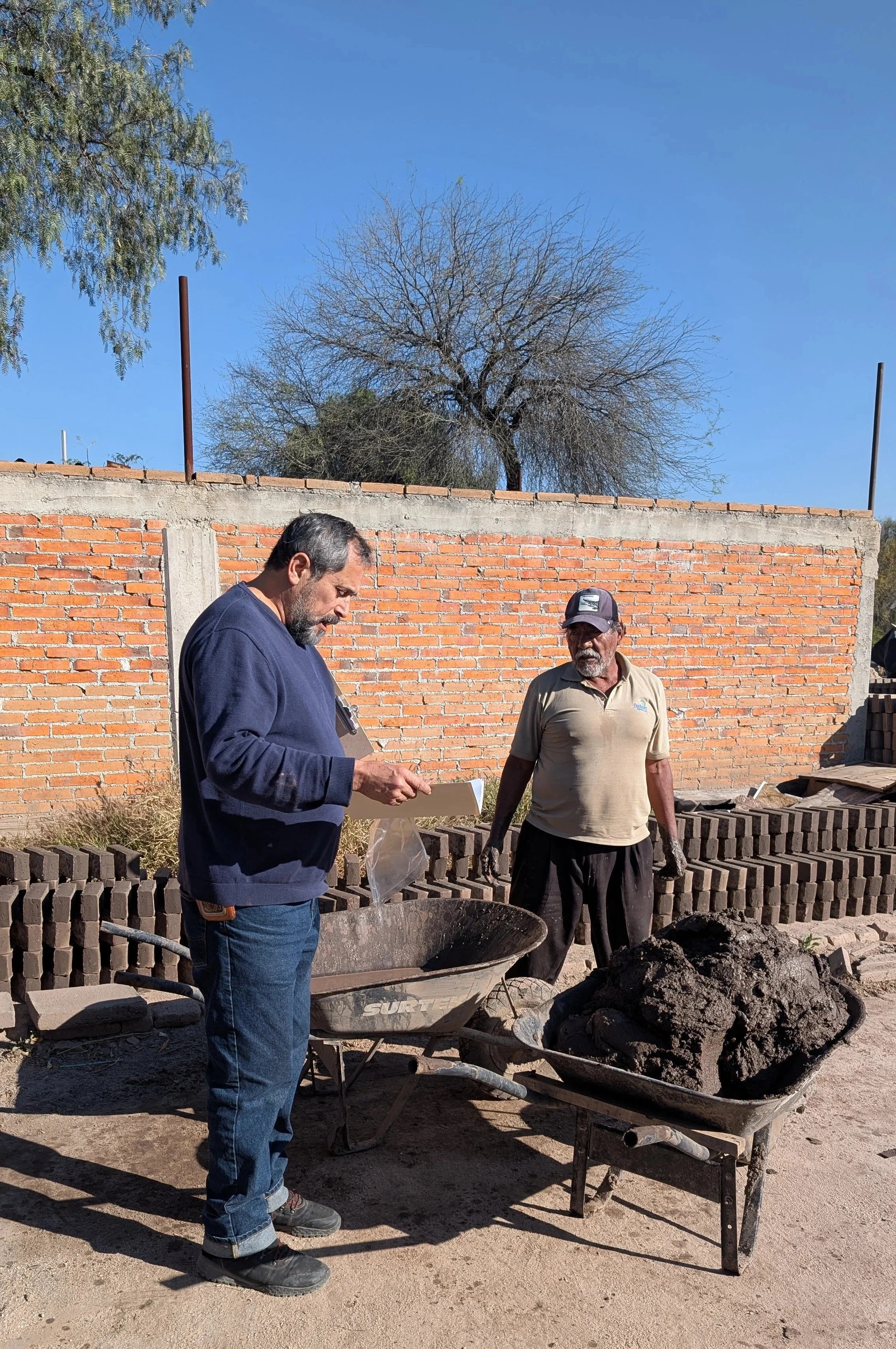
Quiroz hands over a letter to the ladrilleros of San Nicolás for their signatures before it reaches local politicians.
To concretize this ambition, Quiroz and Cantú plan to invite political candidates for the 2027 elections into dialogue with the ladrilleros. This follows a detailed report submitted to authorities last November, which failed to prompt concrete government action. Before reaching out to the politicians, the couple seeks the explicit backing of those most directly affected. By involving the ladrilleros and gathering their signatures, they aim to turn the proposal into a collective demand that politicians can no longer afford to ignore.
The fruits of patient dialogue
After the presentation, the atmosphere is noticeably different. Surprise and emotion surface, in quiet contrast to the men’s outward appearance. Many express heartfelt gratitude. There is a silent sense of disbelief that someone is paying attention - not only to the output of their labor, but to them as people.
One man flips through a book written by Quiroz and Cantú, titled Environmental Pollution and Human Survival in Artisanal Brick Production, based on decades of research and devoted entirely to the realities of the people in this room.
By this point, it is evident that Quiroz and Cantú’s motivation is neither self-interested nor performative. It can be felt in the consistency of their arguments and in the fact that they have come to this room - and to others like it - again and again over the years. Despite repeated setbacks, they continue to fight for change.
Ultimately, their efforts extend far beyond a process improvement. Quiroz and Cantú are driven by a sense of community rooted in care rather than transaction, recognizing those who have long carried the costs of an essential industry and insisting that this history not be overlooked. Grounded in genuine presence and persistence, Quiroz and Cantú embody a form of engagement that is, at its core, deeply human.