
Who Cares: A Disability Justice Activist Navigates the Home Care Crisis in Buffalo, NY
Who Cares artwork by Marisa Zarczynski.
The Who Cares series investigates structural issues and developments in the political economy of care in New York State and how people on the ground are living and responding to these realities. In this first article, Steve Peraza examines how changes to the Consumer Directed Personal Assistance Program (CDPAP), which subsidizes home care services for Medicaid recipients, have strained the access that CDPAP consumers have to home care workers.
Warm suns in arctic skies
It was a cold Thursday in February, even with a warm sun blazing through Western New York’s arctic skies. In Buffalo, you take what you can get. But like warm weather in winter, what you get often isn’t enough...Such is the story for home care workers and consumers in Western New York.

Renee Christian organizes for disability justice with the New York Caring Majority. (Photo: Renee Christian)
On this day, I had the chance to speak at length with Renee Christian, a disability justice activist and organizer for the New York Caring Majority, which is “an organization of people with disabilities, older adults, family caregivers, and home care workers…. organizing to build a sustainable and just caring economy.”
Christian and I had begun to collaborate on the group’s “Care Not Corruption” campaign working to stem the tide of private equity in the home care economy and to improve wages for and access to care workers in Buffalo and the rest of New York State. Together with local activist and advocacy organizations like Partnership for the Public Good, Voice Buffalo, the Self-Advocacy Association of New York State, SUNY-Buffalo Communities of Care, we seek to study the care economy and propose specific solutions to the home care crisis that has affected New York State throughout the 2020s.
I was doing my due diligence, interviewing a colleague, who is also a pioneer in Buffalo’s burgeoning home care movement. When asked about the home care crisis in New York, she offered a concise and discerning explanation of the problem:
“[The home care crisis] means that people who work in care are not getting paid appropriately and are struggling every day just to make ends meet, while other people who need the care are not able to get the care because people are leaving the home care system in droves due to the lack of wages and the unsustainability of working in the care system.”
And there it is, plainly, simply, and profoundly. Home care workers receive wages so low that full-time work does not earn them enough to support their households. As a direct result, the workers leave the industry, creating critical shortages for people with disabilities who need around the clock care. The story has additional layers, of course, especially in the 2026 New York State political economy. But what experts see as an exhaustively complex set of problems, Christian outlined in terms we all can understand.
Through the clouds
New York Governor Kathy Hochul. (Photo: NY Governor’s Office)
“Fraud, waste, and abuse,” said Christian, recalling the terms that NY Governor Kathy Hochul used to justify the decision to move the entire architecture of the state’s home care system under the umbrella of a single private equity-backed company, Public Partnerships LLC (known as PPL). Christian’s own experience sheds valuable light on the impact of this seismic shift.
Christian identifies as a person with physical disabilities. She is also a low-income New York State resident who qualifies for Medicaid, a federal system of health insurance for US citizens requiring financial assistance.
As a Medicaid recipient, she participates in the Consumer Directed Personal Assistance Program (CDPAP). According to the New York State Health Department, CDPAP empowers participants to stay in their homes and receive care from workers they choose themselves, including family members:
“[The CDPAP] is a New York State Medicaid program that allows Medicaid members who are eligible for home care services to choose and hire their own personal caregiver, or "personal assistant". This can include a friend or family member, as long as they are not the Medicaid member's spouse, their designated representative or the parent of a CDPAP consumer under the age of 21.”
Christian said that CDPAP has strengthened her capacity to live independently: “CDPAP was designed by people with disabilities who needed and wanted care but who did not want care in facilities nor long-term care systems.”
Moreover, she emphasized, CDPAP offers its consumers enough autonomy to create their own community of care. For Christian, in fact, creating a community of care through the CDPAP facilitated her development as a community activist:
“See, in traditional home care, you don't have a say who comes into your house. For traditional home care services, you hire an agency. The agency hires the staff, and they send you whoever they got on the schedule that day. Whether you like them, whether you agree with them, whether you're comfortable with them or not, they send them to you. And if you're not home and you don't answer the door within five minutes, they leave and you don't get care for the day….CDPAP puts all that power back in the individual’s hands. I get to dictate how my staff get me dressed, how I transfer out of my chair, if I go in the community or if I stay at home. My CDPAP caregivers, unlike traditional caregivers, can go in the community with me. They can support my home care needs in the community. If I have to go out of the house to work, to make an income, to live, I need somebody to go with me to support me to go to the bathroom etc. With CDPAP, my careworkers are allowed to do that.”
In the fall of 2024, however, Gov. Hochul criticized the CDPAP for fraud, waste, and abuse. Because there were more than 600 companies providing care workers to CDPAP participants, the governor suspected, first, that there was widespread abuse of the social safety net program, and second, that consolidating management of the program under one company would reduce the incidences of abuse.
Christian is skeptical regarding these allegations. She explained that “studies have shown that prior to the transition to PPL, yes, there was fraud, waste and abuse, but in like one percent of the participant organizations.” This is an important affirmation of Gov. Hochul’s concern, but not enough, believes Christian, to change a program that has been working well for its consumers: “95 percent of the organizations, however, were non-profit organizations in our communities, run by people who understood the kind of care that we needed.”
Winter follows the fall
Nonetheless, Gov. Hochul announced in October 2024 that she would grant a $9 billion contract to PPL. The company purports to centralize self-direction in healthcare, signified by patient autonomy and engagement in the development of care regimens: “We think self-directed care is a total game changer for healthcare, and we want to make it happen for anyone and everyone who wants it.” This mission seemingly aligns with the CDPAP’s commitment to consumer-direction. But even this synergy would struggle in the face of New York State’s demanding schedule: PPL would have a year to transfer CDPAP consumers and care workers away from the more than 600 care organizations serving them.
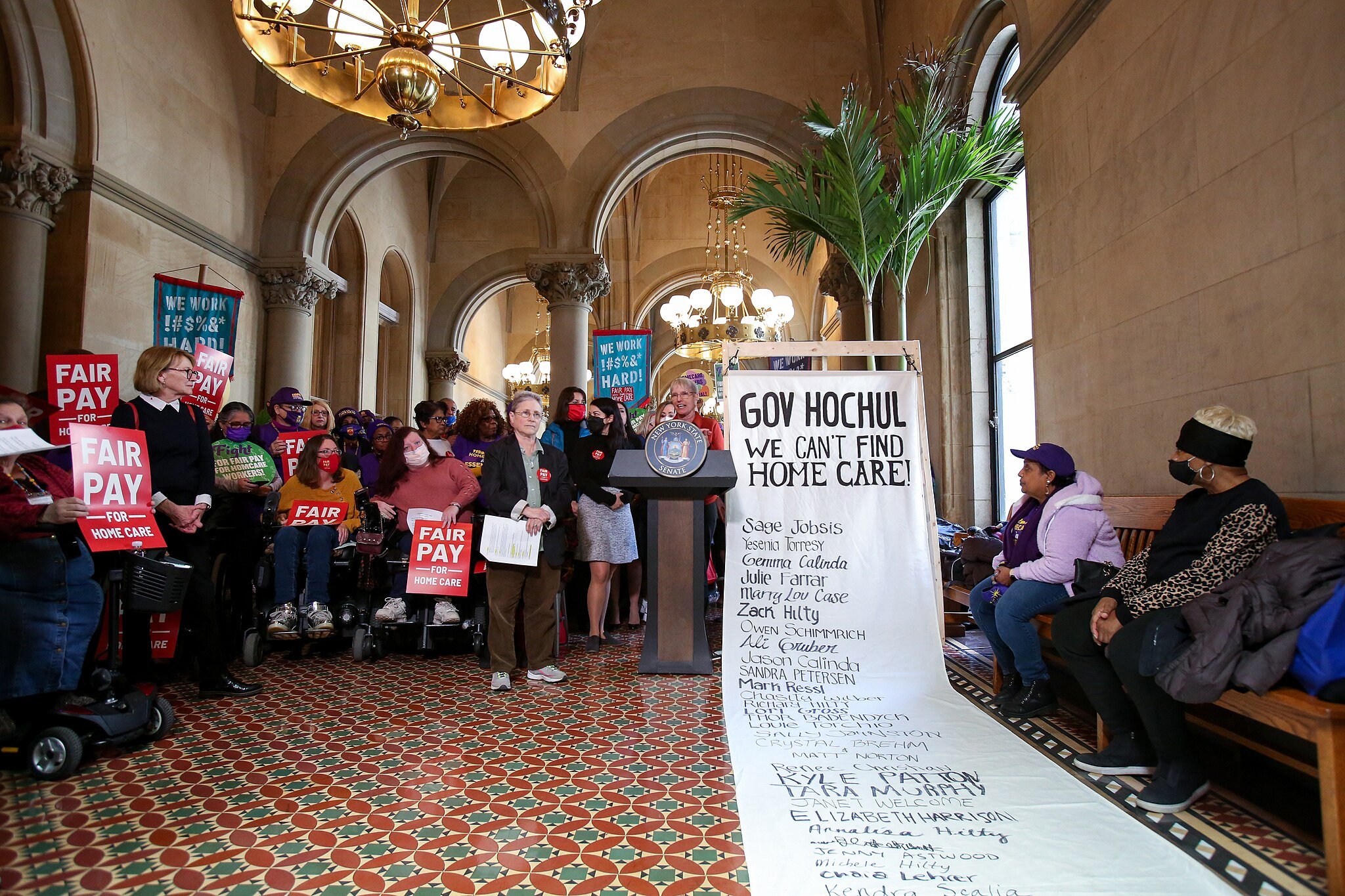
NYS Senator Rachel May speaks at a press conference for home health care workers in Albany in March 2022. (NY Senate Photo, CC BY 2.0, via Wikimedia Commons)
But during this transition, between October 2024 and October 2025, there has been a disastrous decline in the number of care workers available to CDPAP consumers. With that has come an equally disastrous reduction in the capacity for CDPAP consumers to secure enough staff to continue living independently. Christian’s struggles to sustain care workers is emblematic of this treacherous transitional moment:
“Through CDPAP I get 130 hours a week of care, but because of the PPL transition, it’s been very hard to keep staff. When I usually have anywhere from, I want to say like four to six care workers, you know, PPL staff, most of mine have stepped away because they couldn't navigate PPL’s system during the transitions. For others, PPL wasn't communicating effectively. And some of my former staff members weren't getting paid on time.”
Adding to the disruption of care services was the problem of recruiting new workers in the face of ongoing uncertainties with PPL. Again, Christian explained the complexities of this problem in relatable terms:
“I mean, it's a lot more stress to my situation trying to find new people to cover the losses of my former care workers. When you interview people, you have to tell them, like, hey, you know, the job is $18.60 per hour, but I can't guarantee you'll get paid on time, even though I'll do my best to advocate for you. How are you going to get anybody to work?”
It is important to note that, prior to PPL assuming control over the CDPAP, care workers could find employment in more than 600 care organizations participating in CDPAP. This dynamic created an internal labor market that allowed care workers to demand higher wages. CDPAP care workers sought companies that would pay them more for the services they provided, and consumers selected the care workers they wanted, using CDPAP funding to pay the cost of the preferred care work professional. Hourly wages ranged from $18-$30 per hour.
The transition to PPL effectively collapsed this labor market, preventing CDPAP workers from being able to choose among different organizations paying a range of wages. As of January 1, 2026, the Department of Labor requires all CDPAP workers to earn a flat rate of $18.65 per hour ($19.65 per hour for those in the NYC area), which is the New York State minimum wage for home health care aides.
Daylight savings?
The PPL transition has left CDPAP in dire straits. According to the New York Caring Majority, almost 25 percent of home care jobs remain unfilled; approximately 80,000 CDPAP consumers have been forced to find more expensive care options; and approximately 13,000 CDPAP consumers have lost their care funding altogether.
Nor has the problem of “fraud, waste, and abuse” been clearly addressed. In fact, PPL faces lawsuits in other states for withholding worker pay and for illegal negotiations for state contracts, respectively.
It’s perfectly reasonable that CDPAP consumers, local activists, and home care advocacy groups have organized a statewide Care Not Corruption campaign to fight against the PPL transition and to restore CDPAP to its former status. Christian, who is organizing the Buffalo Chapter of NY Caring Majority, believes that:
“Governor Hochul gave that $9 billion contract to a private equity company to pocket most of the money. They're not giving it to the workers. They're not helping the consumers. They're harming us by not paying our staff in a timely manner, by not communicating effectively, by not supporting what we need.”
When asked what everyday people can do to help, Christian said: “Reach out!! We have monthly orientations. And, on March 4th, we’re hosting an educational event on Zoom to explain the home care crisis and how our grassroots movement can stop it.”
I’ll be there. Will you? Registration is open at https://actionnetwork.org/events/care-not-corruption-campaign-western-ny-info-session-2/.

The NY Caring Majority is holding an info session on March 4.