Interweaving with John Collins: Thinking Critically About the Ceuta Story

On July 30, 2026, the Associated Press reported that tens of thousands of people had crossed “irregularly,” some on foot and some by water, into Ceuta, a Spanish territory between the northeastern edge of Morocco and the Mediterranean Sea, and that some had drowned in the effort to reach Ceuta. Many were young Moroccans, but others had previously entered Morocco from other parts of the African continent and beyond. Local authorities in Ceuta called on military reinforcements from Spain’s capital, Madrid, to help them address this crisis of migration. A recent Spanish supreme court decision had found that Spanish authorities could not immediately return to Morocco anyone arriving to Ceuta by water, and this may have helped drive the decision of many to swim to Ceuta on July 30. As of this writing, the number of fatalities on that day has reached at least 141.

The following day, Trump administration officials seized upon the Ceuta story as a propaganda opportunity, claiming that US citizens should expect a similar crisis if they vote for Democratic candidates in the upcoming midterm elections. For example, El Pais, a Spanish news outlet, reported that a White House deputy press secretary commented: “Spain and other countries who have adopted this destructive philosophy should immediately reverse course or risk their own demise…. President Trump has long warned Europe what would happen if they continue to implement far-left, globalist policies, including enabling mass migration.” President Trump also took to the stump, warning: “It’s terrible…Remember that picture. That’s going to be us in three years if the wrong side gets in...If the Democrats get in, you will not live a very good life.”
On August 5, Jesse Lent, host of Frontline Voices on WBAI Radio, interviewed Kenneth Roth, former Human Rights Watch executive director, and Dr. John Collins, founder of Weave News and Emeritus Professor of Global Studies at St. Lawrence University. During the interview, Dr. Collins pointed toward a powerful question which had seemingly been lost in much of the initial reporting and commentary on the Ceuta story: What do the migrants themselves have to say about their decision to make the hazardous trip to Ceuta in hopes of gaining entrance into Spain? Here is a clip from Frontline Voices:
In the rush to declare a border crisis in Ceuta, Spain, journalists around the world had focused almost exclusively on the politics of migration, in Spain, in Morocco, and even in the United States. A dubious silence continues to suppress the voice of migrants - and with the silence has come misunderstandings about the “circumstances of their lives,” which have so much to do with why they are moving en masse.
To understand the significance of speaking to the migrants themselves - that is, to understand “what people on the move themselves are saying” - I followed up with Dr. Collins. In the interview that follows, he discusses the importance of centering migrant voices, the limitations of existing political narratives surrounding migration, and the efforts of far-right forces in Spain to instrumentalize the Ceuta crisis.
SP: In a story that is seemingly about Spain’s border security, why is it so important to understand the “circumstances of [migrants’] lives”?
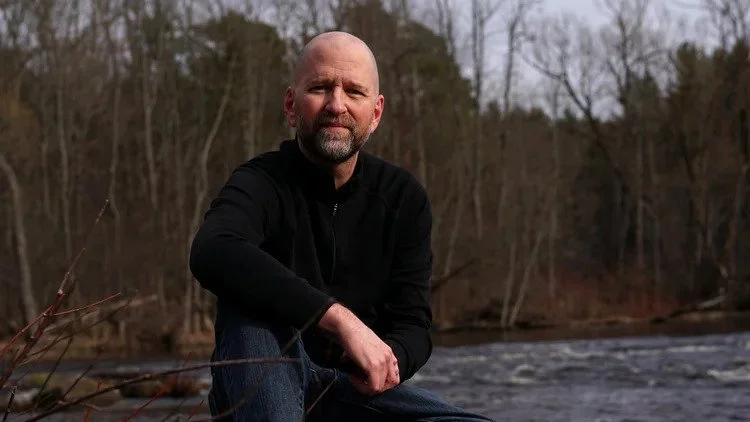
Dr. John Collins, the founder and editorial director of Weave News.
JC: When we make the effort to listen to the perspectives of people on the move, it forces us to step outside the frameworks that construct migration around terms like “security,” “threats,” “invasion,” “hybrid warfare,” and so forth. It forces us to ask: if those who are migrating are people just like us, why is their movement so restricted? Why do they find themselves in such precarious circumstances? Don’t they also have a right to feel secure?
All of this ultimately raises a series of very fundamental and uncomfortable questions for those of us who belong to the global privileged class. The entire hegemonic system that has dominated geopolitics throughout our lives has existed, in part, to facilitate a massive system of global apartheid - free movement for some, violent security regimes for others; social democracy and safety nets for some, undemocratic precarity for others; human rights for some, dispossession and genocide for others; and for those who control the system, endless opportunities for accumulation and profit.
One of the reasons that the so-called “migration crisis” is increasingly occupying the center of the political debate, however, is that the European project itself is in crisis. Responding to this crisis by only seeking to reinvigorate democracy within Europe is insufficient; what’s required is a reckoning with the long-term impact (down to the present) of how Europe plundered much of the rest of the world in order to build the very system it claims the right to “secure.” In this sense, the obsession with a migrant “invasion,” or even just the debate about how best to fortify borders, is a magician’s trick that distracts us from the fact that we are being “invaded” every day by the consequences of our own historical and contemporary actions.
To summarize, listening to the voices of the people who are at the center of global migration flows is necessary in order to get to the most urgent question: why do we allow this system of global apartheid to continue?
Why do you call on reporters to use caution when describing migration as the product of political actors embroiled in international conflicts?
This is a problem in a lot of news coverage, but it’s also a major problem in the world of news influencers and social media in general. The basic reason is that I think it’s dangerous and wrong to speak about people on the move as if they are completely passive.They’re not passive! They never are. Can they be influenced by propaganda or by social media messaging? Of course - they’re human. And some of the most recent reporting indicates that there were well organized social media campaigns encouraging people to make the crossing to Ceuta following the recent supreme court ruling in Spain.

View of Ceuta and the northern tip of Morocco. (Photo: Earth Science and Remote Sensing Unit, Lyndon B. Johnson Space Center, Public domain)
So we need to pay attention to what political actors may be trying to do in terms of provoking migration in particular moments. But there’s a reason why migration scholars for decades have been speaking about the importance of both “push” and “pull” factors in shaping migration decisions and patterns. Migration is an extremely complex social phenomenon. Sadly, the perspectives of people who have the most concrete and relevant information about the subject - the people who are migrating, and the scholars who study the phenomenon - are not featured in news coverage nearly as often as they should be.
The way we talk about migration often betrays deeper assumptions. I’ll give you an example. The other day I was speaking to someone I know here in Spain about the Ceuta story, and they told me that nothing happens in Morocco without the king wanting it to happen. They seemed to be suggesting that no further explanation was needed. Is it possible that the Moroccan government had an interest in making this particular migration wave happen? Of course it’s possible. But the idea that people in Morocco have no agency in the situation is just an excuse for reporters and news influencers to engage in lazy “analysis.”
The reality is that Morocco has its own set of complex social and political dynamics. Yes, there is a monarchy that wields a significant amount of centralized power. But there are also important social movements seeking to push back against government policies. There is widespread discontent with the lack of economic opportunities, especially for young people. There are social media influencers with huge numbers of followers. There are foreign governments that exert covert and overt influence. And ordinary people exist in the midst of all of these forces, making the best decisions they can make for themselves and their families.
In the interview, you mentioned the far right’s political project in Spain. How does the recent wave of migration from/through Morocco fit into this project?
The short answer is that the far right here has seized immediately on the Ceuta story to reinforce its broader anti-Muslim and anti-immigrant messaging. This ranges from ramping up calls for stricter policies on border control and the allocation of public services to openly racist calls for authorities to “hunt down the immigrants one by one.”
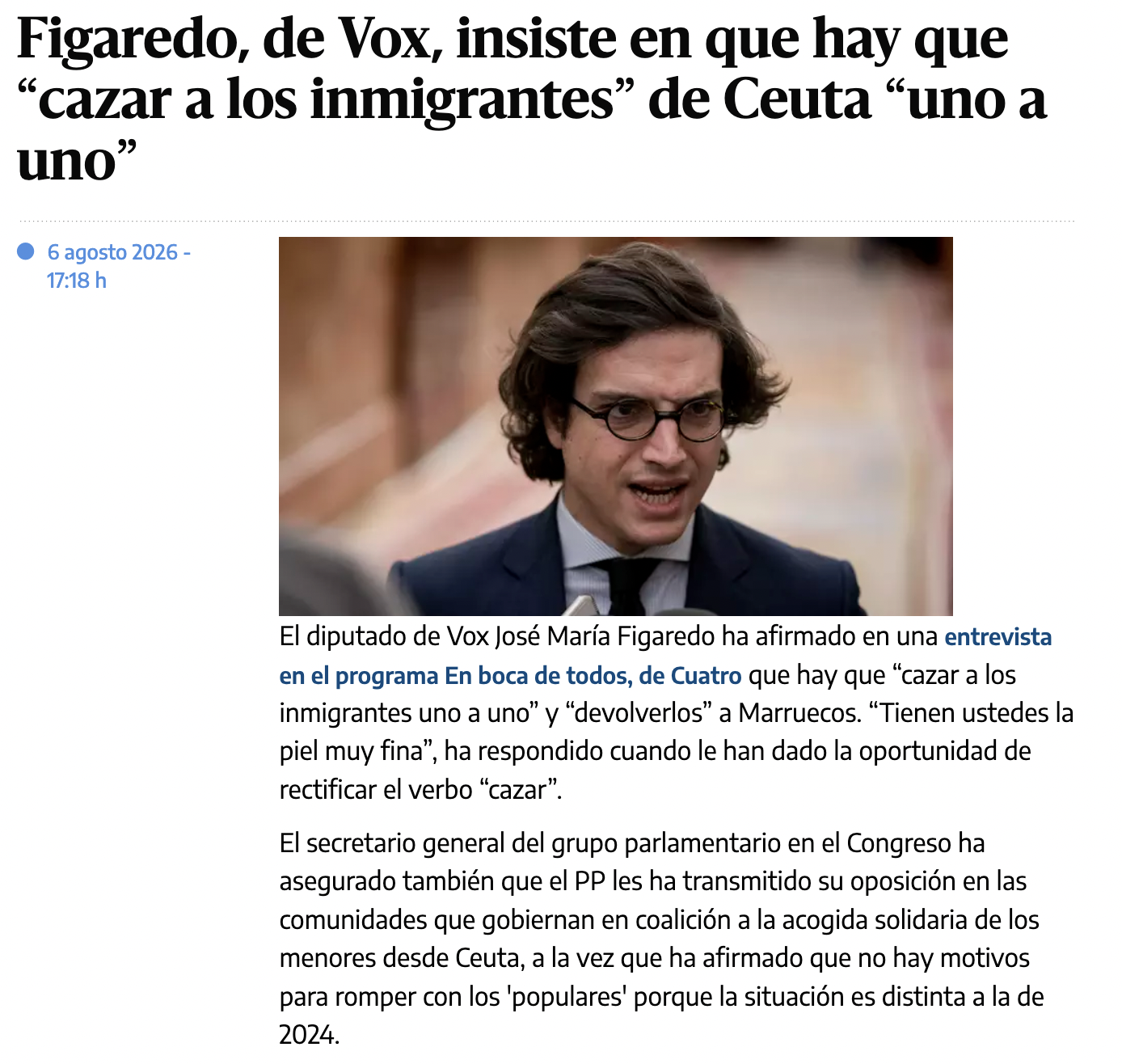
Spanish news outlets including El Diario have been covering the story of Vox parliamentary deputy José María Figaredo, who called for authorities to “hunt down” immigrants. The Spanish Ministry of Equality has called for an investigation into Figaredo’s remarks as a possible hate crime.
Explaining how we got here requires some context. Spain’s traditional conservative party, the Partido Popular (PP), represents the old social and ideological alliance that undergirded the country’s fascist dictatorship: big landowners, the Catholic Church, anti-communism, etc. They are happy to support democracy and European integration as long as their commitments to cultural conservatism, nationalism, and protecting the rights of private capital are not threatened. But they are now in danger of being outflanked on the right by Vox, a relatively new party that has been making steady electoral progress and is now part of governing coalitions with the PP in several of Spain’s autonomous communities. The PP and Vox don’t agree on everything all the time, but they are much closer than their frequent public spats would indicate.
It’s too early to say whether Vox’s project will devour the PP completely (as MAGA has done with the Republican Party in the US). But it’s important to note that Vox has been openly supported by Steve Bannon and other radical right ideologues who are seeking to break the existing democratic system in order to install a new right-wing hegemony across Europe. While the PP is not Bannonist per se, it is increasingly making concessions to Vox as part of its desperate effort to bring down the current Socialist-led government led by Pedro Sanchez. There is a lot at stake, both within and beyond Spain.
Vox has a core of supporters who are true believers in the sense that they are disillusioned with the existing political system and troubled by what they see as threats to traditional culture in Spain (which they define quite narrowly, often in extremely patriarchal and religious terms). But like MAGA, Vox has been able to expand that base through the systematic creation and circulation of disinformation and ragebait. This messaging seeks to channel popular discontent into anger at particular scapegoats: feminism, Islam, liberalism, multiculturalism, globalization. Islamophobia plays a particularly visceral role in Vox’s ideology, linking them with other European far-right parties who regularly speak of immigration as a Muslim “invasion” threatening traditional (Christian) values.
Most recently, Vox’s political messaging has crystallized around the idea of what they call prioridad nacional (national priority): giving native-born Spaniards priority when it comes to accessing housing, employment, and social services. Such proposals ignore the fact that immigration has been a boon to Spain’s economy in recent years. Moreover, they ignore that the largest factor contributing to problems in the capacity of the public health system and affordability in the housing sector is the empowering of private investors. In this sense, Vox’s demagoguery, especially in tandem with the PP’s slightly more “respectable” discourse, is really about leveraging people’s anxieties about geopolitical and cultural change in order to pry open the doors of privatization.
Which independent media outlets in Spain are uncovering the stories of migrants? How do those migrants’ stories help us to understand the circumstances of their lives which may have motivated them to leave their homes and seek new opportunities in Spain?
Spain has a vibrant independent media sector as well as a public broadcaster (RTVE) that provides a solid menu of public-interest reporting. While it’s still true that much of their coverage takes the form of political commentary and analysis, there have also been efforts to get closer to the human reality of the Ceuta story. Soraya Aybar Laafou, writing for the independent outlet El Diario, has published several pieces exploring the stories of young Moroccans sent back home after reaching Ceuta, the complex factors shaping migration decisions for a “generation without clear horizons,” and the tragic story of Faten, a young Moroccan woman who played for the football club Maghreb Atlético Tetuán and who drowned while trying to reach Ceuta on July 30.
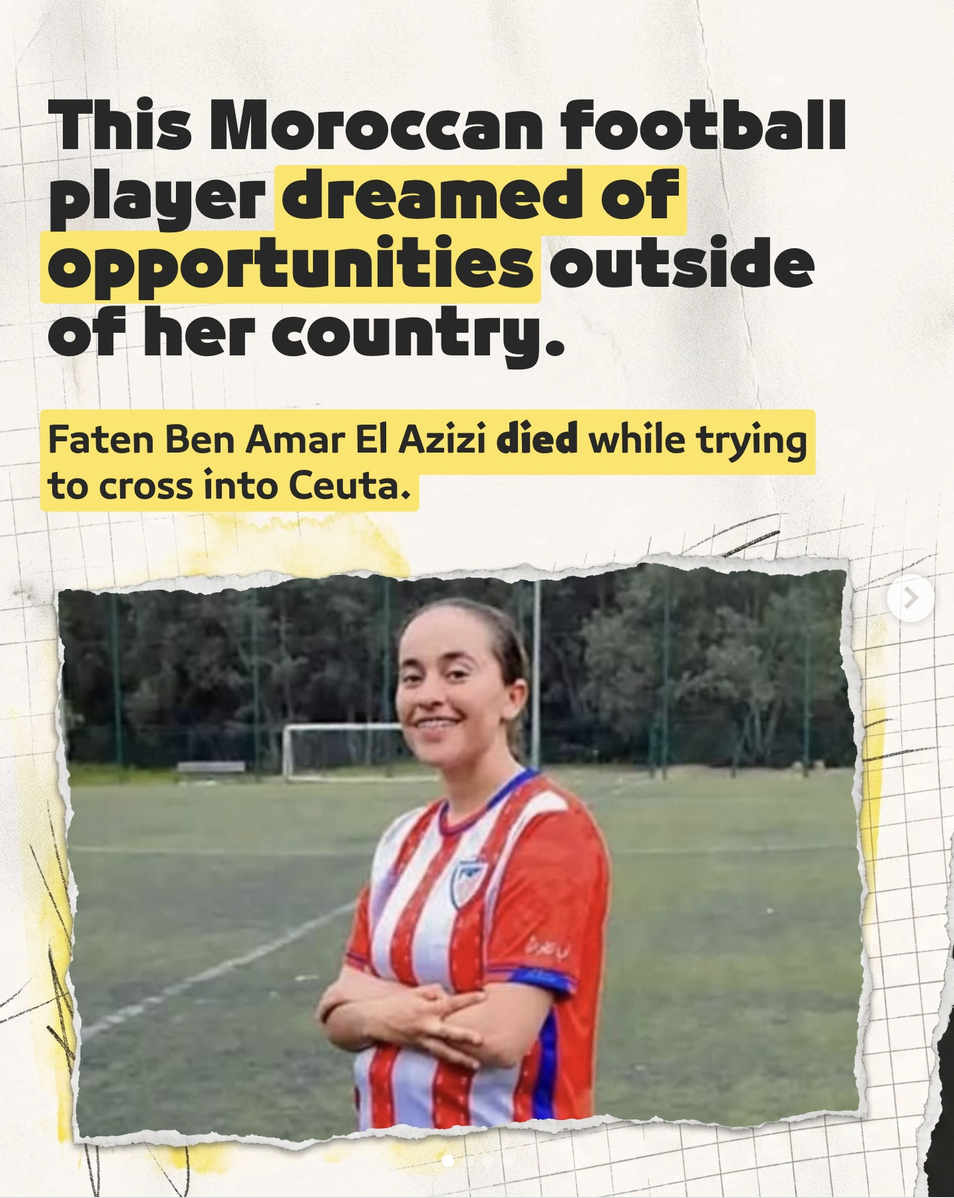
Faten Ben Amar El Azizi, one of the people who died trying to reach Ceuta, was featured in an Instagram post from AJ+.
El Salto is another independent outlet that is always worth consulting. One of their journalists, Sarah Babiker, has been digging into the Ceuta story with on-the-ground reporting that centers the voices of people in the community who are working directly with asylum seekers and other migrants from Morocco as well as other countries including Sudan, Palestine, Yemen, Syria, and Mali.
Having said this, there is still a need for much more reporting on the stories of individual migrants and how those stories connect with broader stories of war, climate crisis, extractivism, and other “push” factors that drive migration.