
Global Indigenous Peoples News Bulletin #13 (February 2026)

This bulletin devoted to Global Indigenous Peoples News, part of the Glocal Exchange project of Weave News, seeks to highlight some of the current issues from Indigenous communities in different parts of the world. The focus of the bulletin is aligned with the overall purpose of the Glocal Exchange project, which examines globalization through its impact from the perspective of local communities. It also supports the Weave News mission to “investigate and report about contemporary issues that are either underreported by establishment and other corporate media or reported in a way that excludes essential context, perspectives, and voices.” These are “issues that have a strong justice component and that reveal connections across communities, borders, struggles, and experiences.”
Indigenous communities under threat
Two major institutional shifts in Brazil threaten to redefine how large-scale projects develop in the Amazon, while drastically weakening the socio-environmental safeguards meant to protect forests and peoples.
First, Brazil’s Congress voted to pass a new law widely known as the “Devastation Law” by overriding President Lula’s veto of the law, which was strongly backed by agribusiness. “The new law shifts oversight of environmental licensing from the federal government to the states,” write Ana Carolina Alfinito and Daleth Oliveira for Amazon Watch, “strips authority from federal bodies such as the National Environmental Council, and weakens consultation with Indigenous peoples and affected Quilombola (Afro-descendant) communities.”
Brazil’s Supreme Court (STF) also recently resumed its debate over Indigenous territorial rights. Although a recent ruling restated that the specious “time-limit” (Marco Temporal) thesis is unconstitutional, it also weakened the constitutional framework that has protected Indigenous rights and allowed for the demarcation of traditional territories since 1988.
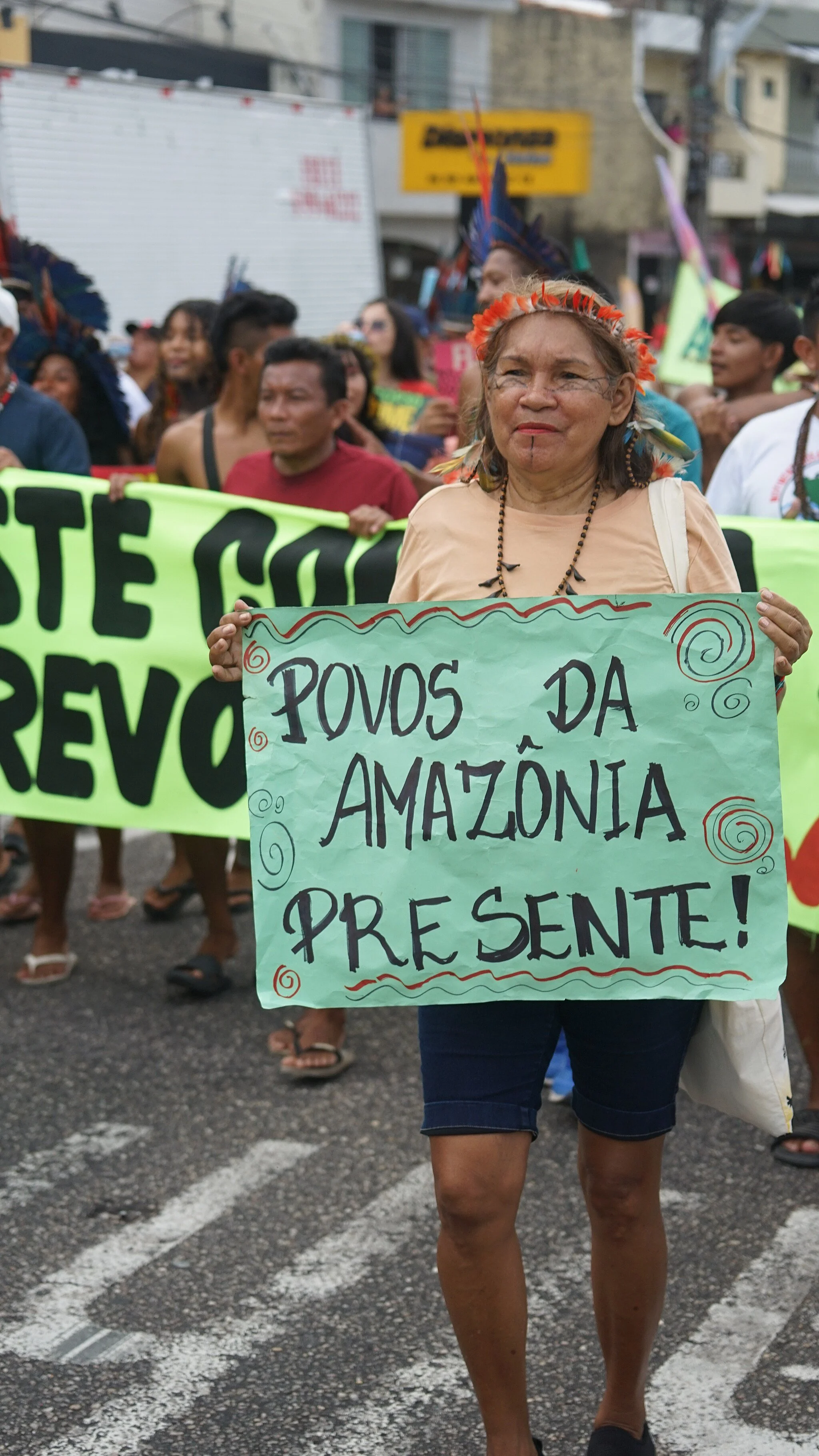
Protests in Belem near the COP30 venue, November 15, 2025. (Photo: Xuthoria, CC BY-SA 4.0, via Wikimedia Commons)
Meanwhile, Arpan Rachman reports that following the COP30 climate summit in Brazil, climate projects in Indonesia continue to threaten Indigenous communities who have to confront land seizures, criminalization, and increased violence. Secretary-general Rukka Sombolinggi of The Indigenous Peoples Alliance of the Archipelago (AMAN)—which represents Indigenous communities across Indonesia—summarized the situation:
“At COP30, countries rarely discussed the rights of Indigenous peoples. Most progress for these groups took place outside the main talks. One major step was when 11 countries agreed to recognize global tenure rights, signing an agreement that covers land-use rights for 160 million hectares. The Indonesian government has promised to restore 1.4 million hectares of customary forests, but this commitment needs more attention since there has been no official progress in recognizing these forests after COP30.”
In more encouraging news, “Colombia has formalized 521,492 hectares of land for Indigenous communities in the Amazon region, granting legal security to 12,792 families from 11 Indigenous peoples across five departments (Amazonas, Putumayo, Caquetá, Guaviare and Vaupés).” According to a report from ColombiaOne, “The measure aims to strengthen territorial governance in an ecosystem that is central to Colombia’s climate and biodiversity agenda.” This formalization also strengthens a governance model that treats Indigenous authorities as long-term custodians of standing forest.
Wetlands and Indigenous knowledge
The official theme for the 2026 World Wetlands Day — “Wetlands and Traditional Knowledge: Celebrating Cultural Heritage”— highlights how Indigenous peoples and local communities “have stewarded wetlands for centuries using deep-rooted systems of observation, practice and respect for nature. The campaign emphasizes that such knowledge complements modern science in conserving these ecosystems amid a vast array of intensifying threats.”
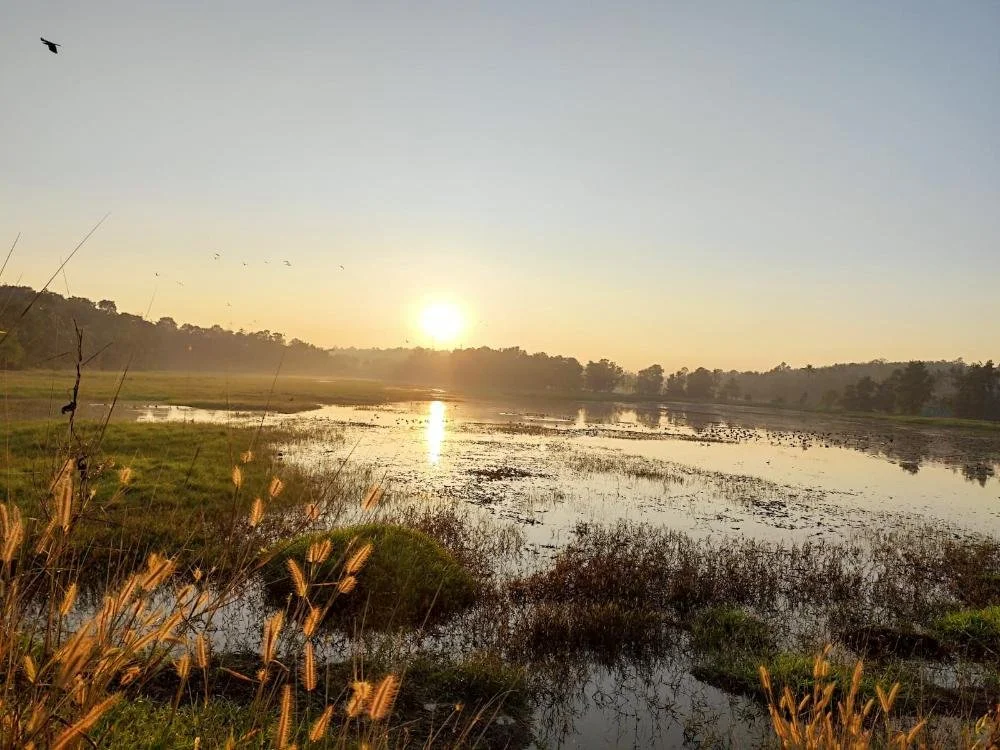
Polachira, Kollam, India. (Photo: World Wetlands Day)
Celebrated on February 2, the UN World Wetlands Day raises awareness about the rich landscapes, where freshwater, saltwater or brackish water covers soil either permanently or seasonally.
Coming up short on climate
At the same time, a new US government report finds that federal agencies are unprepared to expand shared stewardship with tribes as climate pressures intensify and that they are falling short of their legal responsibilities to tribal nations. “The report highlights the role tribes play in land and water stewardship, noting their effectiveness in managing natural and cultural resources and restoring habitat,” writes Miacel Spotted Elk, an Indigenous Affairs Reporting Fellow at Grist. “Through treaties, tribes have also been able to apply traditional approaches to land and water management.”
More generally, an analysis at the International Work Group for Indigenous Affairs (IWGIA) has found that governments are “still far from aligning their climate policy with their human rights obligations.” Authors Rosario Carmona, Graeme Reed, Stefan Thorsell, Rocío Yon also emphasize that governments “are also far from harnessing the knowledge, governance systems and leadership that Indigenous Peoples bring to climate solutions.”
More from the COP30 summit
Returning to the COP30, the UN’s Department of Political and Peacebuilding Affairs (DPPA) notes that the international summit spotlighted the connection between Indigenous women’s leadership, climate action and peace. Around 476 million Indigenous Peoples in 90 countries live on the frontlines of conflict (as 80 percent of armed conflicts globally are in biodiversity-rich hotspots), and Indigenous women in particular “bear the brunt of these overlapping crises, even as they lead the way in advancing climate and peace initiatives.”
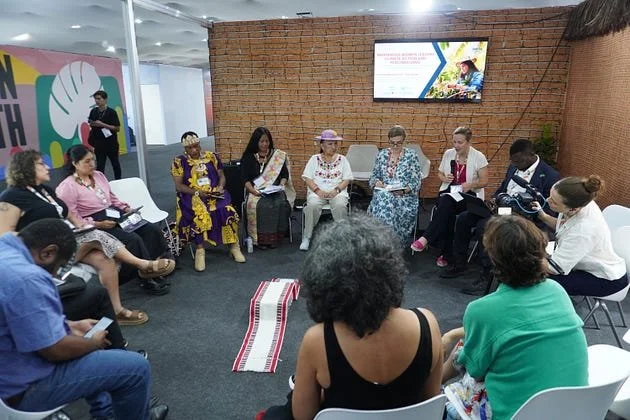
Participants at a COP30 side event focused on Indigenous women’s leadership in climate action and peacebuilding. 19 November 2025. (Photo: UN Women/Rodrigo Herrera)
According to the DPPA, the need highlighted at COP30 was “to recognize and support Indigenous women’s leadership in climate action, peace-building and environmental protection by reflecting their knowledge in global frameworks; to ensure their meaningful participation in climate and peace decision-making; to strengthen Indigenous-led platforms; and to increase funding for gender-responsive, Indigenous-led climate and peace initiatives.”
Also at the COP30, Indigenous leaders came with a message: five percent of the global population is safeguarding 80 percent of Earth’s biodiversity, and concerted action is needed to make sure that there is follow-through on a $1.8B pledge made to support their land rights.
