What’s Left in Spain: Responses to Rufián Reveal Old Divisions and New Opportunities

Photo: Nick Fewings/Unsplash.
The recent public event in Madrid hosted by Gabriel Rufián of Esquerra Republicana de Catalunya (ERC, the Republican Left of Catalonia) and Emilio Delgado of Más Madrid has added fuel to the ongoing debate in Spain about the present and future of the Left. Is Rufián right when he argues for the creation of what would essentially be a new “Popular Front” working to keep the far right out of power? Is it feasible to build such an alliance? If so, what would hold it together, and what could potentially pull it apart?
Many prominent figures on the Left have been offering their own analyses of Rufián’s “gamble” (as it is widely being characterized here in Spain), the potential limitations of the political program he is seeking to build, and the strategic challenges facing the Left at a time when the far-right Vox party is surging and the country’s trend toward neoliberal privatization is intensifying.

What’s Left in Spain: Madrid Event Brings Rufián’s Gamble Into Focus
Weave News also reported on the February 18 event organized by Gabriel Rufián and Emilio Delgado.
A review of some of these responses can help us understand why the work of building Left coalitions in Spain is so fraught even as the need for bridge-building seems more urgent than ever. Each of these responses represents a distinct position with its own history, ideological terrain, and political agenda. Maintaining a productive dialogue among these positions will be essential if the Left is to achieve both greater unity and greater impact in Spain.
Contrasting responses
One of the most strident responses to Rufián came from Anticapitalistas, a revolutionary organization grounded in Marxist, eco-socialist, and feminist commitments. In a February 16 Facebook post, the group sharply dismissed Rufián’s proposal, writing: “same faces and same acronyms for the same strategy: governing with the PSOE.”
For context, the PSOE, headed by President Pedro Sánchez, is the Socialist party that is currently leading Spain’s ruling coalition. While no party in Spain enjoys anything approaching majority support, data from the country’s major polling organization shows that the PSOE is easily the leading party, maintaining a nearly ten-point lead over the conservative Partido Popular (PP). When potential coalitions are taken into account, however, the margins are much closer.
The position articulated by Anticapitalistas and echoed by other groups belonging to what might be called the revolutionary Left is a position that singles out liberalism (in this case, the PSOE) for special scorn. This dynamic is familiar to anyone who follows progressive and Left politics in the US, where many leftist organizers and commentators often seem more offended by the Democratic Party than by the MAGA movement.
One might argue that groups such as Anticapitalistas are themselves also guilty of recycling the “same” old arguments. At times, their boilerplate responses come across as so much Left gatekeeping - endless attempts to stake out a position that is somehow always further to the left of anyone who stands for elected office. One wonders whether there is any party operating within the country’s formal political system that would be acceptable to such critics.
Anticapitalistas and other similar groups would undoubtedly argue, with plenty of evidence to support them, that what really matters is the central importance of grassroots mobilization in forcing politicians to hear the people’s demands. Writing in El Salto, Rubén Burgos and Nicolás Monterde insist that only a “unified struggle” combining street mobilization with efforts within formal institutions is “capable of standing up to the PSOE to prevent more broken promises.”
For his part, Rufián has been fairly open about his willingness to participate in a governing coalition with the PSOE, an arrangement he views as preferable to allowing Vox to govern with the PP. Some on the Left have made the case that by putting the focus on the threat of Vox, he is choosing to let Vox define the terms of debate. Such a choice, they argue, comes at a cost: the refusal to confront the tacit PSOE-PP alliance that enables private capital to take a wrecking ball to Spain’s public health and education systems.
Two mayors - and a new politics?
Ada Colau, former mayor of Barcelona and a key figure in the left-wing Catalan party Barcelona en Comú (Barcelona in Common), has offered a more supportive reading of Rufián’s intervention. In line with Rufián’s warning about the rise of Vox, Colau argues in an op-ed for El Diario that if the likes of Abascal and Isabel Diaz Ayuso (right-wing president of the Community of Madrid) ascend to power at the national level, “we could have ICE officers on the streets of our towns and cities, like in Minneapolis, harassing people simply for being migrants, feminists, or LGBTQ+. Or we could return to 12-hour workdays and dismissal without severance pay, as Milei just approved in Argentina.”
In the face of such threats, Colau, who participated in the 2025 Gaza Sumud Flotilla, insists that the Left’s clear priorities actually speak to what most Spaniards actually want and need. “We need to remember that we are the social majority,” she argues, “and that we’re capable of doing incredible things when we join together.” She seeks to shift the debate from the question of the Left’s future to the question of how best to secure “the future of the people’s well-being.”
Ada Colau shared with her Instagram followers an update on the Gaza Sumud Flotilla.
Colau’s framing of Left politics in Spain echoes the kind of message that helped Zohran Mamdani become the mayor of New York City. It is a message that tries to leave behind dogmatic legacies and rivalries in favor of a politics of care and compassion. Both figures offer a tacit response to Left critics who insist that the “same old” formal political system can only produce betrayal.
Fascism and digital power
Even as questions of economic justice remain central in Left debates in Spain, other voices on the Left warn that the Right has been remarkably successful at deflecting public attention away from such questions. “Fascism has inserted itself among us because it has waged a cultural battle that the Left has underestimated,” pop-rock songwriter Nacho Vegas recently told an interviewer in La Marea. “We have to reclaim it from the ground up.”
At the Madrid event, Rufián acknowledged that in Spain today, being facha (slang for “fascist”) is now “in fashion.” He sarcastically noted that political parties will spend huge amounts of money hiring expert consultants to provide what should be an obvious answer to the question of why young people, especially young men, are gravitating toward the far right. The answer, he insisted, lies in the financial resources that the Right has poured into the machinery and platforms of what he called “the most powerful form of power there is today” - digital power.
An anti-immigrant message shared by Vox on its Instagram feed, where the party has more than one million followers.
The result of these investments in “digital power,” he said, is that fascist and other right-wing messaging is ubiquitous and never far from people’s everyday consciousness - and their screens. Referencing the work of the Italian Marxist thinker Antonio Gramsci, who wrote extensively on the importance of cultural power in revolutionary and counter-revolutionary struggles, Rufián suggested that the cultural face of fascism works hand in glove with the daily realities of workers. After coming home at the end of a 12-hour workday, he admitted, why would anyone want to crack open Gramsci’s Prison Notebooks when social media feeds and nighttime shows featuring cynical, often right-wing perspectives offer a few laughs and an easy escape?
Echoes of the indignados?
At the Madrid event, Delgado highlighted in various ways the need for the Left to meet people where they are, respecting the diversity of their identities and the specificity of their experiences. Echoing a piece of self-criticism that has been widely heard in the US over the past decade of Trump/MAGA ascendancy, he suggested that talking down to people - or insisting they must be as ideologically pure as many progressives or leftists imagine themselves to be - is a political dead end.
In this light, one additional response to Rufián’s “gamble” deserves a mention. In a February 19 blog post, Spanish Revolution praised the Madrid event as a principled call to action grounded in the inclusive belief that all elements of the Left can and must be part of the struggle to stop Vox. It lauded Delgado in particular for articulating a message that was undeniably “uncomfortable” for those members of the “institutional left” whose approach has allowed the Right to occupy cultural and ideological space.
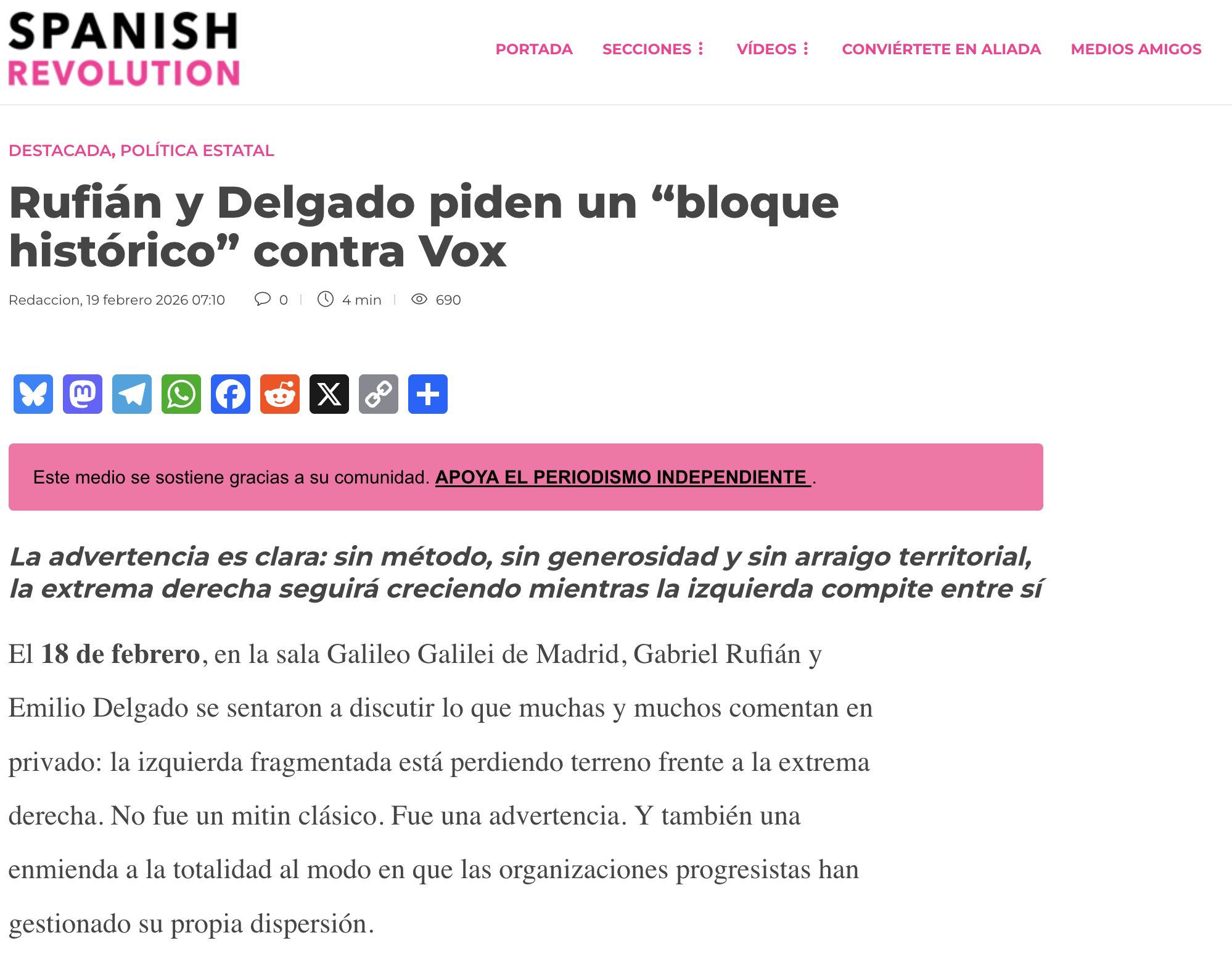
Blog post by Spanish Revolution on February 19, 2026.
This response is significant coming from a group that emerged from Spain’s famous 2011 mass anti-austerity mobilizations, known as 15-M or the indignados movement. Those mobilizations briefly forged a new kind of political bloc: one that included many Spaniards who might not have previously thought of themselves as part of “the Left” at all. By celebrating the importance of the conversation that Rufián has helped to open, the SR blog post serves as a reminder that the horizontal, radically democratic spirit of 15-M remains embedded, if latently so, in Spanish society.
The search for common ground
These are just a few of the key voices and perspectives that form part of what is a lively and ongoing dialogue on the Left about Rufián’s initiative. The stakes are high, whether one frames those stakes in terms of the possibilities for advancing anti-capitalism, defending the welfare state, or fighting fascism.
My take? The critiques coming from those who claim space to the left of Rufián are familiar, sometimes annoyingly so, and they are always going to be there. They also have considerable validity given the sheer speed and recklessness with which the Right (sometimes aided by the PSOE, sometimes not) is carrying out its assault on the very idea of the public good and on the structures and systems that exist to protect and promote the well-being of the people.
At the same time, the idea that one must choose between fighting Vox and fighting neoliberal capitalism strikes me as a false choice, and a politically disastrous one at that. Surely there must be a way to build upon shared opposition to a party that is not only deeply racist, misogynist, and anti-democratic, but also deeply committed to the right-wing project of empowering the ultra-rich and punishing the vulnerable through rampant privatization. Is Vox the sole force behind these trends? Of course not. But winning coalitions are built on tactical choices, and Rufián’s intervention represents a call to tactical intelligence.
Here it is also useful to note that Left fragmentation and infighting undermine the task of fighting back against the Right’s digital power. Given the political economy of the tech and media industries, this fight is an uphill battle. It will become an impossible battle if the Left is unable to construct something like a consistent set of messages and use them to cut through the noise of right-wing disinformation.
Who cares?
Given the urgency of these overlapping challenges, the distinctive political wisdom of current and former mayors like Ada Colau and Zohran Mamdani may prove to be decisive. While much has been made of Mamdani’s ability to center the issue of affordability during his successful campaign, for example, less has been made (so far) of the fact that his entire model of politics is arguably grounded in the politics of care.
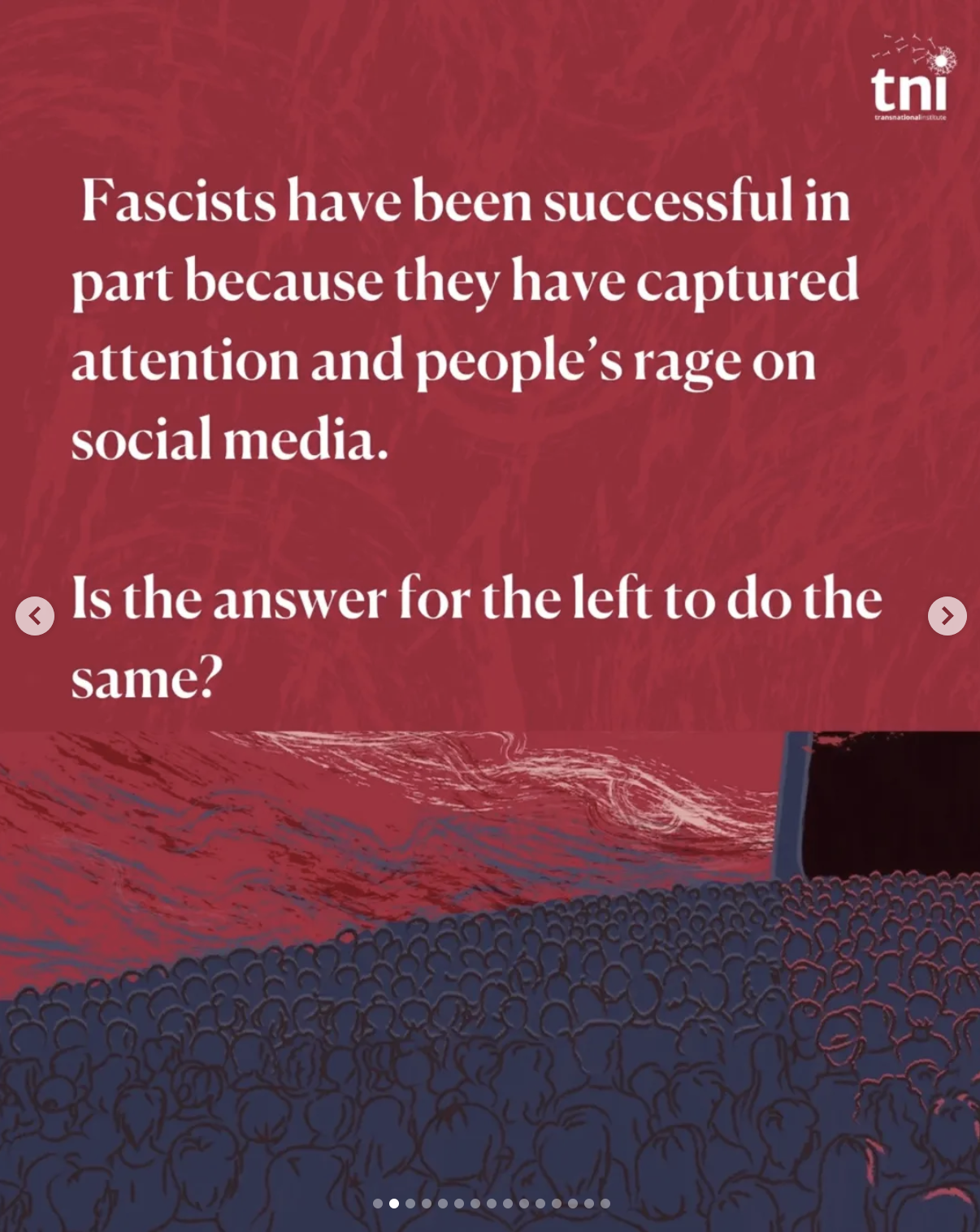
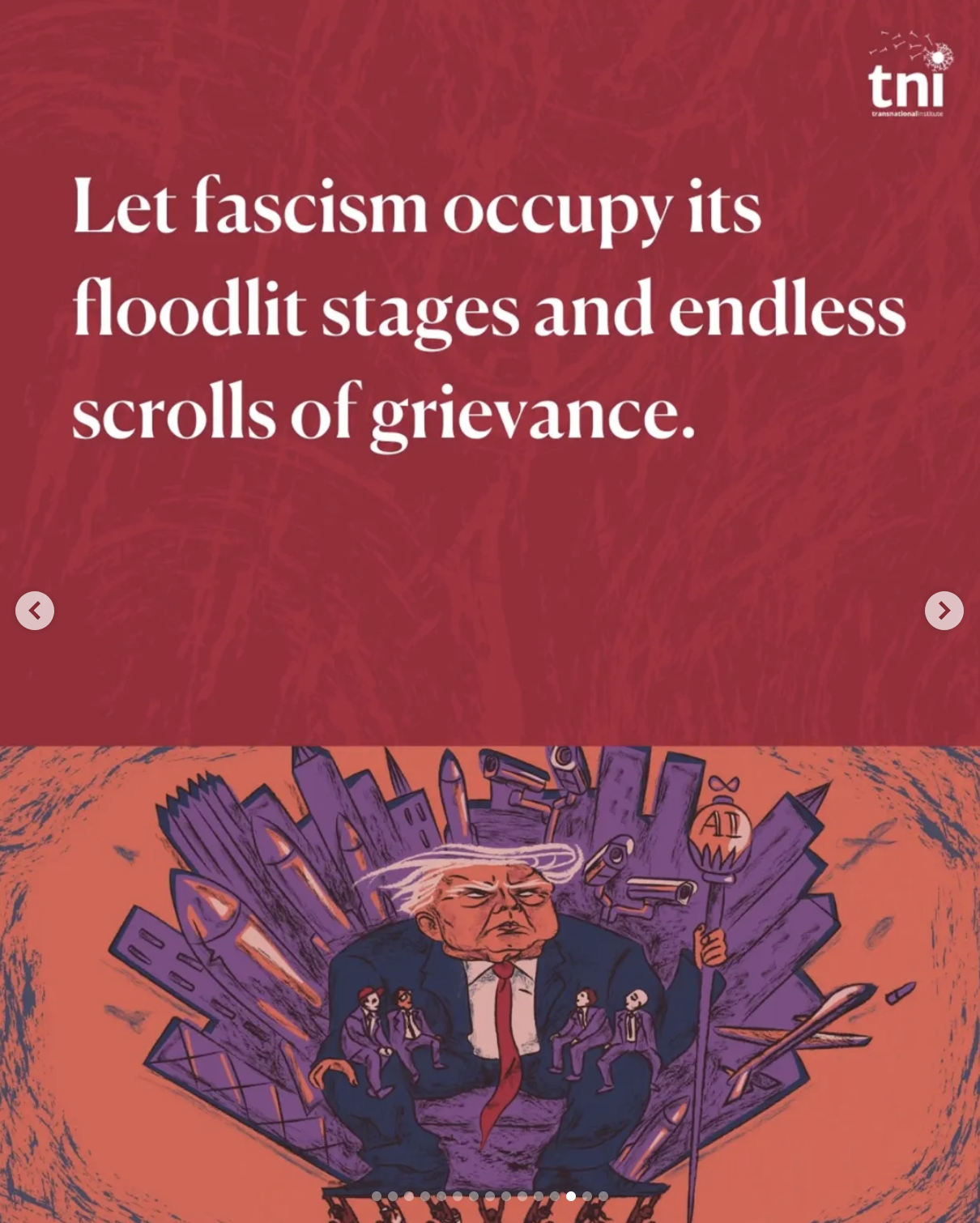
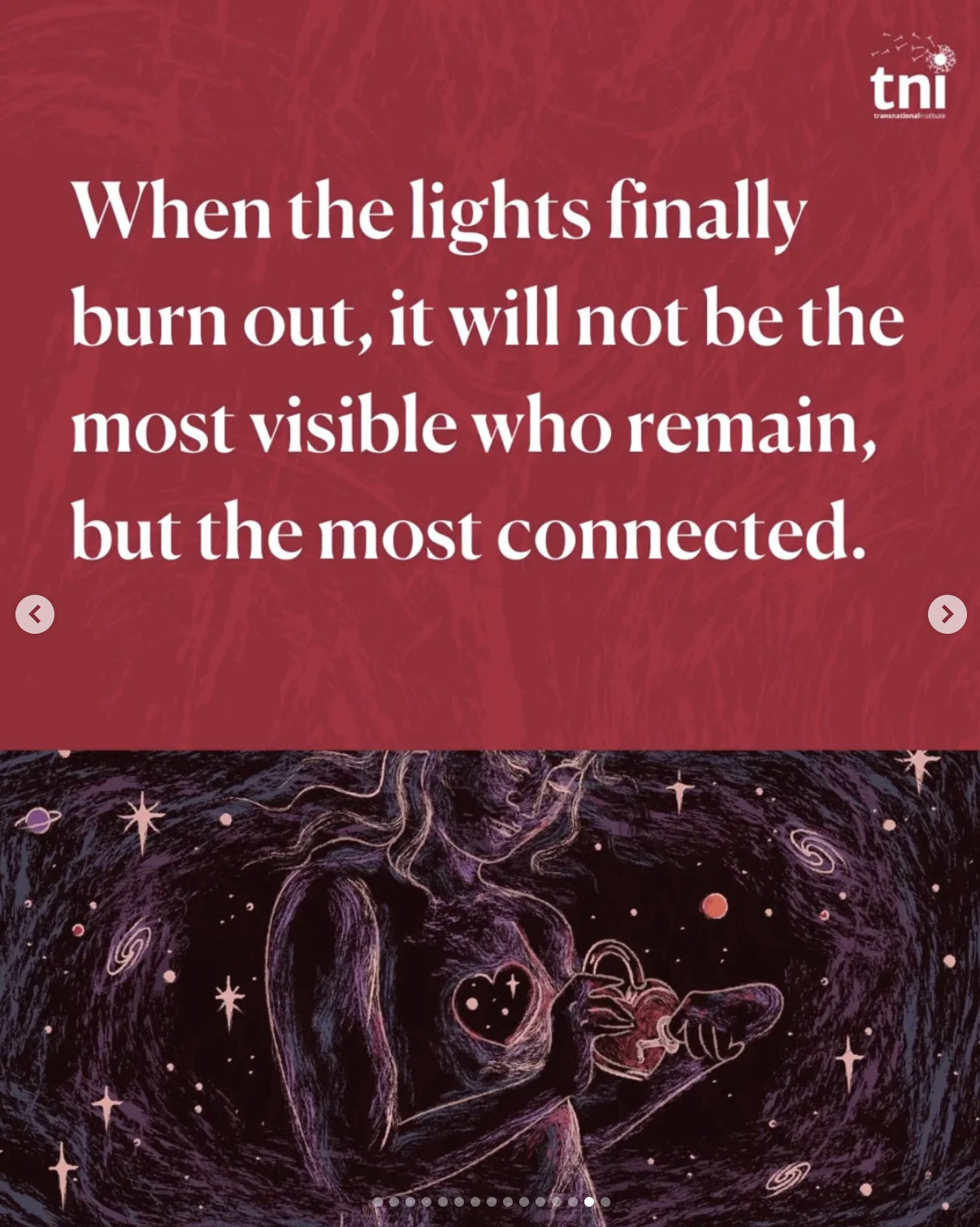
Slides from a recent post by the Transnational Institute (TNI) summarizing an article by the Kenyan writer Ylkye.
Affordability and care are obviously connected; some might even insist that the two are essentially synonymous when social design and policy reach the ground. At the same time, the distinction between them matters because while the far right is capable of making at least clumsy gestures toward affordability, it is almost existentially unable to care. Indeed, many in the MAGA movement and in the boardrooms of their tech overlord allies proudly insist that theirs is a fight to banish empathy from the “Western civilization” they seek to defend.
There is a reason that some analysts have defined the fundamental lack of empathy as a core element of fascism.
In our current moment, this technofascist assault on empathy dovetails with misogynist movements aiming to promote narrow, cold, and militaristic concepts of masculinity. And as the world continues to process the horrors of the Epstein files and the impunity-fueled, vicious misogyny they reveal, it becomes clearer each day that the existing system is the antithesis of care and community.
This is why voices such as Colau’s and Mamdani’s are so vital right now. Their politics of care is accompanied by a rhetorical style that is both calm and uplifting in a way that contrasts with others on the Left who seem unable to avoid relying on, and feeding into, the politics of rage that constitutes the most toxic element of digital power’s entire business model.
A moment of opportunity
Finally, it is worth returning to the memory of the 15-M movement and what it means in 2026 for a Left that is looking for a new path forward. Can the spirit of that movement be re-activated in Spain as part of a transnational struggle against the far right?
However fleeting it was, the indignados movement was a rare moment when “the people” - that category that the Left loves to invoke - actually became visible as a body. As Spaniards gathered to occupy plazas small and large, the movement took a shape that embodied a kind of politics of care. It was as if people were saying, “the rich and powerful have abandoned us, so we have to look out for one another - we are all we have.”
Of course, the moment passed, and the Left was ultimately unable to leverage that moment into a successful program for meaningful change. But the fact that the world has moved on - for better or worse, today’s conjuncture is not 2011’s - constitutes an opportunity for the Left to try again, and to do better.