What’s Left in Spain: Madrid Event Brings Rufián’s Gamble Into Focus

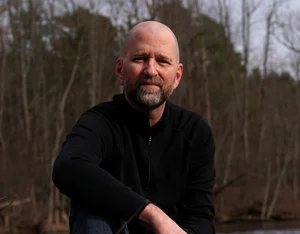
Emilio Delgado of Más Madrid (left), journalist/moderator Sarah Santaolalla (center), and Gabriel Rufián of the ERC (right) at the February 18 event in Madrid. (Photo: InfoLibre)
“This is hope.” With those words, journalist Sarah Santaolalla opened a highly anticipated public dialogue held in Madrid, Spain, on February 18. The gathering, billed as “Contest the Present to Win the Future,” was spurred by Esquerra Republicana de Catalunya (ERC, the Republican Left of Catalonia) politician Gabriel Rufián’s recent call for unity among Spain’s many leftist parties (generally considered to be those located to the left of the ruling Socialist party, the PSOE). Rufián and Santaolalla were joined on stage by Emilio Delgado of the Más Madrid party.
Tickets for the event, held at Madrid’s famous Galileo Galilei music and comedy venue, had sold out within minutes. Those who were able to attend heard a spirited discussion of how the Left can both learn from its own past mistakes and, more importantly, use this knowledge to build a winning strategy in the ongoing struggle against the surging Vox party and the far-right movement in which it is embedded. (Video of the full event is available here, courtesy of El Diario.)
There were at least four central points of emphasis that emerged from the discussion.
“Science, method, order”
In the European context, the event came at a complex moment that includes the recent national elections in neighboring Portugal, where the Social Democratic Party (PSD) won a resounding victory and succeeded in keeping the far right out of power. It also, however, took place as many observers are predicting the possible victory of the far-right National Rally when French voters go to the polls in 2027 for presidential elections.
Rufián said there is ample reason to worry that Spain’s next national elections in 2027 will yield a right-wing coalition featuring not only the conservative Popular Party (PP), but also Vox. In one of the most quoted moments of the night, he directly addressed the nature of this threat, referencing the words of Vox leader Santiago Abascal:
“I’m afraid! Maybe that’s because I’m very aware of what’s coming. Very aware. And what’s coming isn’t the usual political back-and-forth between Left and Right, which can be healthy. No! What’s coming is savage: cheap imitators of [Argentine President Javier] Milei, or [US President Donald] Trump. Abascal says so, and clearly: “We will do the same thing as in the US and Argentina.” Which is suffering.”
Rufián’s characterization of Vox as a uniquely dangerous threat in Spain led directly to a second point of emphasis: the need for a strategic approach grounded in what he called “science, method, and order.” Specifically, he argued that leftist parties, rather than competing among themselves for relatively small electoral spoils, need to work together to decide which candidates to run in each local and regional jurisdiction. The goal, he said, should be to “win seats away from Vox” in every town, city, and province.
“How does it make sense for 14 parties representing more or less the same thing to all stand for election in the same space?” he asked. “I have absolutely no desire for Abascal to be Minister of the Interior.”





Some of the many leftist parties in Spain.
It is too early to tell whether the country’s main leftist parties will be open to the idea of changing the way they approach electoral politics in Spain’s often byzantine parliamentary system. Nonetheless, both Rufián and Delgado agreed on the absolute necessity of meeting the demands of the moment. “We need to build a historical bloc worthy of what lies ahead,” affirmed Delgado.
A common political program
Perhaps as a way to postpone thorny discussions about how to decide which parties will represent a hypothetical Left coalition in which elections, Delgado continued by foregrounding a third point: the need to promote “mobilization at all levels” and to open spaces for dialogue not dominated by political parties. The goal, he insisted, is for the people to feel “part of the solution” and to recognize that they have a “historic mission” in the fight against the far right.
For his part, Rufián also emphasized the critical importance of building a political program that prioritizes issues on which most Left parties generally agree while still allowing different parties to maintain their commitments on other issues.
At the top of his list was the issue that is widely recognized as the greatest concern facing working class and middle class Spaniards: affordable housing. Spain’s public broadcaster RTVE reports that the price of housing rose 13.1 percent in 2025 alone, reaching an all-time high of 2,230 Euros per square meter.
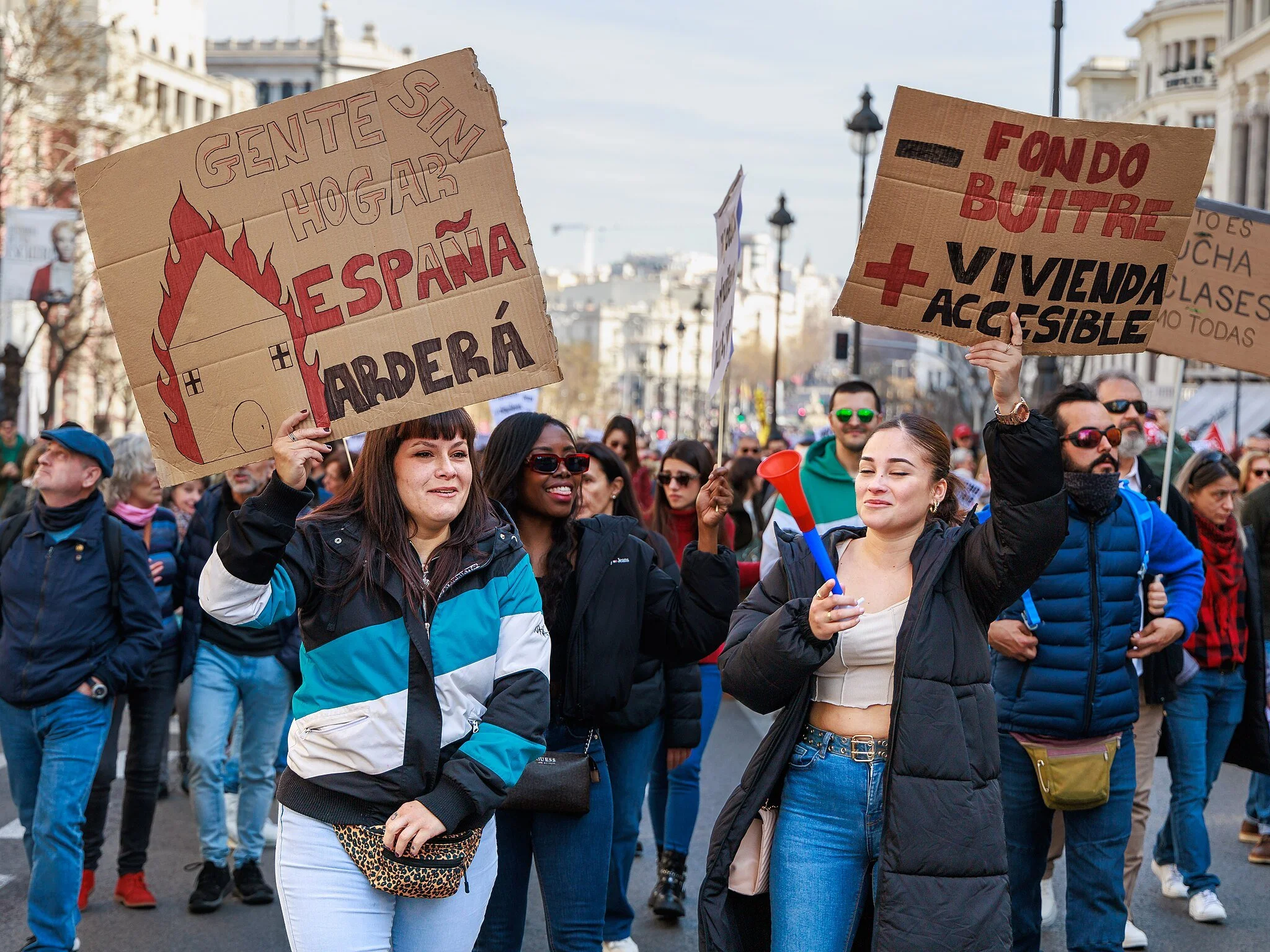
Two young women lead a group of demonstrators marching along Madrid's Calle de Alcalá towards Puerta del Sol during the 'Manifestación por una vivienda digna' (Demonstration for Dignified Housing) on February 9, 2025. (Photo: Barcex, CC BY-SA 4.0, via Wikimedia Commons)
In addition to the housing issue, Rufián argued for anti-fascism as a critical plank of his envisioned political program, referencing a commitment which resonates deeply in a country where fascist ruled ended only half a century ago, He also proposed centering the idea of “self-determination” and the struggle to “dignify the conditions of life” for all Spaniards.
Avoiding past mistakes
Delgado’s point about treating the electorate as more than the audience for posters plastered on walls by political parties also signaled a fourth takeaway from the Madrid event: an emphasis on the need for the Left to practice what in Spanish is called autocritica (self-criticism). He and Rufián appeared to share a recognition that the success of the Right always implies shortcomings of the Left.
On this point, both speakers directly and indirectly referenced the tension that comes from parties understandably seeking to build, extend, and protect their political brands. In the lead-up to the Madrid event, Rufián provocatively argued that “what’s coming can’t be stopped by acronyms” (a reference to the letters used to abbreviate party names). But he has simultaneously argued that it should be possible to build a successful coalition without requiring parties to abandon the identities they have worked so hard to build.
At other points during the Madrid dialogue, the call for self-criticism took the form of sarcastic comments about the need to resist the seductive spaces of social media, especially X/Twitter, and the tendency to take pride in givingbuilding the perfect theoretical analysis or in giving what Rufián called “fucking awesome speeches.” This connected with Delgado’s insistence on taking steps to reach working people who may be disenchanted with politics in general.