Global Indigenous Peoples News Bulletin #11 (December 2025)

This bulletin devoted to Global Indigenous Peoples News, part of the Glocal Exchange project of Weave News, seeks to highlight some of the current issues from Indigenous communities in different parts of the world. The focus of the bulletin is aligned with the overall purpose of the Glocal Exchange project, which examines globalization through its impact from the perspective of local communities. It also supports the Weave News mission to “investigate and report about contemporary issues that are either underreported by establishment and other corporate media or reported in a way that excludes essential context, perspectives, and voices.” These are “issues that have a strong justice component and that reveal connections across communities, borders, struggles, and experiences.”
Indigenous people at the COP30 climate summit
Indigenous protests at the COP30 United Nations climate talks in Belém, Brazil called for territorial rights, forest protection and an end to extractive industries. After the COP30 concluded, Indigenous people reflected on their participation in the talks. “Many Indigenous people who attended the talks felt strengthened by the solidarity with tribes from other countries and some appreciated small wins in the final outcome,” reported the Associated Press. “But for many, the talks fell short on representation, ambition and true action on climate issues affecting Indigenous people.”
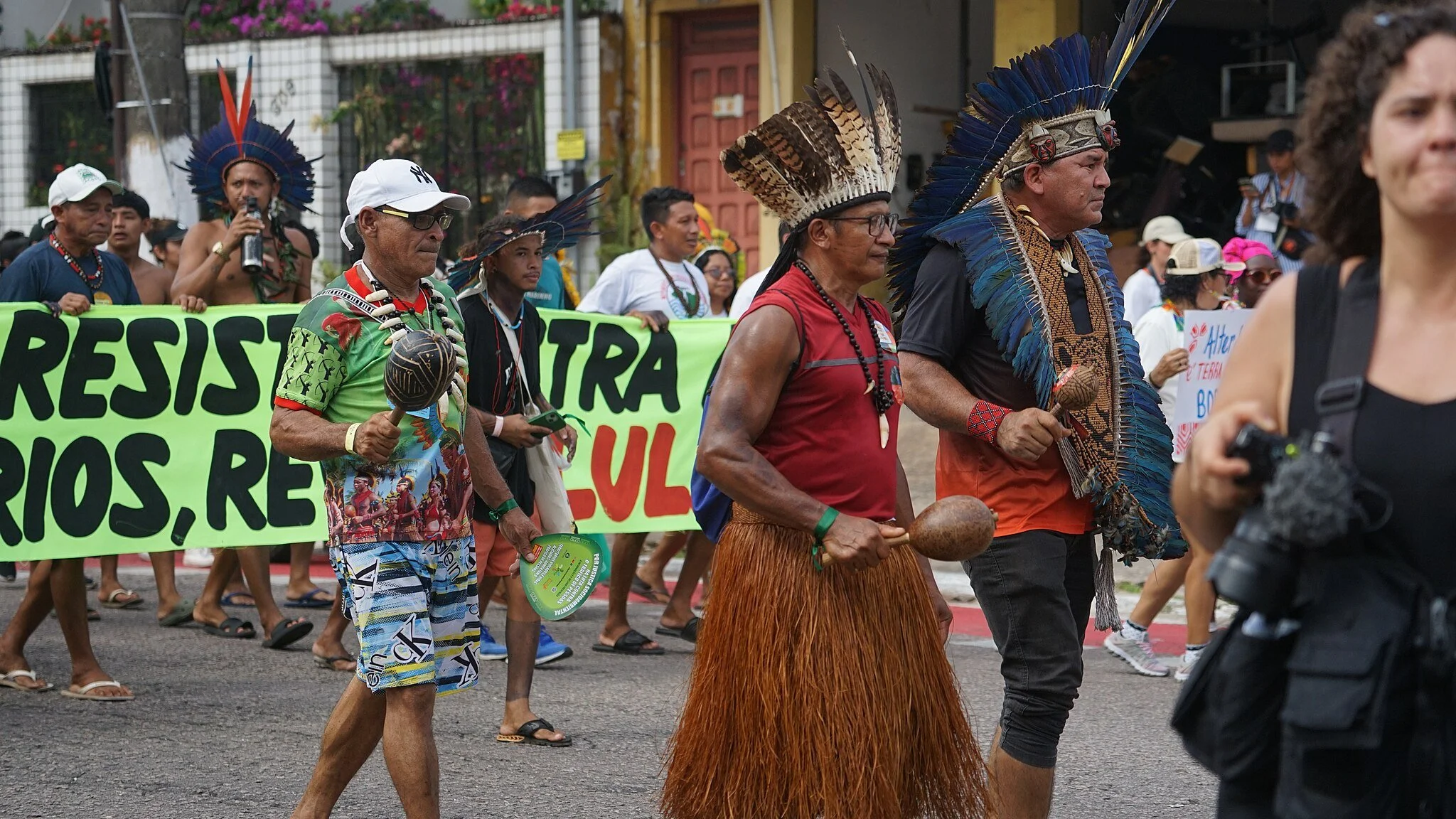
Protests in Belem near the COP30 venue, Nov. 15, 2025. (Photo: Xuthoria, CC BY-SA 4.0, via Wikimedia Commons)
Climate scientist Sineia Do Vale — also known as Sineia Wapichana — argued that the first step toward effective climate policy is ensuring the rights of Indigenous peoples over their territories. Some of the concerns raised by Indigenous people had to do with the lack of any mention of fossil fuels. Others lamented what they perceived as tokenism, insisting that visibility isn’t the same as true power.
The Intergovernmental Panel on Climate Change (IPCC) highlighted in its sixth report the need to integrate local and Indigenous knowledge to achieve effective solutions to climate change. According to Dunio Chiriap Jimbicti, this means that “[c]limate justice cannot be achieved without gender justice and without the recognition of ancestral knowledge as the basis for a sustainable future.” For example, despite cultural, political and gender barriers, Indigenous Shuar women are protecting the Ecuadorian Amazon while leading forest restoration efforts and preserving ancestral knowledge.
Indigenous territories
Threatened by illegal logging, Indigenous people combat the exploitation of their natural resources. This is the case of Loma Santa, which was established as the first Indigenous protected area in the Bolivian Amazon. Five Indigenous peoples are the guardians of Loma Santa, providing a key example of Indigenous territorial governance and participatory conservation.
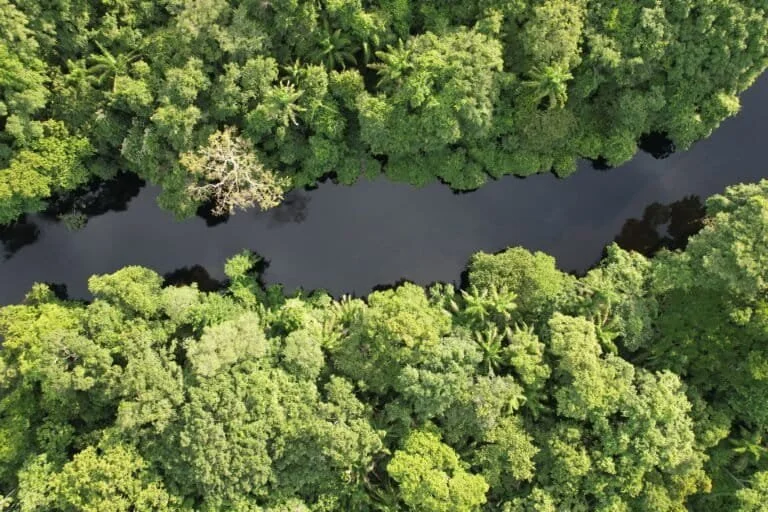
The Apere River is part of the Loma Santa Indigenous Conservation Area. (Photo: ORÉ via Mongabay)
In California, a milestone in Indigenous land restoration efforts was marked by restoring nearly 900 acres of ancestral territory to the Southern Sierra Miwuk Nation. “This transfer adds momentum to the growing movement of Indigenous land back initiatives across the United States,” writes the editorial team at Optimist Daily. “It also highlights how collaborative conservation models can combine ecological protection with long-overdue justice for Native communities.”
Human Rights Defenders Day was marked on December 9, commemorating the anniversary of the 1998 UN Declaration on Human Rights Defenders while celebrating defenders’ achievements and countering narratives that criminalize or delegitimize them. Doug Specht notes that in addition to defending Indigenous rights, this work takes many forms such as “investigating torture and arbitrary detention, documenting discrimination and forced evictions, exposing environmental destruction, supporting migration and refugee rights, challenging corruption, and advocating for women’s rights, LGBTIQ+ equality, and freedom of expression.”
Indigenous groups from Ecuador, Colombia and Peru met in early December in Ecuador’s Amazonian community of Sinangoe to collectively strategize how to defend their ancestral lands. In recent years, emerging threats to the Indigenous territories of the Indigenous communities in the Amazon rainforest have given rise to a greater need for the self-defense forces known as the Indigenous Guard, as they confront illegal mining and logging, drug trafficking, armed groups, forced gang recruitment and extortion.
Uniquely vulnerable are the uncontacted Indigenous peoples of the Amazon which are under an existential threat from organized crime as illegal gold miners, drug traffickers, loggers, and poachers advance into the world’s largest rainforest. According to a report in InSight Crime, “the interests behind these networks are often powerful players in the legal economy, who can often count on local and even national political protection and support.” Herlin Odicio, a Kakataibo leader from Ucayali, says that the uncontacted Indigenous peoples have no way to defend themselves: “They can’t protest or talk to the state, they live in the forest. That’s why the only alternative is for us ‘civilized’ Indigenous people, as they call us, to protect these territories.”
Indigenous knowledge
The decision of Brazil’s federal government to create an unprecedented higher education institution, the Indigenous Federal University (Unind) for Indigenous peoples, “represents the fulfillment of a constitutional mandate and respect for traditional knowledge.” Célia Xakriabá argues that the Indigenous university “can already be recognized as the climate university as Indigenous people make up 5 percent of the world’s population and protect more than 80 percent of the planet’s sociobiodiversity.”
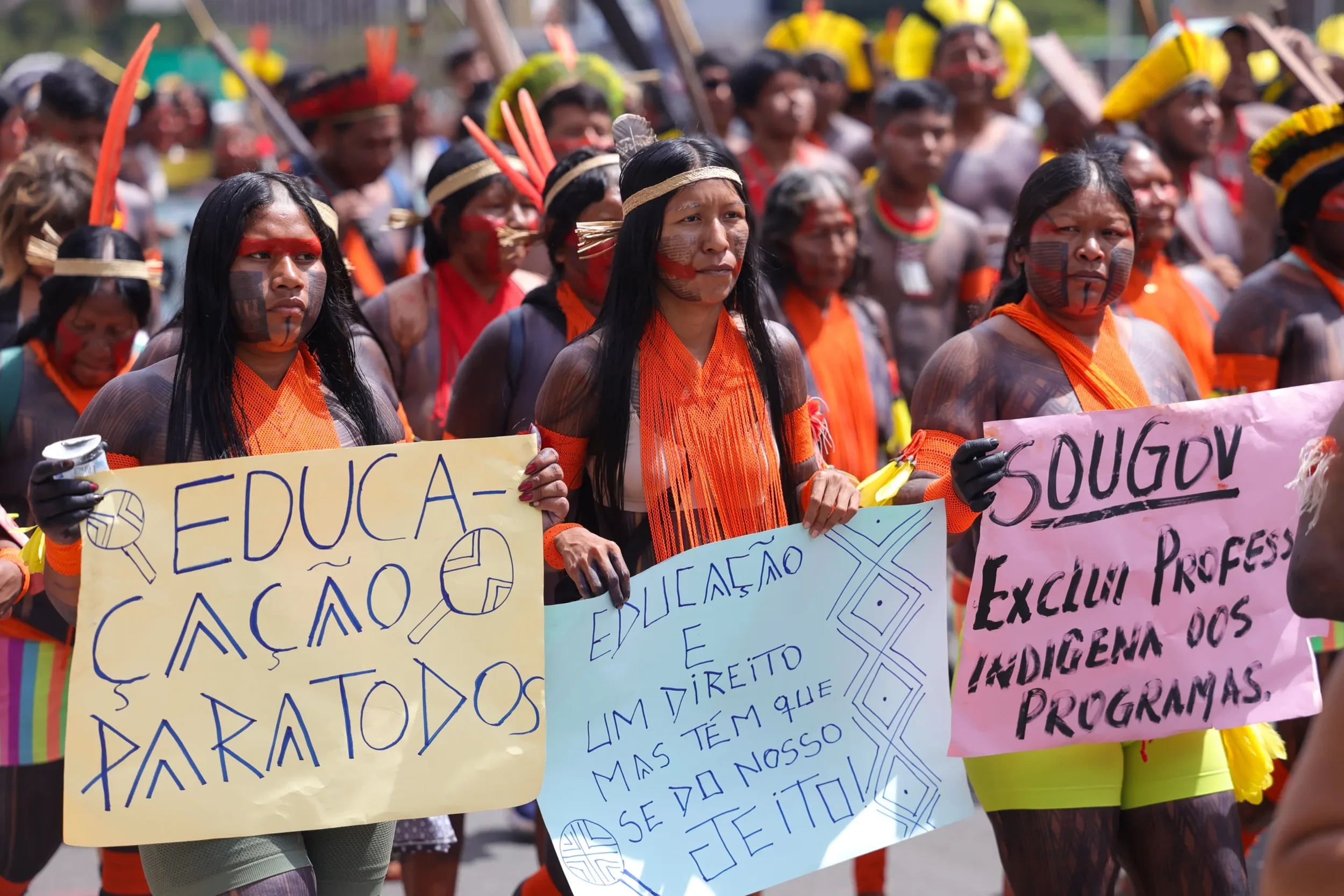
Indigenous people from various ethnic groups participated in the Free Land Camp (ATL), on the Monumental Axis of Brasília, in April 2025. (Photo: Fabio Rodrigues-Pozzebom/ Agência Brasil via BdF)
Meanwhile, the World Health Organization (WHO) officially launched the WHO Traditional Medicine Global Library. “Worldwide, billions of people rely on traditional, Indigenous, complementary, and integrative practices for health promotion, disease prevention, and maternal, neonatal, mental, and community care,” notes the Pan American Health Organization (PAHO).” The new library “addresses this challenge by offering a reliable, structured and inclusive digital platform that brings together ancestral knowledge and contemporary science in support of public health.” Editor-in-Chief João Paulo Souza affirms that the project is grounded in “respecting collective intellectual property of Indigenous Peoples and local communities.”
This Library is important especially in the context of climate change threatening medicinal plants globally, with rising temperatures, shifting rainfall and habitat loss jeopardizing health care for the 80 percent of the world’s population that relies on traditional medicine. “Communities worldwide are fighting back through conservation efforts,” writes Liz Kimbrough for Mongabay, “including creating medicinal plant gardens, developing alternative species lists, training new healers, documenting traditional knowledge and combining agro-forestry with forest restoration to protect their health care systems.”
Indigenous peoples and digital technology
For Indigenous communities, digital technology brings risks when it is allowed to operate without rules, without ethics, and without respecting the owners of cultures. Such relationships are grounded in unequal access to technology and the commodification of culture without control. If used wisely, however, the digital world can offer Indigenous communities space to tell their stories, protect their territories, strengthen their economies, and safeguard their identities by preserving their cultures and languages.
For example, an Australian Aboriginal community with only eight fluent speakers left has launched a mobile phone game to help reconnect their youth with the tongue of their ancestors. Apps and games are being used to help revive other Aboriginal languages, too. A storybook app that teaches science concepts was designed by a man from the Goldfields region of northern Australia. He is one of only three people who speak Ngalia, a dialect of the more widely spoken Mantjiltjintjarra, that’s featured in the application.
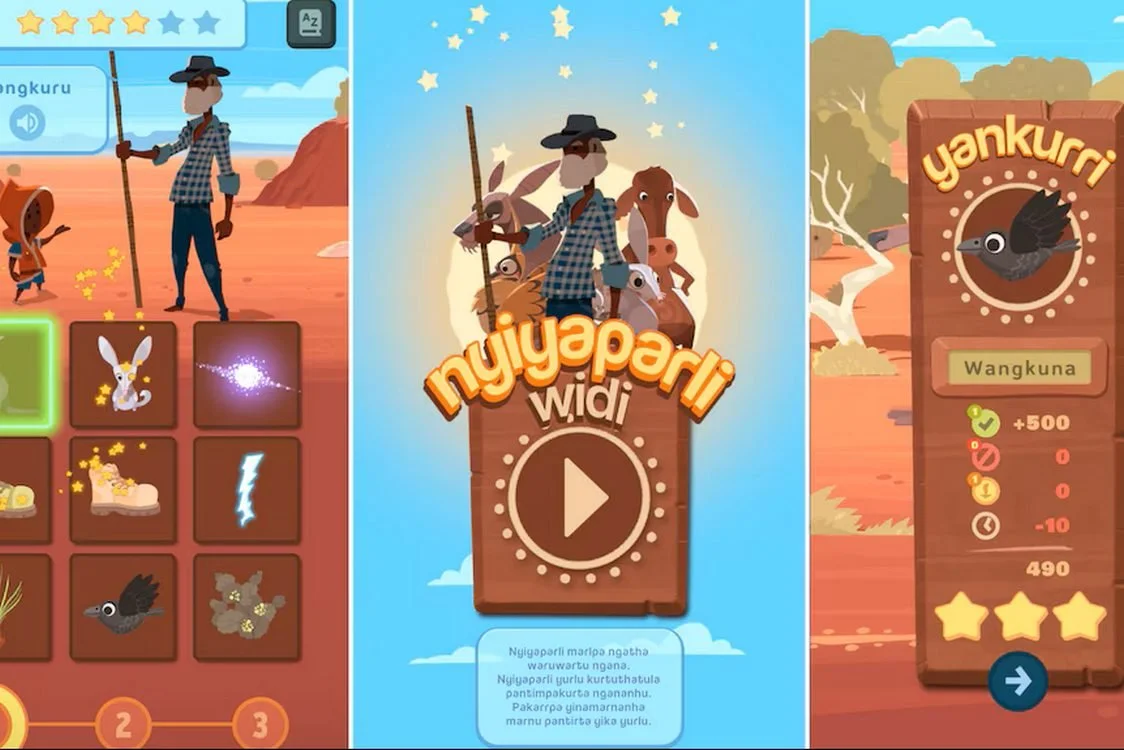
Screenshots from the Nyiyaparli living language project app. (Photo: Nyiyaparli Widi via Good News Network)
Facing “challenges like intergenerational transfer and digital accessibility,” UNESCO reports that “more than 40% of the world’s 7,000 languages are at risk of disappearing, with one Indigenous language lost every two weeks.” New modern GenAI solutions aim to help Indigenous communities connect generations through conversation and preserve language with cultural integrity. One example is Culture Q, a conversational platform that enables communities to capture, store and actively engage with their cultural resources. Created by Kiwa Digital, a New Zealand-based Indigenous technology company pioneering cultural preservation through innovative digital experiences, CultureQ shows that generative AI can preserve accuracy, cultural integrity, and privacy – empowering Indigenous communities to protect and share their language and identity on their own terms.
