
Weavers of Life: Mónica Solarte Moreano - Guardian of the Seed and the Memory of the Iguailik People
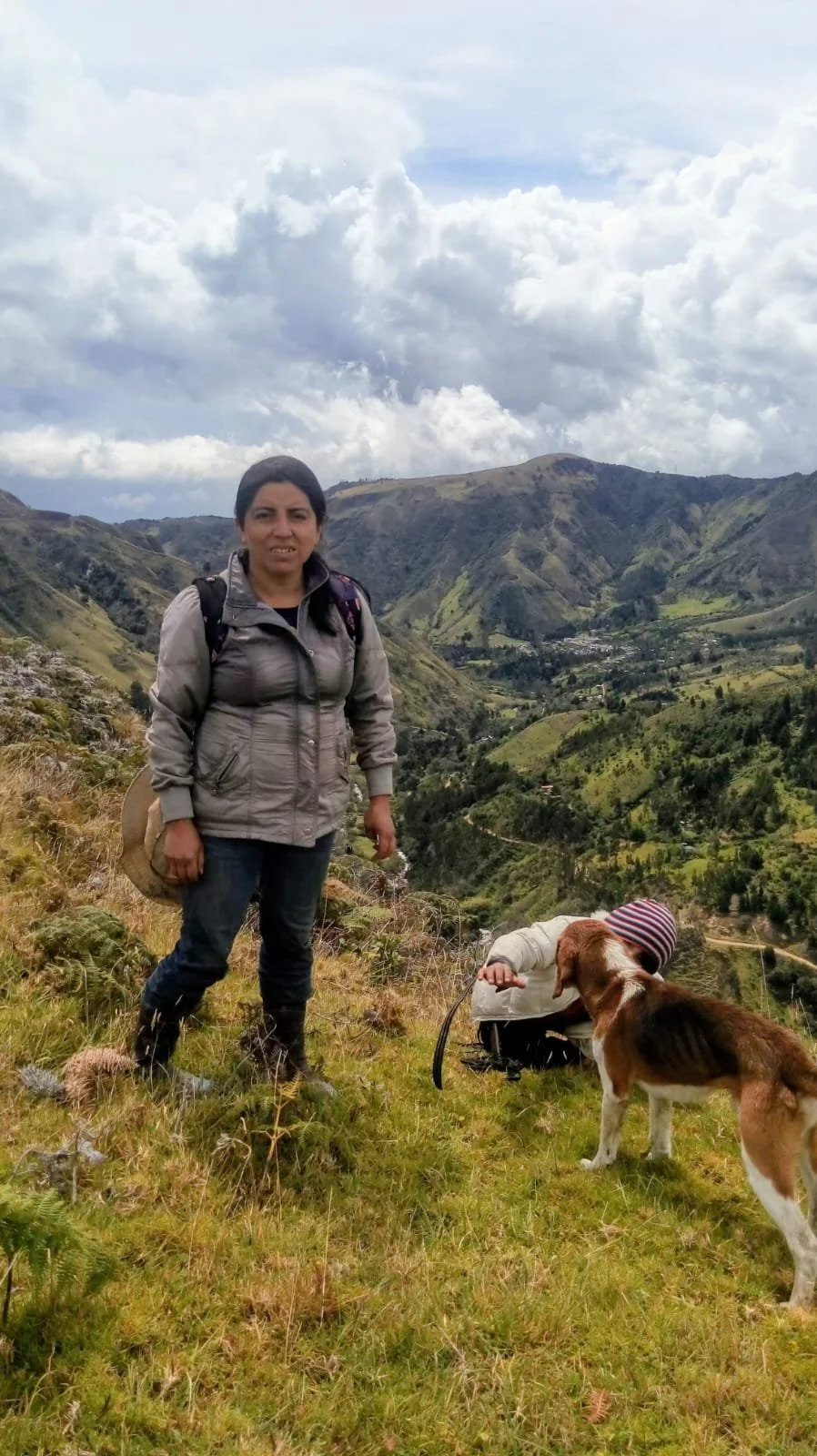
Mónica Solarte Moreano. (Photos provided by the interviewee)
Lea la versión en español aquí.
In the territory of Iguailik, where water is both origin and memory, the life of Mónica Solarte Moreano is interwoven with the history, struggle, and spirituality of the Iguailik people. Awá by birth and Polindara by adoption, Mónica is recognized as a guardian of the seed and of Mother Earth—plant, animal, and human. Through her experience as a woman, mother, and professional, she embodies ancestral knowledge, the defense of territory, and the transmission of an identity.
Mónica Solarte Moreano is 51 years old and the mother of two daughters and one son. She is Awá by birth but, as she explains, Polindara “by struggle.” She has lived in this territory since 1998 and is officially registered there. Her right to be recognized as Polindara was also granted through her partnership with a Polindara man and the decision of the community assembly that accepted her. Originally from Altaquer, she is Polindara by adoption because these people respect her as a woman and as a professional.
The original ancestral territory covered approximately 34,000 hectares, from which they were dispossessed by a family from the department of Cauca, in southern Colombia, where they are currently located. Today, their territory comprises 2,222 hectares, plus another 22 hectares recovered by the community members. Over the past 20 years, the people of this community have managed to resolve territorial disputes—what they call “sanitation”—and to purchase additional hectares.
These people obtained official recognition in August 2014. The reason for this late recognition lies in the loss of identity, as many members no longer self-identified as Indigenous. However, in 1998, through the development of their life plan, young people, with some elders, began a process of discussion and action planning aimed at achieving organizational autonomy, remaining in the territory, and recognizing themselves as distinct from neighboring Indigenous peoples such as the Nasa, Kokonucos, Misak, and Totoroez.
These people are characterized as being stubborn or persistent, with clear and quick thinking, and bellicose. Physically, they are of short stature and strong, with straight black hair; most women wear their hair long. Like other Polindara women, Mónica is a caretaker of Mother Earth and of the “seed”—plant, animal, and human. She transmits knowledge and wisdom, the use of medicinal plants, and the performance of rituals.
Iguailik: The People of the Water
This entire process led them to clarify something essential: the true name of the territory is Iguala, and the name of the people or community is not Polindara but Iguailik, meaning “people of the water” or “Polindara people.” According to their law of origin, they are children of the water and grandchildren of the wind.
For these people, there are three spaces of existence. In the first, life is born from the principles of the cosmos and love; in the second, they coexist with all living beings; and in the third, they return to the cosmos as counselors and companions, relating to this space through rituals and dreams.
Recovering and preserving their identity as a people is essential in order, through their ancestral knowledge, to sustain a better relationship with nature that allows them to strengthen their own systems of education, health, economy, and environmental care. Similarly, the relationship with Mother Earth is expressed through rituals carried out by the Makuko, the traditional healer, and by families according to their biological development. For example, when a woman is pregnant, rituals are performed to protect the baby, and she is advised not to pass through “rainbow waters” or landslides.
Rainbow waters are yellow waters in which the colors of the rainbow appear; technically, they are waters with a high mineral content. Landslides, on the other hand, are believed to have a “bad hour,” meaning harmful spirits that can affect the baby. At birth, the baby’s umbilical cord is buried among the tulpas—the stones that form the hearth and support the cooking pot—so that the child remains connected to the territory.
The aré ritual is performed for girls when they experience their first menstruation. They are taken to an isolated place in the house, are not allowed to cross rivers, and are given warm food so they do not suffer pain and to nourish their womb. This ritual prepares them for adulthood. There is also a ritual for boys when they become teenagers; the purpose is to strengthen their abilities for work, such as fishing. For those who have transitioned to the third space, who died, offerings are made during the first week of November, as is also done by the Kamënts̈á people of Putumayo, Colombia.
Like many other Indigenous peoples in Colombia, they ask permission when entering the mountain, carrying out an activity, or taking something from Mother Earth. There are also “chosen” individuals who relate directly to her through the senses and dreams, through which they can predict what is to come. They perform other rituals to remain in harmony with the whole.
Among these practices is the seed ritual, in which seeds are refreshed with fresh plants before planting. There is also an offering to Mama Dominga, a rock located in the páramo and considered the mother of the Polindara people, to whom salt, panela, and other items are offered.
As worthy heirs of the legacy of Manuel Quintín Lame, a great leader and fighter, son of Doña Dolores Chantre from the village of La Unión, they continue to fight for the land. For the Polindara, as for Quintín Lame, Mother Earth is a teacher, and nature is their source of learning and inspiration.
Seeds, cooking, and resistance
Like many Indigenous peoples around the world, they face the defense of Mother Earth with love and commitment. Among their main actions is raising awareness in the community so that foreign species such as pine and eucalyptus are not planted, and instead strengthening traditional agriculture with native seeds and encouraging their consumption. For them, there is no better way to store seeds than to keep them alive in family gardens.

Mónica planting the seeds of identity and ancestral knowledge with young people.
Planting and consumption are complementary and essential practices, because what is not consumed tends to disappear from the gardens. For this reason, Mónica encourages her students to recover their traditional gastronomy. Beyond that, she constantly seeks new ways to prepare foods such as squash, sweet potato, arracacha, ullucos, tubers like majua and oca, pumpkin, and cider gourd, so that more people will cook them on their hearths—spaces where food is shared not only as nourishing dishes but also as words and advice.
To live in harmony with other living beings, work has been carried out with children, who are especially sensitive to the territory and often draw attention to the damage caused by adults.
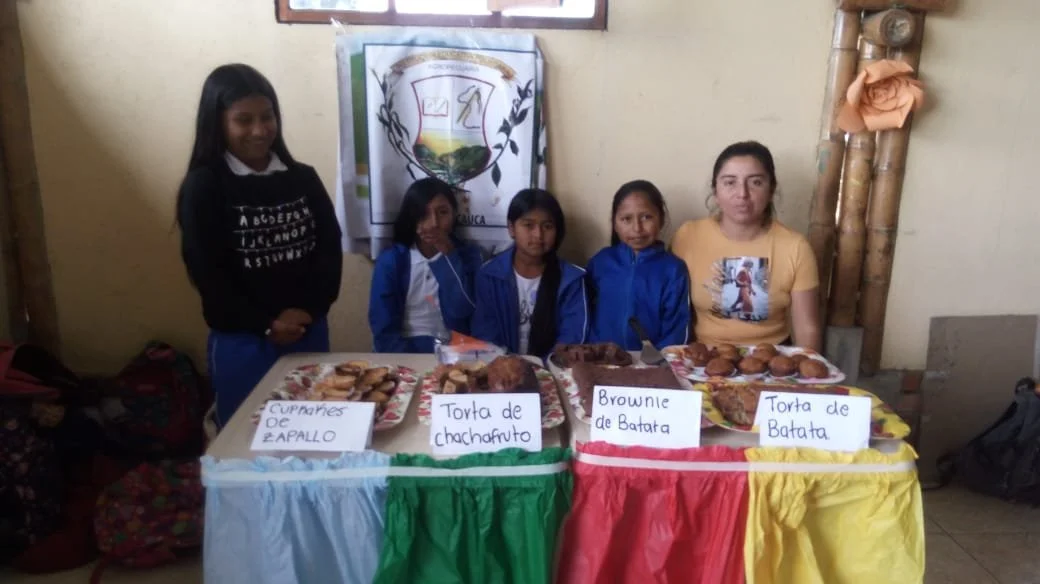
Mónica exhibiting foods made with traditional seeds.
For this Indigenous people, life is understood not only as human life but also as the life of animals, plants, and rocks. Some animals are considered messengers of certain situations: for example, the chiguaco (a bird), if it crosses your path head-on, warns of something bad that may happen where you are going; the snake, if it enters your home or appears in a place, indicates that someone will leave or not return. Plants serve medicinal purposes; they may be cold or hot, sweet or bitter, and are used according to need.
Thus, among rituals, seeds, hearths, and teachings, Mónica Solarte Moreano continues to sow memory and future in the Iguailik territory. Her work with children, the defense of native seeds, traditional cooking, and respect for all living beings reflect a way of inhabiting the world in which Mother Earth is teacher and guide. In a context of dispossession and resistance, her path reaffirms that preserving identity is not only about remembering the past but about sustaining life—human and non-human—in balance, as a legacy for generations to come.