
YES to ICE Training: Affirmative Vote on 287(g) MOA by St. Lawrence County, NY, Legislators Leaves Many Constituents Cold
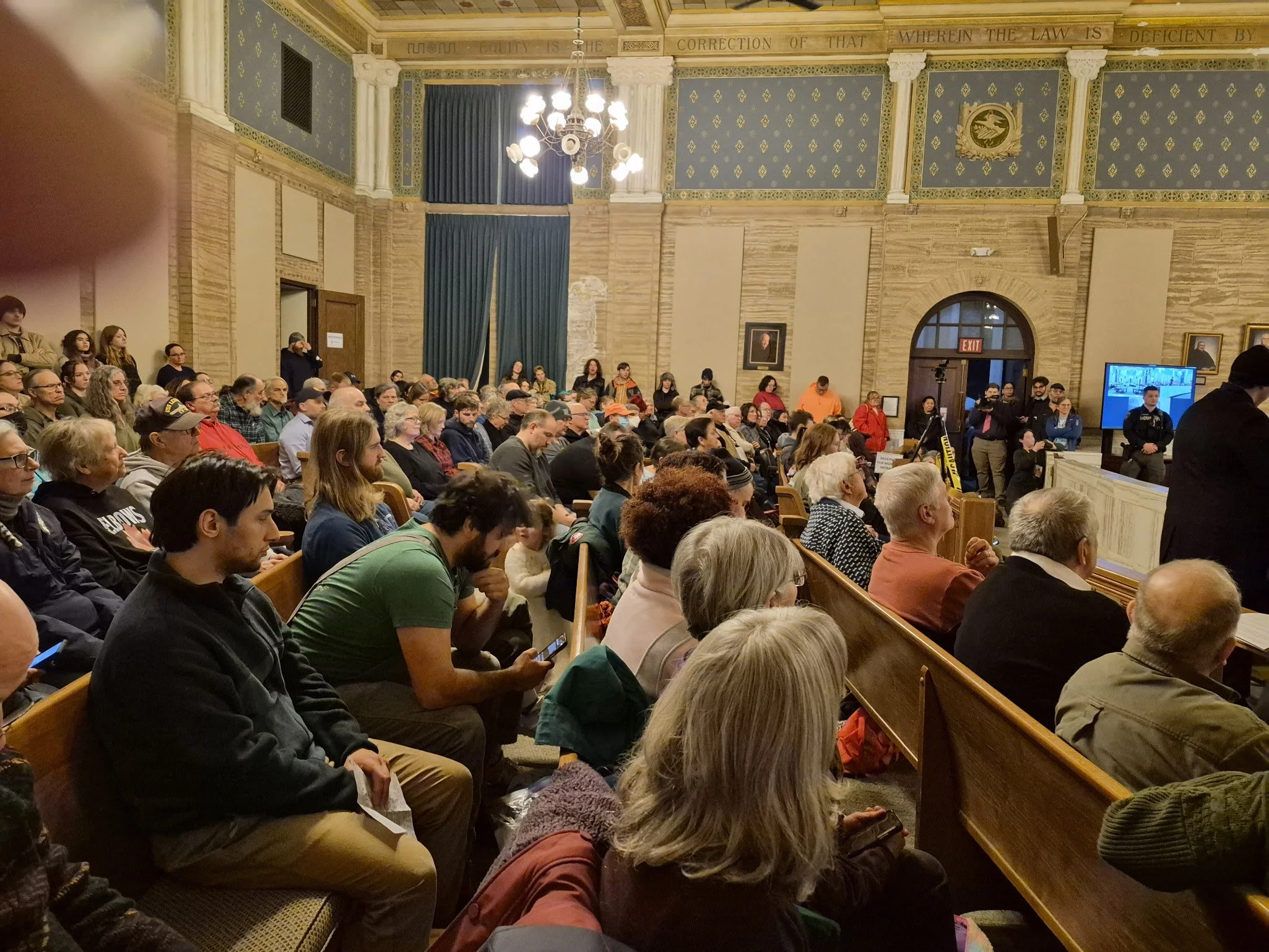
Courtroom C of the St. Lawrence County Courthouse in Canton, NY, was filled to overflowing on Monday evening, Feb. 2, 2026, for county legislators' vote on a proposed 287(g) agreement between ICE and local law enforcement. The agreement passed on an 11–4 vote, largely along party lines. (Photo: Sue Novak)
Stories have spread worldwide about the Immigration and Customs Enforcement (ICE) presence in Minneapolis, where ICE officers have killed two U.S. citizen protesters and injured countless others. Fear in large cities is rising as officials for the Department of Homeland Security (DHS) remind everyone that these actions will continue until all undocumented immigrants with criminal backgrounds — and likely all other immigrants — have been removed from the country.
On Monday night, citizens of St. Lawrence County in northern New York felt this fear move a step closer to home as the county’s 15-member Board of Legislators voted 11–4, largely along party lines, to approve a proposed Section 287(g) Memorandum of Agreement between the county sheriff’s office and ICE.
The MOA, which has been under consideration for several weeks, outlines the handling of immigrants who have been arrested in the county. Sheriff Rick Engle said that the chosen Jail Enforcement model — one of three models of the 287(g) agreements that have been proliferating across the country since the start of the new Trump administration in 2025 — would train local law enforcement officers to search the ICE database to determine whether someone in sheriff’s custody who has been arraigned before a judge has an ICE warrant out for their arrest.
If so, Engle said, “We contact those [ICE] authorities, advise them that we have this person in custody and that they’re being held, and then prior to release, we contact them, and they come and get them.”
An overflow crowd
The proposed 287(g) raised many concerns among local citizens. The St. Lawrence County chapter of Indivisible organized several calls to action against the move, and the St. Lawrence County Democratic Committee issued a statement of opposition to the agreement.
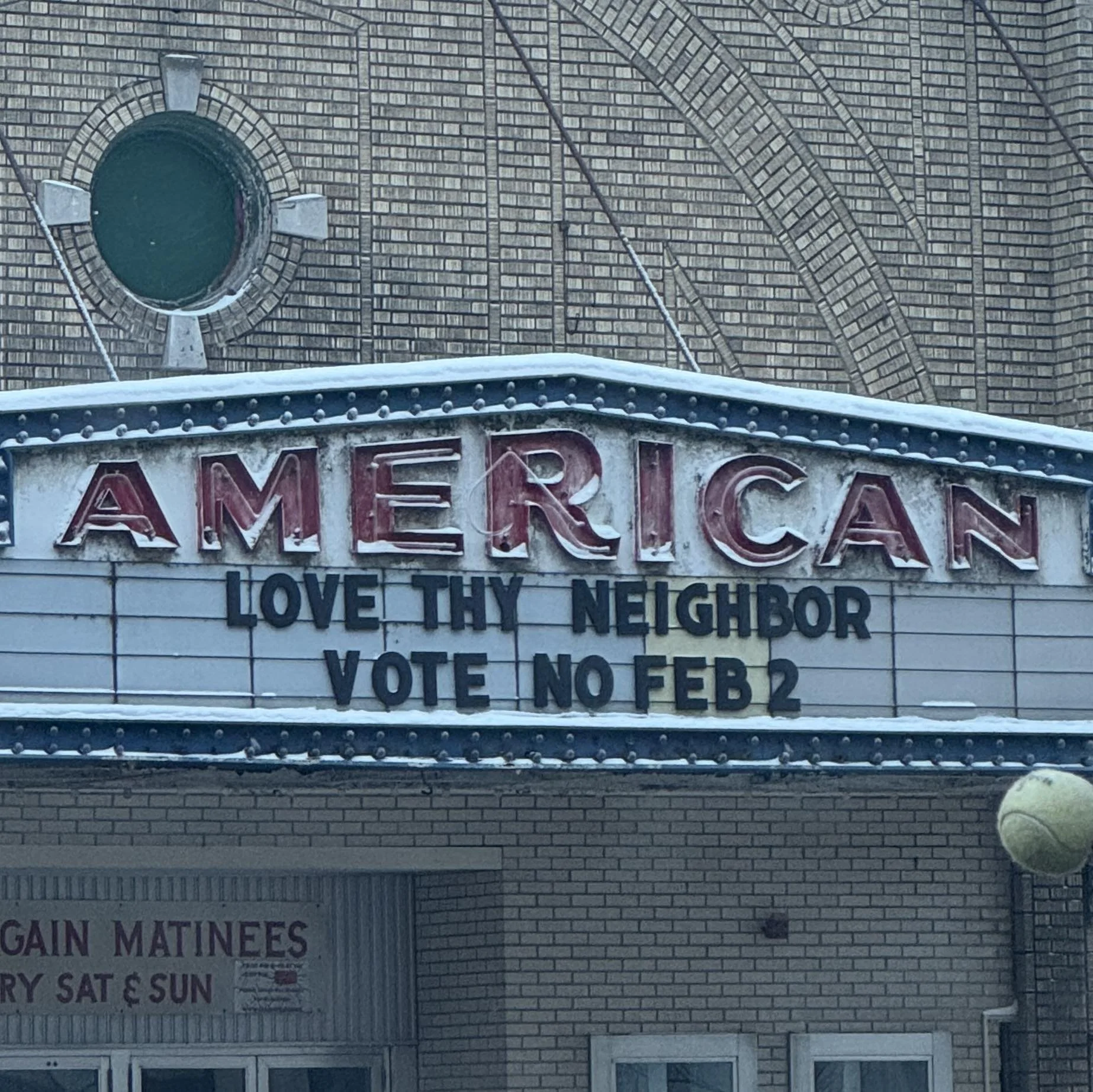
A message posted on the movie theater marquee in downtown Canton, NY, in advance of the Board of Legislators vote on the 287(g) agreement with ICE. The marquee has been a frequent canvas for local residents to share messages of hope and resistance during the Trump years. (Photo: Jessica Sierk)
More than 200 protesters holding signs and candles lined the street in front of the St. Lawrence County Courthouse an hour ahead of Monday night’s meeting, and then moved inside the building along with about a hundred other citizens to attend the proceedings.
Anticipating a large crowd, the board changed the venue from the usual legislative chambers to a larger courtroom, which quickly filled to standing room only and sent others to an overflow room where the meeting was live-streamed. Those who wished to speak to the board publicly were given a 3-minute time limit. The 85 people who signed up to speak were in addition to letters to the board in general that were read into the meeting’s minutes. Other email statements and phone calls went directly to individual legislators.
Concerns about “catastrophic consequences” and racial profiling
Speakers overwhelmingly opposed the 287(g) memorandum, with no more than five who supported it, and several others suggested tabling the motion until more information about the agreement could be shared.
Speakers opposed to the agreement frequently referenced inadequate training of ICE officers, and the violent and unprincipled tactics, caught on video recordings, that have been used against both suspected undocumented immigrants and protesters alike.
“We are witnessing catastrophic consequences” of ICE movements, said Ginger Storey-Welch, who spoke on behalf of the St. Lawrence County Democratic Committee. Storey-Welch noted that this group of ICE officers “is not like the ICE from before.”
Susan Mitchell of Canton echoed these sentiments. “These are not normal times; this is not business as usual with ICE,” she said.
“It quickly became clear, however, that democratic public comment was irrelevant to the Republican majority, who had already made up their minds before the meeting had started. Their comments indicated that they viewed opposition to the memorandum as an attack on the honor and bravery of local law enforcement. Their comments included high praise for and personal stories about the sheriff’s officers and other law enforcement officials, none of which related to the agreement in question.”
Most concerns adhered to the talking points suggested in Indivisible St. Lawrence County’s “Checklist to Stop Ice in Our County.” The five points were the vague language of the resolution that leaves it open to abuse, fiscal and operational concerns of the agreement, the county’s liability and Constitutional abuse risk, public safety and community trust, and conservative federal governance over local control.
Many speakers addressed the potential economic consequences to the local dairy industry that depends heavily on often-undocumented immigrant labor; to the educational institutions in the region, specifically the four Associated Colleges of the St. Lawrence Valley that depend on full-paying foreign student enrollees; and to the health care institutions in the region, which are served by a large number of immigrant physicians. Katrina Hebb, a minister at the First Presbyterian Church of Potsdam, pointed out that these immigrants “contribute $59 million annually to our county.”
Several attendees said they thought that any agreement made with ICE would create the wrong image for the public. Rivka Eckert of Canton said that comparable and better training for local law enforcement was available without the 287(g) agreement, and that signing the memorandum “tells immigrants they aren’t welcome here.”
Perhaps most telling of the mood were the Indigenous and immigrant speakers, who said that they knew firsthand what fear was. Sarah Nandi attended the meeting alone, she said, because her immigrant husband was afraid to attend. Whenever they are not together, she said, she worries that “they will profile him, that they will not ask questions.”
Echoing similar sentiments was a student whose family had come to the area to escape dangerous conditions in the Dominican Republic. Her mother was a U.S. citizen, but her father so feared being captured and sent back that he left on his own. “He won’t be here for my graduation,” she said.
Framing immigrants as “enemies”
The few who spoke in favor of the agreement presented different concerns. “No one has mentioned the 56 people who have been killed by immigrants,” former Massena mayor Jim Hidy said.
Narley Wright, Massena, spoke of concern for the safety of his neighbors and the community’s children. Rather than addressing the memorandum, he said he hoped for a better immigration system in the future, “but for now, we don’t know who they are. They need to go."
An army veteran said he thought that 287(g) was necessary. The people who want to destroy our way of life are already here, he said, and “We don’t know all the enemies who came across the borders in the past four years.”
John Williams, Norwood, also supported the agreement. “The sheriff has to deal with illegal aliens no matter what, so why not take the training?” he said.
Voices ignored
At the end of comment period, the legislators thanked everyone who had attended and spoken, commending everyone for showing respect for the other speakers. Several noted that the meeting showed “democracy in action.”
It quickly became clear, however, that democratic public comment was irrelevant to the Republican majority, who had already made up their minds before the meeting had started. Their comments indicated that they viewed opposition to the memorandum as an attack on the honor and bravery of local law enforcement.
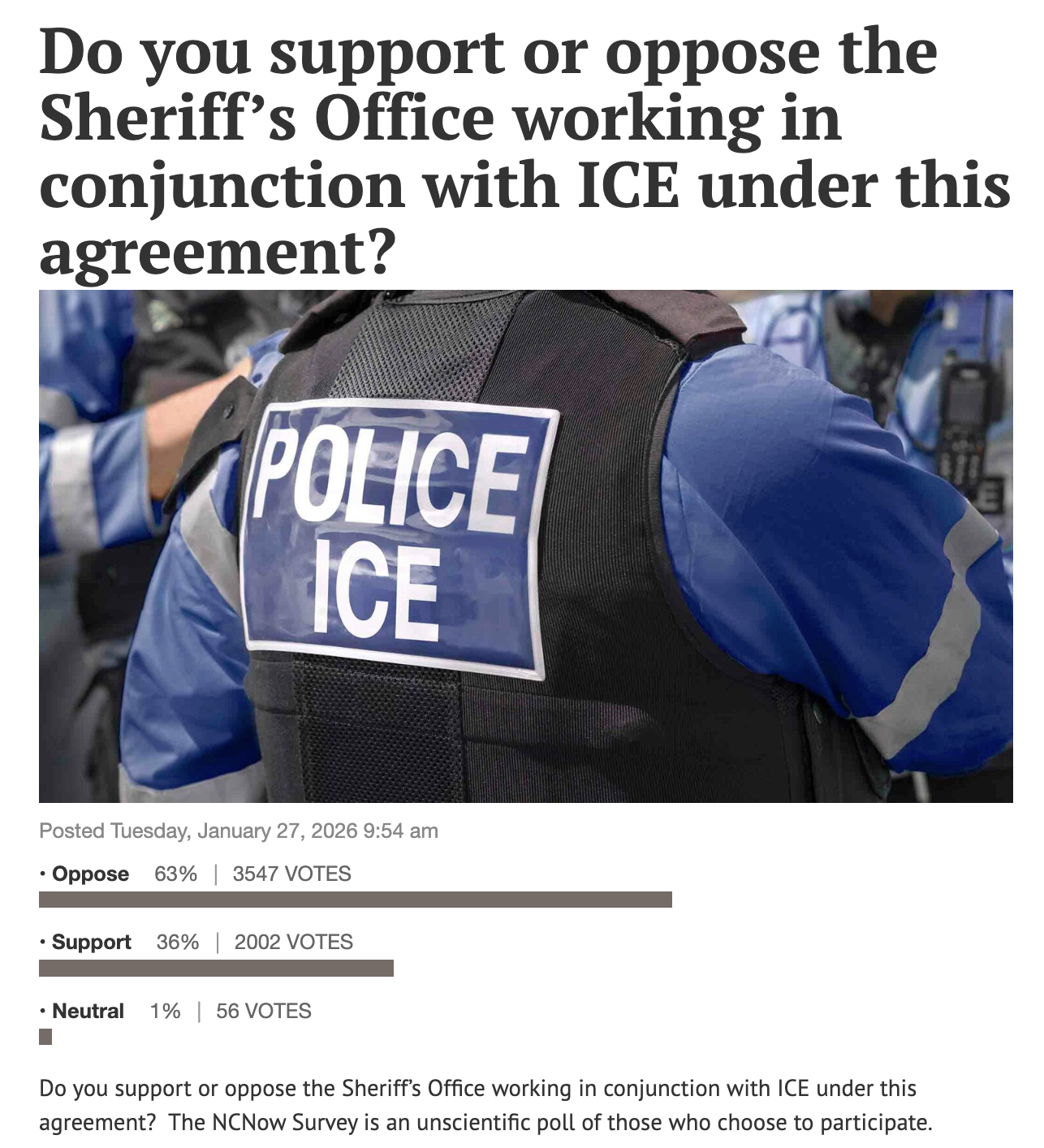
An unscientific poll published by local news outlet North Country Now during the week leading up to the board meeting drew more than 5,000 votes, with a strong majority expressing opposition to the proposed 287(g) agreement.
Republican legislators quickly quashed two attempts to table the proposal to give the legislators more time to speak directly with their constituents, and they reminded the audience that ICE would come to the county regardless of whether the memorandum was signed.
Their comments included high praise for and personal stories about the sheriff’s officers and other law enforcement officials, none of which related to the agreement in question. Several indicated, through their responses, that to believe local law enforcement would somehow be corrupted by working with ICE was an insult to the officers’ integrity and professionalism, therefore voting against the memorandum was something they would not do.
Joseph Lightfoot (R), who represents District 3, said he knew that the sheriff was concerned for public safety and did not want to release criminals from jail and back onto the street. “I understand that completely,” Lightfoot said, “and I congratulate him for keeping that in mind.”
The lone crossover, John Burke (R), representing District 12, said that listening to the evening’s speakers had “given another dimension” to what he had learned from reading constituent letters sent to him in advance of the meeting, and it had raised new concerns for him about citizens who had said they felt fearful about walking down the street. “This was a real eye-opener for me tonight,” he said.
Looking ahead: a possible NY state ban on 287(g)
New legislation being proposed by Governor Kathy Hochul of New York may ultimately supersede Monday evening’s vote. The “Local Cops, Local Crimes Act” Hochul announced on Jan. 30 “builds on recent legislation introduced as part of her State of the State agenda to protect the constitutional rights of New Yorkers from federal overreach and hold federal agents accountable for unconstitutional action.”
According to the press release, “In New York, 14 New York law enforcement agencies across nine counties have signed 287(g) agreements with ICE. With this legislation, all existing 287(g) agreements will be void and New York will join seven other states that currently prohibit 287(g)s: Washington, Oregon, California, Illinois, New Jersey, Delaware, and Connecticut.”
Such an act, however, may be too late to repair the sense of dismissal that many local citizens felt from their representatives following Monday night’s vote.