
The HOPE Initiative Comes to Buffalo, NY
In Buffalo, New York, progressive non-profit organizations like Community Action Organization of Western New York (CAO) continue to address the endemic problem of urban poverty by preparing low-income and no-income populations for the work opportunities emerging locally. One strategy driving a new initiative aims to meet financially insecure community members where they are by building networks of support that can help them find gainful employment in an ever-changing labor market. Questions remain, however, about whether such efforts can succeed in an environment where living wages are hard to find.
The HOPE Initiative
On January 29, 2026, the CAO of Western New York announced that they would implement the Harnessing Opportunities Pursuing Employment Initiative (HOPE) to help low-income and no-income residents in Buffalo prepare for and find jobs.
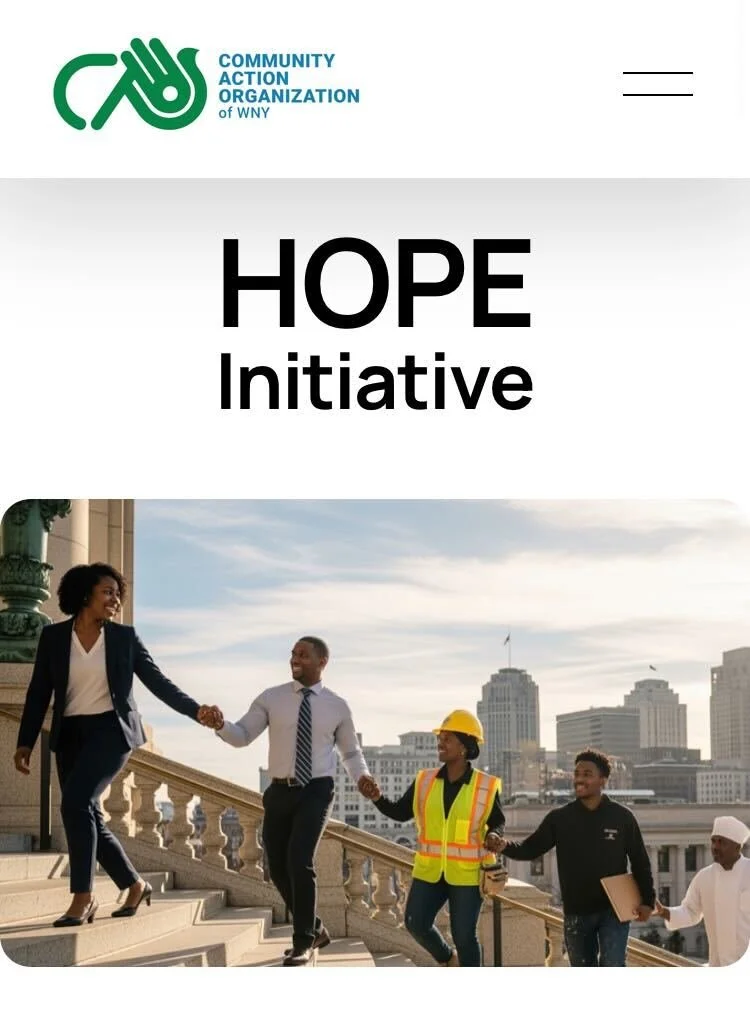
The HOPE Initiative is highlighted on the CAO’s website.
To bring the HOPE Initiative to Buffalo, CAO has partnered with the Erie County Department of Social Services. In seeking to develop a pathway from “public benefits to self-sufficiency,” the initiative echoes past efforts at “welfare reform,” in this case by teaching financial literacy, providing workforce development and readiness training, and offering counseling services to participants in personal and professional goal setting.
The CAO announcement follows four years of development, beginning with the New York State Legislature’s passage of the Child Poverty Reduction Act in March 2022. The law states:
“New York should take any steps necessary to reduce the overall child poverty rate by fifty percent in the next ten years. Nearly three million New Yorkers are living in poverty, eight hundred ninety-five thousand of which are children…To effectuate this reduction, the child poverty reduction advisory council shall be established to research policy ideas, develop best practices, and continually monitor relevant benchmarks to ensure that New York continues to work towards reducing child poverty by fifty percent in ten years.”
The HOPE Initiative stands on solid organizational grounds, drawing on the work of New York’s Child Poverty Reduction Advisory Council (CPRAC). This coalition of state officials, community and non-profit organization leaders, and expert constituents has been charged with “analyzing child poverty in New York; making policy recommendations to reduce child poverty by over 50 percent over ten years; and measuring and reporting on the State’s progress towards the goal.”
Among the founding members of the CPRAC is Dr. Marie Canon, President and CEO of the CAO of Western New York. Under her leadership, CAO has been awarded $11.75 million to create the HOPE Initiative for Buffalo. The program will seek to assist Buffalo residents who have no job, or a low-paying job, and who receive social service benefits. The program also accepts Buffalo residents who are at or below 100 percent of the Federal Poverty guideline and who have a child at or below 18 years in the household. HOPE Initiative participants will receive guidance, coaching, and mentoring to find jobs that “build economic stability” for individuals who currently are not economically self-sufficient.
The child care conundrum

Vonetta T. Rhodes-Osi, executive director of WNY Child Care Action Team.
Reducing child poverty means helping parents find their financial footing in a slippery job market. This is no small task in postindustrial Buffalo, where the median household income is $51,656, well below the national figure of $79,466, according to US News and World Report. While unemployment figures have improved somewhat in recent years, low paying, often precarious jobs remain common. Preparing workers for job opportunities is an important step, certainly, but an uphill climb in a city where jobs pay so little.
Vonetta T. Rhodes-Osi, the executive director of WNY Child Care Action Team, is an affiliate of the CAO. She sees the HOPE Initiative as a promising step forward for a region where “[the] economic and employment levels are constantly wavering and very fickle, depending on the field you are pursuing.”
One industry where workers are needed is child care, in part because wages in that field have been too low to sustain its workforce and attract new workers. Child care advocacy groups, like the Empire State Campaign for Child Care, have been demanding that child care workers earn more to perform this essential task. For parents to work, they entrust their young children to care workers. If they cannot find child care because there are too few workers available, parents’ capacity to work is threatened. To address low wages in the child care industry, a new bill in the New York State legislature would create a workforce compensation fund to augment historically low wages paid to child care workers.
In Buffalo, the CAO plans to use state funding to ensure that HOPE participants receive affordable child care. In the process, Rhodes-Osi believes the initiative might help the local child care industry boost its workforce. “I encourage the HOPE Initiative to add Child Care to their list of leading WNY Industries,” she says, “for it is suffering from staff shortages and closures.”
“It seems likely that the child care industry will serve as a bellwether for success for the HOPE Initiative. For the program to help reduce child poverty in Buffalo, unemployed parents with children must receive child care. But will people pursue jobs in early childhood education if the wages remain as low as they are?”
Improving workforce opportunities for child care professionals, argues Rhodes-Osi, has a ripple effect throughout the local economy: “The CAO HOPE Initiative is a critical need for Western New York...Without child care, the workforce has great absences, shortages, and turnover rates. The HOPE Initiative aims to end this factor with a well informed, resourced, equipped, prepared, and supported workforce.”
The workforce opportunities in Buffalo can grow, says Rhodes-Osi, but many workers find themselves ill-prepared to take advantage of them. Ideally, the HOPE Initiative can make the difference between finding gainful employment in Buffalo or leaving the region to look for work elsewhere: “Jobs can be plentiful in some areas, but the preparation to not just enter these fields but also stay employed and achieve a long term career and income is what truly makes the difference,” she notes. “It is the determining factor between short-term participation in the gig economy and leaving Buffalo for more stability or even maintaining employment with a company because the person is vested, feels valuable, and has upward mobility.”
The elusive living wage
Retooling the Buffalo working class has the potential to profoundly change the city. Reaching that goal necessitates that its members become aware of where they can gain access to living wage job opportunities and how to take advantage of them. It also requires local industries to pay them appropriately.
Given these realities, it seems likely that the child care industry will serve as a bellwether for success for the HOPE Initiative. For the program to help reduce child poverty in Buffalo, unemployed parents with children must receive child care. But will people pursue jobs in early childhood education if the wages remain as low as they are?
This question applies beyond child care, too, and it is a reminder that workforce preparedness is not the only – nor the main – factor in the impoverishment of Buffalo residents.. If local jobs (like child care work) continue to offer only low-wage opportunities that fail to provide sustainable solutions for low-income and no-income Buffalonians, workforce development programs like HOPE will likely struggle.