American Shock: The NYT Magazine Goes to Minnesota

Protesters march at the Ice Out of MN march in Minneapolis, Minnesota. (Photo: Lorie Shaull, CC BY 4.0, via Wikimedia Commons)
When US President Gerald Ford pardoned his predecessor, Richard Nixon, after the Watergate scandal, Gil Scott-Heron brilliantly satirized the “shock” that many Americans were feeling: “America leads the world in shocks!” Later in the same monologue, Scott-Heron turned his attention to Ford’s Vice-President, Nelson Rockefeller and his role, as Governor of New York, in suppressing the Attica prison rebellion: “doubtlessly being promoted for the job he did at Attica - 43 dead and millions of Americans once again in shock!”
But it was the line following his observation about the Nixon pardon that contained Scott-Heron’s deepest and most trenchant analysis of American naivete: “Unfortunately, America does not lead the world in deciphering the cause of shock.”
I was reminded of Scott-Heron’s “We Beg Your Pardon” today when I saw a social media post promoting Charles Homans’ long-form piece for the New York Times Magazine about the ongoing federal occupation of Minneapolis and the popular mobilization in response to the murder of Renee Good. In the social media post, the Times chose to highlight a quote from the article that caught my eye:
The federal agents looked more like a platoon of soldiers navigating a hostile foreign capital than conventional law enforcement in an American city.
I have no desire to undermine the visceral impact of Homans’ reporting and the accompanying images. The article is a valuable document of an immediate, evolving, and horrifying situation. (So is the urgent coverage provided daily by local Minnesota outlets ranging from the StarTribune and Minnesota Public Radio to independent outlets like Sahan Journal and Minnesota Reformer.) But the quote deserves critical scrutiny, because it reveals something fundamental about the particular forms of denial, naivete, and exceptionalism that characterize dominant US political discourse.
In other words, if I may borrow one more line from Gil Scott-Heron’s memorable song, please pardon my analysis.
A failure to decipher
What the NYT article expresses is a faint, incomplete recognition of what critical scholars of global history and politics have been saying for literally decades, dating back at least to the pathbreaking work of Aimé Césaire. Much of this work has been summarized under the category of what’s often called the “imperial boomerang” - Césaire’s idea that the brutality and barbarism at the core of Western “civilization” inevitably return home after they have been tested out in the colonies and other territories of the global south. For Cesaire, as many have noted since, fascism is simply colonialism turned inward.
And this is where Gil Scott-Heron’s observation about “shock” becomes so penetrating in its insight. The New York Times report from Minneapolis represents a powerful expression of shock - essentially asking, how could this be happening in an American city? - but it has nothing to say when it comes to what Scott-Heron calls “deciphering the causes of shock.”
To someone with a journalist’s eye for detail, the entire scene in Minneapolis is filled with information that points directly to the “imperial boomerang” and its vicious impact. How many of the ICE and Border Patrol agents are ex-military? How many served in Iraq, Afghanistan, Somalia…? Why do “law enforcement agencies” possess weapons of war? Why were some of the federal agents driving around in a vehicle called a Jeep Grand Cherokee? (Homans references the vehicle by name, but it doesn’t occur to him to ask why US carmakers and weapons manufacturers make a habit of giving their products Indigenous names.) Why are Indigenous activists playing such a prominent role in many of the marches and other actions in Minnesota? Why did ICE set up its headquarters near Fort Snelling, site of an infamous concentration camp used by US forces as they prepared to expel Indigenous people from their ancestral lands in the mid-19th century?
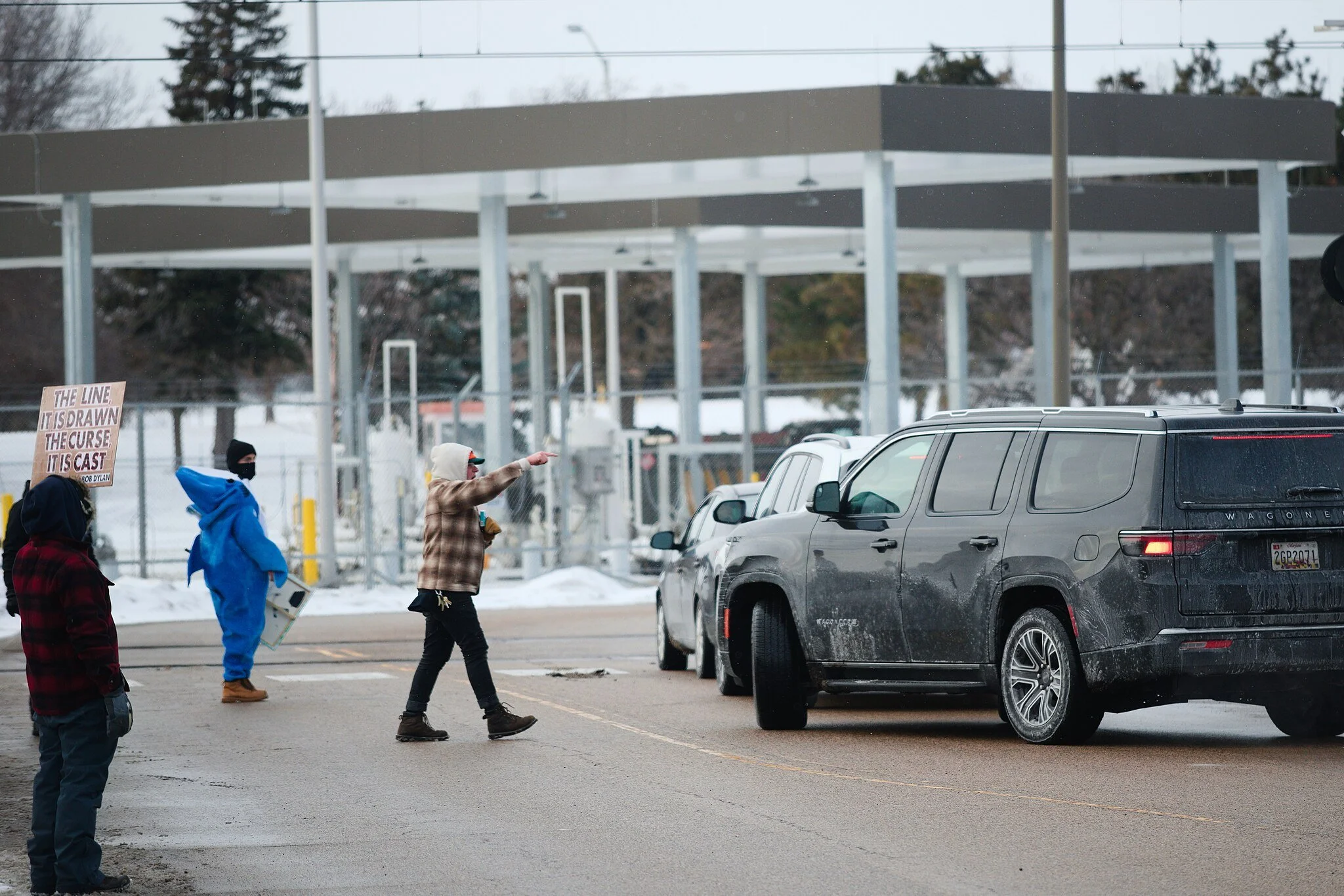
Protest against ICE in south Minneapolis, January 17, 2026. (Photo: Fibonacci Blue, CC BY 4.0, via Wikimedia Commons)
And what about the tactics used by the federal agents (and, indeed, the entire Trump regime) in Minnesota? Addressing this issue honestly would have required asking serious questions about Palestine. To anyone who has been paying attention and looking at the world without putting on the lenses of US exceptionalism, those tactics have everything to do with the tactics used by Israeli forces against Palestinians. As Mitchell Plitnick wrote on Facebook on January 24, “I don't think there is a single person who has ever been to or seen #Israeli behavior at #WestBank protests that does not feel a sickening sense of familiarity while watching #Minneapolis today.”
If Homans had bothered to talk with the activists he mentions midway through his article - the ones who were chanting “Free Palestine!” - perhaps he would have learned something about the material reasons why these two situations look increasingly similar. (Side note: much of the Somali community that has been so viciously attacked by the Trump administration lives in an area of Minneapolis literally known as the West Bank…)
Instead, Homans dismisses the “Free Palestine!” cries as an example of “itinerant leftists leading chants for unrelated causes,” displaying a shocking ignorance of the entire US-Israeli alliance and the corporations that provide the technical architecture for surveillance, repression, and assassination both “here” and “there.”
Decades of media failure
In short, Homans has no answer for the question that is implied in the pull quote his editors chose: why does Minneapolis look like a “foreign” war zone? He has no answer because the New York Times, like most US establishment media outlets most of the time, has spent the entire period of US global hegemony refusing to explore the boomerang effect of US militarism.
Imagine if the NYT had given critical, anticolonial and anti-imperialist voices (like Césaire or any of the major scholarly voices that have followed in his footsteps) the same opportunity to be heard as they have given the imperial apologists who routinely fill up their news reports and op-ed pages. How would the narrative be different today? How would the public’s understanding of these issues be different?
The seeds of a global movement?
The point of this analysis is emphatically NOT to invalidate the experiences or the heroism of those Minnesotans who are standing up to defend their community, their neighbors, and their rights - much less to suggest that their trauma and suffering are somehow justified because of the history of US imperialism. On the contrary, we must affirm that this is precisely what human beings with a conscience do when their communities are attacked - in Minnesota or on the other side of the world. The Vietnamese restaurant owner who opened her doors to people suffering from tear gas inhalation following the killing of Alex Jeffrey Pretti, hugging them and crying with them in an act of profound humanity, has her counterpart in the Palestinian shopkeepers who have played that role for people living under military occupation for decades.
Too often, however, our media gatekeepers are complicit in maintaining the dangerous fiction that the suffering of people inside the US can never be connected with the suffering of people elsewhere. In other words, when it comes to “deciphering the causes of shock,” we can’t rely on the New York Times any more than we can rely on establishment Democrats who vote to send billions of dollars to Israel annually while expressing empty “shock” when the effects of the “Deadly Exchange” linking US and Israeli policing become visible on the streets of American cities.
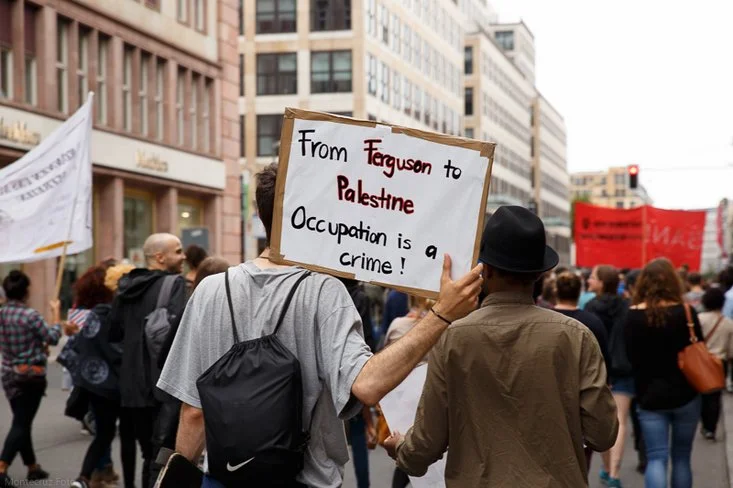
Following the Ferguson uprising in 2014, many activists become more aware of the strategic relationship shaping US and Israeli policing practices. (Photo: Montecruz Foto via The Forge)
Yet, despite these chronic media failures, moments like the one we are living through can plant the seeds for a different kind of future and a different kind of collective understanding. Here it is useful to recall the words of critical theorist Slavoj Žižek. Just days after the attacks of September 11, 2001, Žižek challenged Americans to have the courage to learn what should have been the obvious lesson of the attacks: that a nation cannot expect its “holiday from history” to last forever. Presciently, he also insisted that the 9/11 attacks represented an opportunity for Americans: a chance to move from the naive logic of “A thing like this should not happen HERE!” to the more mature logic of “A thing like this should not happen ANYWHERE!”
In other words, moments of profound shock offer the opportunity to develop a more empathetic and relational understanding of how global politics actually work and how transnational violence creates the basis for transnational solidarity.
What might that look like? Perhaps it would look like a truly global, grassroots movement whose target is not any particular nation or government alone but rather the structures that link the actions of so many repressive governments and the corporate and other actors who work hand in glove with them - that is, a global movement against the machinery of death operating in and from Washington, Moscow, Tel Aviv, Riyadh, so many other capital cities, Silicon Valley, and the headquarters of the fossil fuel companies who profit from human and planetary destruction.
We will see whether the New York Times will take this moment as an opportunity to connect the dots. In the meantime, as I said, please pardon my analysis.